


Bittensor’s first ecosystem conference, Exploit Summit, opened in Montreal on September 28 at New City Gas, bringing together builders across decentralized AI.
Day one featured subnet teams, researchers, founders, and developers sharing ideas, progress, and products being built across the Bittensor ecosystem.
Sessions ran across the OTF and RAO stages, covering Gamma tokens, AI training, drug discovery, robotics, drones, and incentive design.
OTF Stage Highlights
1. Gamma Tokens Could Create a Market Between Subnets
Jacob ‘Const’ Steeves introduced the idea of Gamma tokens, a proposed system that would allow subnets to use part of their emissions to buy products and services from other subnets.
Gamma could create a deeper internal economy where one subnet becomes a customer of another, without having every subnet operating independently.
2. Macrocosmos Introduces the IOTA SDK and Liquid Compute
Macrocosmos’ Will Squires and Steffen Cruz announced the IOTA SDK (Software Development Kit) and Liquid Compute, tools designed to make distributed AI training easier across machines that are not located inside the same data center.
This builds on the team’s work around training large models across geographically distributed hardware and could make decentralized training more accessible to developers.
3. Metanova Moves Drug Candidates Into the Lab
Metanova Labs’ CEO, Micaela Bazo, shared that drug candidates produced through its Bittensor competitions have now moved beyond digital modelling and into physical laboratory synthesis.
The team also announced plans for another competition focused on ADME modelling, which studies how potential drugs are absorbed, distributed, metabolized, and excreted by the body.
It is another step toward connecting subnet competitions with real-world drug development.
4. Targon Reports 27,000+ Confidential Workloads
Targon (SN4) noted it has deployed more than 27,000 confidential workloads this year and reached a $12 million annualized revenue run rate.
That means its current revenue pace would equal about $12 million over a full year if the same pace continues unchanged. Confidential computing lets organizations process sensitive data on external infrastructure while keeping that information protected throughout the entire computation process itself.
5. Dendrite Takes Aim at Reward Gaming
Dendrite, owners of SOMA (SN114), focused on one of the hardest problems in decentralized incentive systems. Whenever miners are rewarded according to a benchmark, some will naturally search for shortcuts that maximize their scores without necessarily solving the intended problem.
Dendrite’s approach centers on stronger ground truths and transparent scoring systems that are more difficult for miners to manipulate.
6. KubeTEE (SN90) Wants Customers to Verify Trust Themselves
KubeTEE discussed verifiable attestation, where customers can independently confirm that confidential infrastructure is operating as promised. KubeTEE lets people run AI on shared GPUs while keeping their data and models private from the machines hosting them.
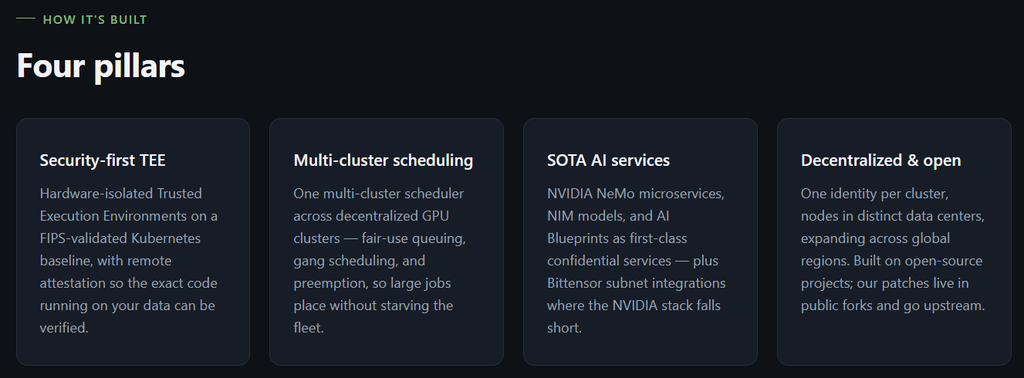
Instead of simply trusting a provider’s claims, users receive cryptographic proof that can be checked before sensitive workloads are sent to the system.
7. Taostats Shares the Reality of Closing Subnets
Marcus Graichen of Taostats took a different direction, discussing the decision to shut down three subnets that were not succeeding.
The conversation went beyond economics and touched on the human side of subnet closures, including the impact on the teams that had spent months building them.
It was a reminder that subnet competition does not only produce winners. Capital, time, and careers are also tied to these experiments.
8. URnetwork (SN25) Makes the Case for an Open Internet
The team at UR (SN25) discussed the importance of keeping internet access open and globally available. His argument focused on a future where connectivity should not depend heavily on geography, particularly as more economic and AI activity moves online.
9. How Fast Should Bittensor Change?
A panel of Manifold’s Rob Myers, and TAO.com’s Yoav Cohen tackled a growing question inside the ecosystem. How quickly should Bittensor’s protocol evolve? The discussion highlighted the tension between moving fast and giving builders a stable foundation.
10. Chutes (SN64) Runs an 8B Model on a Phone CPU
Jon Durbin of Chutes (SN64) demonstrated Parallax, running an 8-billion-parameter model at roughly 60 tokens per second on a regular phone CPU. There was no GPU or dedicated AI accelerator involved.
The demonstration showed how improvements in inference software could expand where large AI models can run, including directly on consumer devices.
RAO Stage Highlights
1. A Beginner’s Guide to Bittensor Incentives
One session broke down how subnet incentive systems work from the ground up. It covered how validators score miners, how those scores translate into rewards, and what happens when miners discover unintended shortcuts inside the evaluation system.
For newer attendees, it provided useful context for many of the more technical conversations happening across the summit.
2. Khala Research Pushes Open Source Into Robotics
Khala Research’s Jack Ai Leung brought the open-source conversation into robotics. He argued for more open models, open research, and broader access to different forms of robotic hardware so developers are not limited to closed ecosystems.
3. Multisig Can Reduce Key Management Risk
Cameron Fairchild from Latent Holding discussed safer approaches to managing crypto infrastructure through multisig. Multisig systems require approval from multiple parties before important actions can be completed, reducing reliance on a single person or private key.
4. ORO (SN15) Turns 11 Million Products Into AI Training Tasks
ORO (SN15) showed how its catalog of roughly 11 million products can continuously generate new tasks and evaluation environments for shopping agents. The large catalog gives agents a constantly changing environment where they must learn how to search, compare products, and complete commerce-related tasks.
5. ChronoLLM Is Moving Toward a 16B Model
ChronoLLM (SN38) announced plans to move from its current 3-billion-parameter baseline to a 16-billion-parameter model soon. The team also discussed the importance of preventing future information from leaking into historical prediction tasks, a major challenge when evaluating models designed to make forecasts.
6. Seby Rubino Says Start With the Customer Outcome
Seby Rubino challenged one of the most common pitches across AI infrastructure. Being faster and cheaper is not enough. His argument was that teams should begin with the result a customer actually wants, then build the technology around delivering that outcome.
7. Bitcast (SN93) Adds Subnet Summer and TAPE
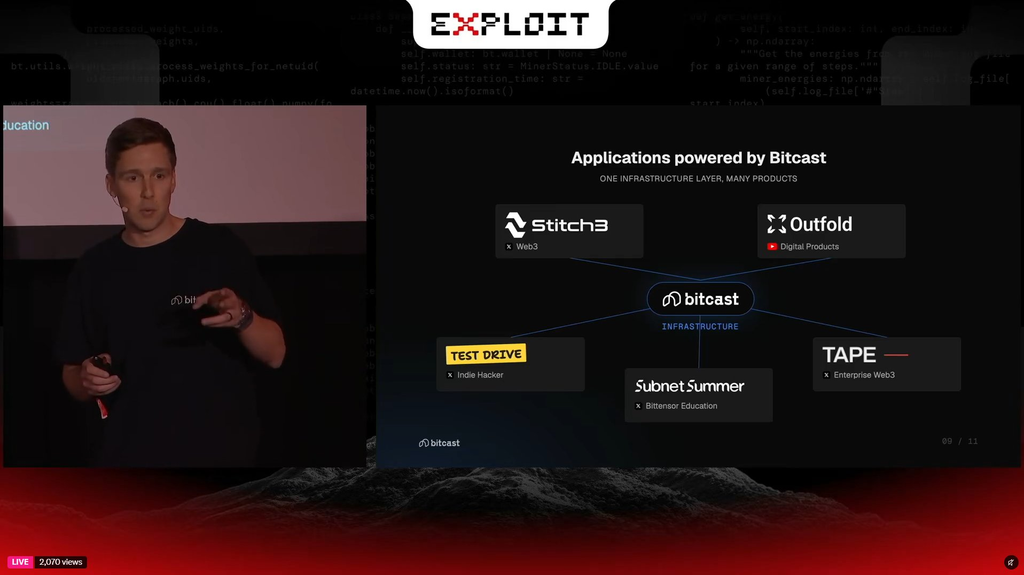
Bitcast announced Subnet Summer and TAPE as applications built on top of its infrastructure. The announcement showed another direction for subnet infrastructure, where the underlying network becomes a foundation that other applications can build on.
8. DeSci Claims V1 Goes Live
DeSci Claims presented the first version of its system, which went live on September 27 after roughly a month of testing on Bittensor mainnet. The platform has now moved from testing into producing live data.
9. Swarm Introduces Autonomous Security Drones
Swarm (SN124) presented Sentinel, an autonomous drone system designed to patrol solar energy facilities and report potential security issues.
It was one of the clearest examples on day one of Bittensor infrastructure being connected directly to physical-world operations.
10. Leadpoet (SN71) Turns Sales Agents Into a Competition
Leadpoet showed how miners compete to improve AI sales agents. Each round produces a stronger winning solution, which then becomes part of a shared baseline for the next generation of agents.
The model turns continual competition between miners into continual improvement of the underlying product.
11. Enigma (SN63) Rewards Solved Problems
Enigma (SN63) presented a challenge-based incentive model where rewards continue accumulating until someone solves a particular problem. Once a successful solution is found, it is published so others can use and build on it. This connects rewards directly to completing useful work.
12. Tokens or Equity?
Zipcode (SN46)’s Seby Rubino and Yanez (SN54)’s Jose Caldera explored a question many Bittensor teams are beginning to face. How much should move into decentralized systems run by miners, and validators?
The discussion reflects a broader shift as subnet teams move from experiments into companies with customers, employees, products, and revenue.
13. What Makes Groups Cooperate?
Philippe Beaudoin, a researcher, explored how records of interactions between humans and AI systems could help researchers better understand cooperation.
Studying how groups form, coordinate, and remain stable could eventually improve the design of both AI agents and the systems where they interact.
Day One Showed Bittensor Moving Closer to Real Products
A clear theme emerged on day one, as Bittensor teams moved beyond infrastructure and incentive experiments toward products people can actually use. Drug candidates entered laboratories, AI models ran on phones, drones supported security, and shopping and sales agents improved through miner competition.
At the same time, discussions around Gamma tokens, incentive design, protocol stability, and subnet sustainability showed that Bittensor is still evolving. Exploit Summit continues, with sessions beginning at 10:30 AM Montreal time and Pitchtensor scheduled for 3 PM on the OTF Stage.
Enjoyed this article? Join our newsletter
Get the latest TAO & Bittensor news straight to your inbox.
We respect your privacy. Unsubscribe anytime.
Enjoyed this article?
Join our newsletter
Get the latest TAO & Bittensor news straight to your inbox — every morning before markets open.



No comments yet — be the first.