


Harvard researchers have released a massive dataset showing how people and AI agents use AI models in the real world.
The data comes from Chutes (SN64), a decentralized AI inference platform built on Bittensor. Chutes connects GPUs from independent providers into a shared computing network, allowing developers and businesses to run AI models without managing their own servers.
Its large and growing volume of real-world AI activity gives researchers valuable insight into how models perform under everyday workloads.
The research covers 6.12 billion AI requests collected over one year. It gives researchers a rare look at what happens when thousands of AI models serve real users every day.
By understanding how AI is used, developers can build systems that run faster, cost less, and handle more users.
A year of real AI activity
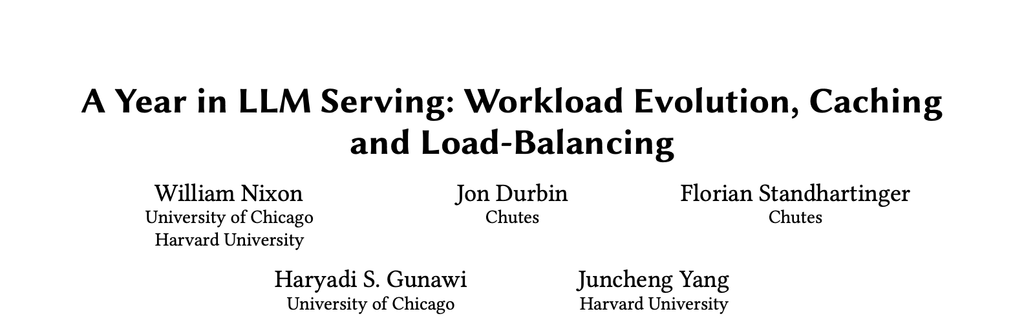
The study, titled A Year in LLM Serving, was carried out by researchers from Harvard, the University of Chicago, and Chutes.
The team studied records of AI requests made through Chutes between April 2025 and April 2026.
Here is the scale of the research.
| Measure | Number |
|---|---|
| AI requests | 6.12 billion |
| Users | 314,970 |
| AI models | 9,174 |
| Input tokens | 35.80 trillion |
| Output tokens | 2.52 trillion |
| Dataset size | 91 GB |
Note that the public dataset does not contain users’ actual conversations. It records information such as which models were used, how many tokens were processed, and how long requests took.
What the researchers discovered
The study found several things that could change how AI systems are built.
1. AI agents are changing how models are used.
AI requests are increasingly filled with long instructions and produce short answers. This fits how AI agents work. An agent might read thousands of lines of code just to decide what to do next.
Developers need to prepare for AI systems that read a lot of information and answer quickly.
2. AI can save time by remembering recent work.
When an AI model receives similar requests, it can reuse information it has already processed. This is called caching.
The research found that 99% of repeat requests from the same user to the same model arrive within 15 minutes. Keeping recent information ready can help reduce repeated work.
The team also found that simple ways of managing this stored information often worked as well as, or better than, more complex methods.
3. Sending requests to the right GPU matters.
Imagine an AI agent working on a coding task. If its next request goes to a GPU that already holds its earlier information, the model can reuse that work.
Sending it to a different GPU may mean processing the same information again.
The researchers found that smarter routing could improve reuse while keeping the workload reasonably balanced across GPUs.
Together, these findings can help developers build AI services that respond faster and use computing power more efficiently.
Chutes is becoming more than an AI hosting platform
The Harvard collaboration is part of a larger development at Chutes.
The subnet already provides the computing power needed to run AI models. Now, it is also helping researchers understand how to improve those systems and developing methods to train its own models.
| What an AI lab does | What Chutes is doing |
|---|---|
| Run AI models | Uses a shared network of GPUs |
| Conduct research | Works with Harvard, University of Chicago, and other institutions |
| Share discoveries | Publishes research and open datasets |
| Train AI models | Develops Parallax for training across distributed GPUs |
Parallax is particularly interesting. It is Chutes’ approach to training large AI models using GPUs spread across different locations, including consumer hardware. Early tests suggest this could make training less expensive, although the training runs are still in progress.
Chutes is bringing together three important parts of AI development. It has the infrastructure to run models, real-world data to improve them, and a growing effort to train new ones.
By making its research and tools publicly available, Chutes is helping other developers build on what it learns. That is how Subnet 64 is growing into an open-source AI lab.
Want to explore the research? Read the full paper, explore the public dataset, or access the research code on GitHub.
Enjoyed this article? Join our newsletter
Get the latest TAO & Bittensor news straight to your inbox.
We respect your privacy. Unsubscribe anytime.
Enjoyed this article?
Join our newsletter
Get the latest TAO & Bittensor news straight to your inbox — every morning before markets open.



No comments yet — be the first.