


A founder can spend thousands of dollars on sales tools, pull hundreds of promising leads into a CRM, and still end up asking the same question: who is ready to buy?
The problem is rarely a lack of contacts. It is that most prospecting starts with static information such as company size, job title and industry, while buying decisions are driven by what is happening inside a company right now.
A company hiring aggressively may suddenly have budget. A new funding round may create demand for new software. A technology change may force a team to replace an existing solution. A public complaint about a competitor may elicit a job opening.
The challenge for a small sales team is finding that valuable information before everyone else does, and proving that it helps the business.
That is where Leadpoet is taking a different approach.
From finding companies to finding reasons to contact them
Leadpoet’s sales intelligence platform is built around live buying signals, helping businesses identify prospects based on what is happening right now.
It monitors more than a dozen types of public activity, including hiring, funding, technology changes, product launches, social activity and community discussions.
It then matches those signals against a company’s ideal customer profile and produces a shortlist of accounts with an explanation of why the company fits and why now.
Instead of giving a salesperson 400 leads and asking them to figure out which ones are worth pursuing, the goal is to give them a smaller number of leads where there is already evidence of a potential need.
The Arena launched this week to make the intelligence behind that process improve continuously.
The Arena is the interesting part
The Leadpoet Lab Arena, running on Bittensor Subnet 71, turns sales-agent development into an open competition.
Developers (miners) submit AI agents that compete on hidden ideal-customer profiles. They are scored on company fit, buying intent and the evidence supporting their recommendations.
To become the new baseline, an agent has to outperform the existing one. Its winning code is then made public, giving the next developer a stronger starting point.
The result is a simple feedback loop: better agent → stronger baseline → tougher competition → better agent.
For Leadpoet, that could solve an important problem in business generally. Markets change quickly, and the signals that matter today can become outdated just as quickly.
New industries produce new patterns. Companies change technologies, hiring plans and strategies. The Arena gives developers an incentive to keep adapting the system to those changes.
Why should a business owner care?
Consider a software company selling to mid-market operations teams.
The traditional approach might be to buy a database, filter for operations directors, and send hundreds of emails.
Leadpoet’s approach is closer to starting with the event that creates a reason to sell.
Perhaps a target company has just raised funding, started hiring implementation managers and changed part of its technology stack.
Instead of simply knowing the company exists, a salesperson gets the context needed to understand why the company might be worth contacting now.
That can mean less time building lists and more time having conversations.
The current product also includes account monitoring, allowing teams to continue watching saved accounts for new signals.
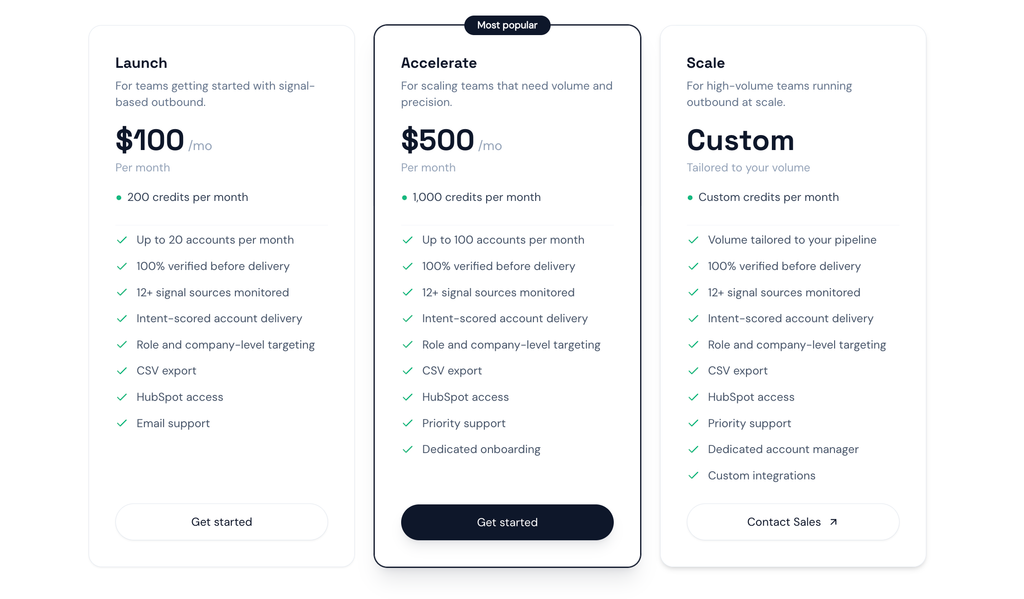
Pricing starts at $100 per month for the Launch plan, with a $500 Accelerate plan aimed at higher volumes.
How Leadpoet compares
This puts Leadpoet somewhere between several established sales categories.
Tools such as Apollo and ZoomInfo are powerful databases for finding contacts. 6sense and Demandbase are built around account intelligence and intent. Clay and similar workflow platforms give sophisticated RevOps teams the ability to build their own signal-driven prospecting systems.
Leadpoet is more distinct. It lets the system find the signal, identify the account and explain the opportunity.
Traditional sales software is largely improved by its own product team. Leadpoet is attempting to create an open competition where developers around the world are financially incentivized to make the underlying sales agent better.
Winning systems become part of the public baseline, creating a mechanism for improvement that compounds over time.
That does not mean Leadpoet will automatically produce better sales results than every established competitor. The Arena’s benchmark scores still need to translate into the metrics that matter to a business: qualified opportunities, meetings and revenue.
But the direction is compelling.
For a business owner, the appeal is not the underlying Bittensor subnet. It is the possibility of buying sales intelligence that gets better after you buy it.
Most sales databases become stale. Leadpoet is betting that its sales agent can become sharper as more builders compete to improve it.
Enjoyed this article? Join our newsletter
Get the latest TAO & Bittensor news straight to your inbox.
We respect your privacy. Unsubscribe anytime.
Enjoyed this article?
Join our newsletter
Get the latest TAO & Bittensor news straight to your inbox — every morning before markets open.



No comments yet — be the first.