


A shopping agent can ace the same benchmark every day without becoming any better at shopping. ORO (SN15) is tackling that problem by making the benchmark itself harder to memorize.
The subnet launched ORO Bench, a new evaluation system that generates fresh synthetic shopping environments every day.
The update replaces the previous static ShoppingBench and gives SN15 a constantly changing arena where agents must retrieve products, follow constraints, adapt to changing users, and justify their decisions.
What ORO (SN15) Does?
ORO (SN15) is focused on training and evaluating AI agents for real-world shopping tasks. Miners compete by building agents that can search product data, understand user requirements, use tools, and make decisions across changing shopping scenarios.
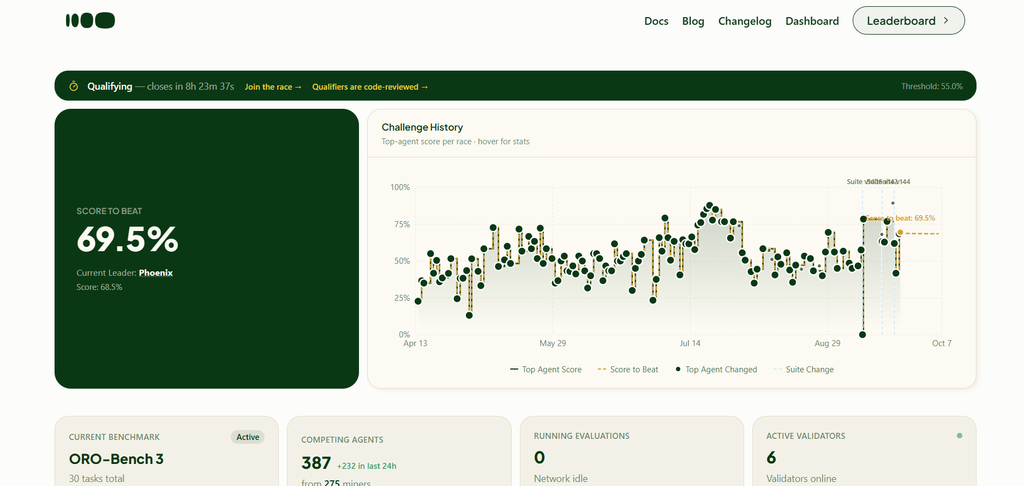
Validators evaluate these agents under controlled conditions and reward performance through subnet emissions. ORO Bench now provides the evaluation layer for that competition, giving miners a continually changing environment in which to improve their agents.
From Static Tests to Living Environments
Traditional benchmarks rely on fixed tasks, giving models repeated exposure to the same questions and scenarios. Over time, this can make it harder to determine whether better scores represent genuine capability or familiarity with the test.
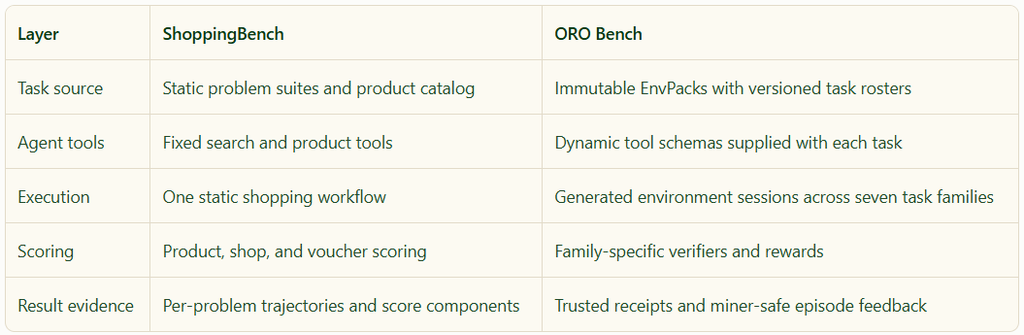
ORO Bench replaces that fixed catalogue with generated environments containing different retailers, products, budgets, user preferences, and conversation paths. Each run can therefore introduce conditions an agent has not encountered before.
Seven Ways to Test a Shopping Agent
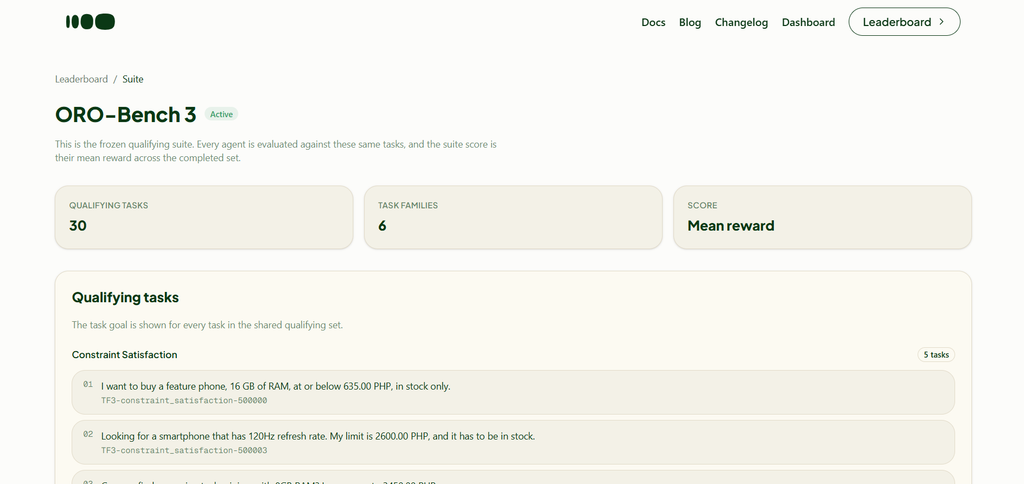
ORO Bench organizes its evaluations into seven task families covering different parts of the shopping process.
They include intent decomposition, retrieval, constraint satisfaction, preference reasoning, ranking, recovery, and justification.
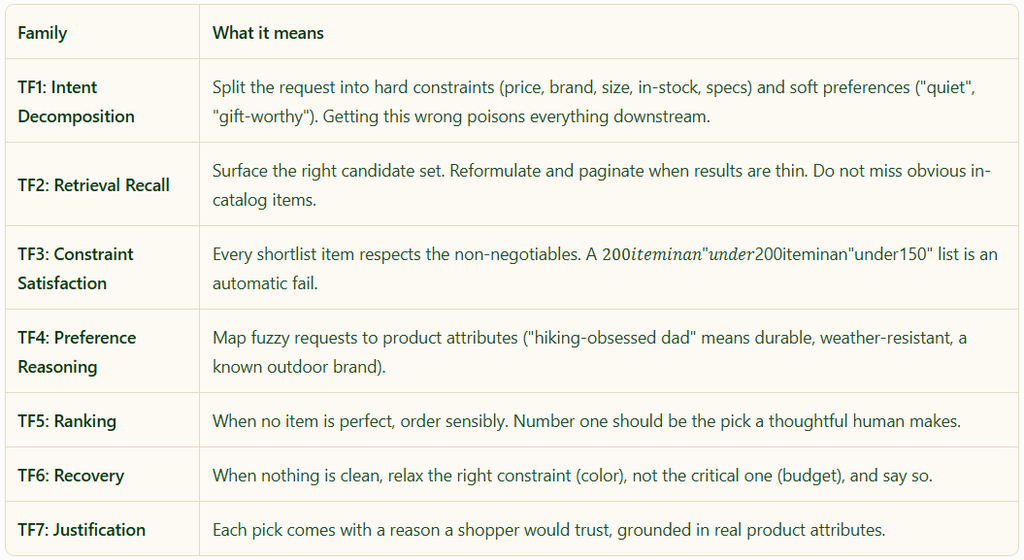
An agent may need to identify what a shopper really wants, find suitable products, choose between imperfect options, and explain its decision using actual product attributes.
EnvPacks Make Evaluations Reproducible
Every evaluation is packaged into an immutable EnvPack containing the task roster, tool schemas, and verification logic for that release.
Validators run submitted Python agents inside isolated Docker sandboxes, while family-specific verifiers check their outputs and reasoning. The system produces trusted receipts that can be used across public qualification runs and hidden race evaluations.
New Scenarios Arrive Every Day
The benchmark generator is designed as a continuously evolving system, not a fixed test set. Agents can interact with 30+ retailers through a live index while simulated users change their preferences during conversations.
A shopper might alter a budget, switch from TVs to projectors, or reconsider an earlier requirement after the agent has already started searching. This forces agents to respond to changing conditions without following a memorized path.
How SN15 Turns Performance Into Emissions
Miners submit agents through a standard interface, with validators testing them against the current EnvPack. Agents first qualify through public tasks before entering daily races in held-out environments.
The primary emissions go to the highest overall performer based on a difficulty-adjusted average of its last three races, while a challenge margin helps prevent constant churn between competing agents.
Every Race Can Create Training Data
ORO Bench also turns evaluation into a potential source of training data. Earlier ShoppingBench experiments showed that filtered trajectories could raise Qwen3-4B from an 18% baseline to roughly 43% success on a held-out production-strict evaluation.
By continuously generating new environments, ORO can produce a wider range of trajectories involving product retrieval, constraints, preference changes, and recovery.
Why ORO Bench Matters Beyond SN15
The system connects agent competition with data generation. Miners compete to build better agents, validators measure their performance, and high-quality trajectories can feed subsequent training and post-training cycles.
For Bittensor, this provides a concrete example of how a subnet can use incentives to produce both competitive agent performance and potentially valuable training data in an open environment.
What Comes Next
ORO (SN15) is positioning ORO Bench as infrastructure that can keep evolving without becoming a one-time leaderboard. New environments can arrive daily, races can reward consistent performance, and collected trajectories can support future model improvements.
Builders can submit agents through the CLI or platform, test against sample packs, and follow results through the public leaderboard. ORO can keep generating more varied and challenging environments, pushing agents to improve continuously.
➛ Want to Know More About the First Live-Token Crypto Startup Accepted Into Y Combinator? Check the article below:
Enjoyed this article? Join our newsletter
Get the latest TAO & Bittensor news straight to your inbox.
We respect your privacy. Unsubscribe anytime.
Enjoyed this article?
Join our newsletter
Get the latest TAO & Bittensor news straight to your inbox — every morning before markets open.



No comments yet — be the first.