


Yanez (SN54) doubled sales over the third quarter and October, bringing its estimated annual recurring revenue above $500,000, founder and CEO Jose Caldera said on the Ventura Labs podcast.
Newer products make recurring revenue harder to isolate, he said. The company also signed one of the world’s largest social networks for compliance and risk technology, but the client’s name remains confidential.
Yanez (SN54)’s original product line helps enterprises test their financial crime prevention and regulatory systems. It continues to serve many of Yanez’s largest customers, who are also potential buyers for its newer verification tools.
The second product line (Proof of Humanhood and Uniqueness) launched during the summer and has become the company’s main strategic focus. It aims to verify both human presence and user uniqueness.
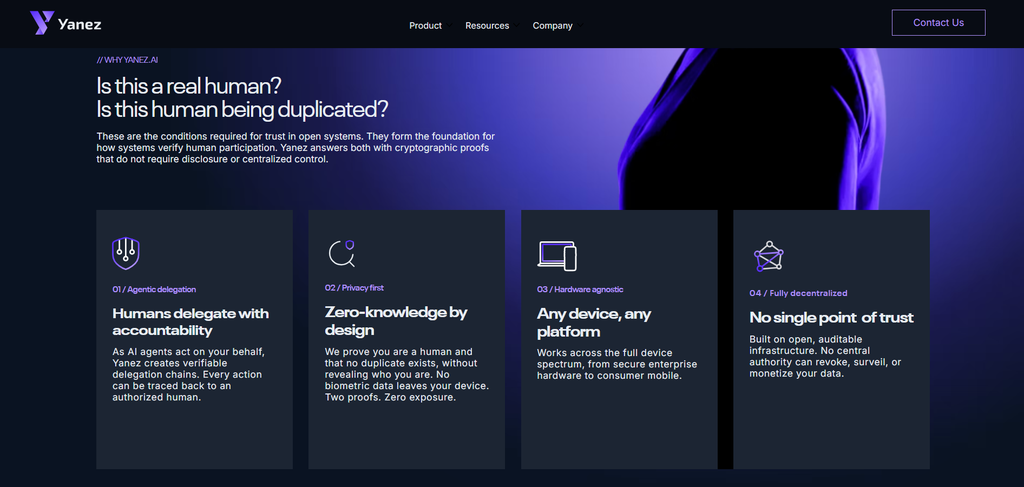
To verify human presence, Yanez must distinguish a live person from a recording or a fabricated feed injected into a sensor. Its current system uses phone cameras for facial checks, with webcam support planned.
Yanez is also collecting voice samples to train deepfake detection models; linking face and voice checks into a single proof remains an open technical problem.
Yanez is designing its verification tools to work on devices people already own and to keep biometric data out of centralized databases.
Jose sees an application in how people delegate tasks to AI agents. An agent could handle routine transactions within agreed limits, while a large transfer or a change to a payee could require approval from a verified human.
Jose pointed to reports of consumer agents making unexpected transfers, raising the question of who bears responsibility when an agent exceeds its instructions.
Credentials and attestations could help establish what an agent is authorized to do. For now, Yanez is focusing on how people grant that authority and confirm sensitive actions when agents act on their behalf in financial transactions.
Yanez uses Bittensor to develop and stress-test its verification systems against attacks such as deepfakes. Selling that technology to banks and governments takes additional work.
The founder said enterprise sales cycles can last 6 to 18 months, and customers may require compliance certifications, operational controls and assurances about where miners operate. Yanez plans to work with specialist partners on detection models.
Yanez expects to release a new product in the first week of December. Jose tipped that it addresses a marketplace problem and that early testers responded positively.
The company plans to share details at launch. He expects mainstream adoption of agent-driven commerce to take time, as regulation moves more slowly than technology and many consumers have limited experience with AI tools.
Enjoyed this article? Join our newsletter
Get the latest TAO & Bittensor news straight to your inbox.
We respect your privacy. Unsubscribe anytime.
Enjoyed this article?
Join our newsletter
Get the latest TAO & Bittensor news straight to your inbox — every morning before markets open.



No comments yet — be the first.