

qBitTensor Labs’ #17 livestream focused on Enigma (SN63) and its partnership with BlueQubit, whose quantum-generated peak circuits power the subnet’s quantum-proof challenge.
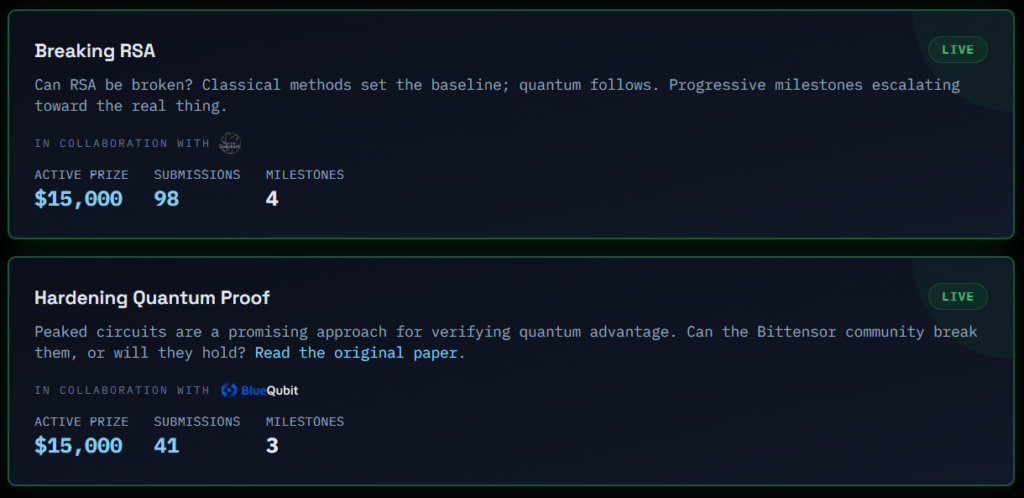
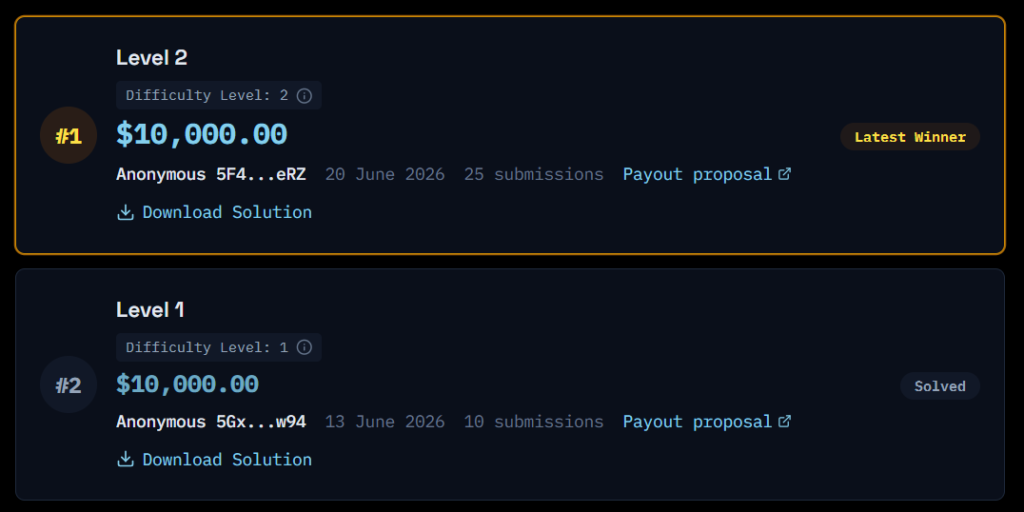
Enigma (SN63) is running two open challenges at the frontier of classical and quantum computing, with prize pools that increase the longer they remain unsolved. The ‘peaked circuits’ challenge has been held at difficulty 3 for weeks, with rewards rising from $10,000 to $15,000 despite repeated attempts by quantum computing experts.
If it eventually reaches a $1M prize without being solved, the teams believe it could become one of the strongest public demonstrations of quantum supremacy to date.
The Race to Crack Enigma’s Hardest Challenge
The conversation moved through the state of both challenges, the mechanics of peak circuits, the BlueQubit collaboration, and the broader implications of putting real money on unsolved quantum problems.
1. Enigma (SN63) runs two live challenges: The RSA breaking challenge and the hardening quantum-proof challenge. Each milestone starts at $10,000, winner takes all.
2. Prize escalation is the forcing function: Prizes bumped to $12,500 last week and $15,000 this week. Every unsolved cycle pushes them higher.
3. Difficulty one and two fell quickly. Difficulty 1 took about a week or less, difficulty 2 took longer but resolved cleanly. Difficulty 3 has resisted for weeks.
4. BlueQubit generates the circuits: The company calibrates parameters at each difficulty level and hands the circuits to Enigma’s validators, who host the challenges on-chain.
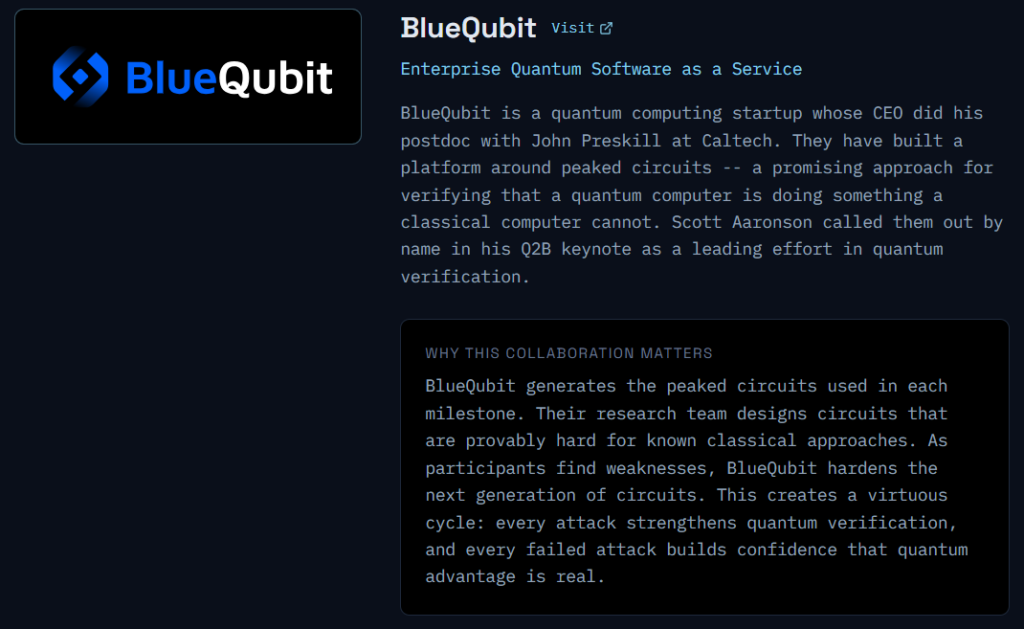
5. Peak circuits are the field’s current best proof of quantum advantage: Quantum computers can solve them efficiently, but classical computers cannot. The concept comes from a 2024 Scott Aaronson paper introduced at Q2B (Quantum 2 Business) conference.
6. BlueQubit itself does not have a general solution to difficulty three: They can solve some circuits in the family but not all of them, which is exactly why the escalating prize is worth watching.
7. Rules now enforce open source on all innovations: Publicly available binaries stay allowed. Anything custom must ship as open source so the next builder can stand on the shoulders of giants.
8. The RSA challenge is modeled on the original 2000 RSA challenge: That was how the world built enough conviction to base global cryptography on the RSA problem. Enigma is running the same pattern for peak circuits.
9. Serious quantum professionals have attempted difficulty three and failed: BlueQubit’s CTO personally pointed his network at the challenge, told them it was easy, and started getting texts back about how it was not easy at all.
10. Treasury wallet architecture insulates Enigma from the attacks: Owner keys stay air-gapped, and validators must vote on every payout, meaning any suspicious proposal can be canceled before funds move.
Money Where the Math Is
Enigma has created the public arena where quantum supremacy can be tested with financial incentives instead of academic claims.
If difficulty 3 remains unsolved as the prize climbs toward $1M, it could become one of the clearest real-world demonstrations of quantum advantage. Meanwhile, BlueQubit is already preparing an even tougher ‘difficulty 4’ challenge to keep pushing the frontier.
Together, the experiment is showing how decentralized incentives can produce meaningful scientific proof of what quantum computers can achieve beyond classical systems.
Enjoyed this article? Join our newsletter
Get the latest TAO & Bittensor news straight to your inbox.
We respect your privacy. Unsubscribe anytime.
Enjoyed this article?
Join our newsletter
Get the latest TAO & Bittensor news straight to your inbox — every morning before markets open.



No comments yet — be the first.