

Zipcode (SN46) published Zipcode Finance’s full documentation as an on-chain credit rail that funds warehouse-style lines of credit to Home Equity Line of Credit (HELOC) originators, moving the subnet from real estate intelligence into working financial infrastructure.
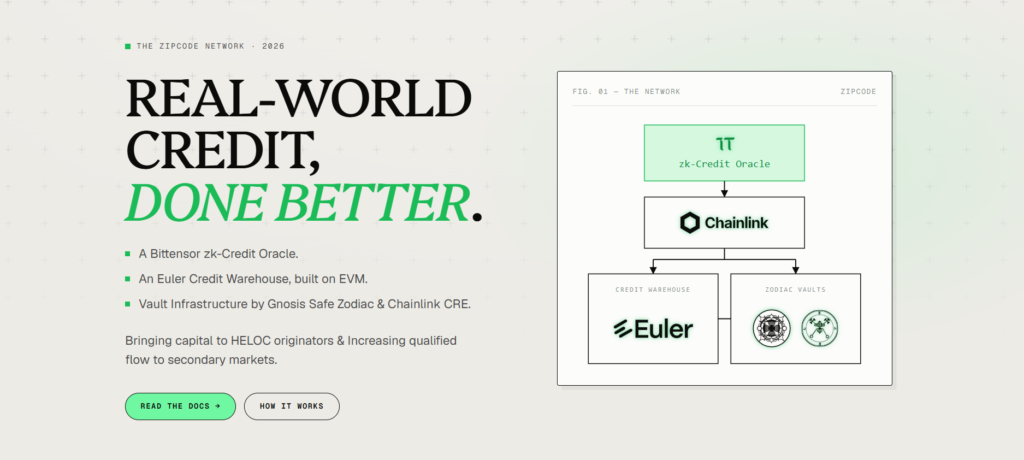
Lenders supply capital in $USDC, vetted HELOC originators access property-backed credit lines, and the yields cycle back to $SN46 through programmatic buybacks. That structure ties the credit protocol’s performance directly to the subnet’s own token economics.
Documentation is live with the next milestones being the first vault fill and the opening of the curator competition to outside risk curators.
What the Product Actually Does
Zipcode functions as an on-chain lending desk purpose-built for HELOC originators who need warehouse-style credit against real property.
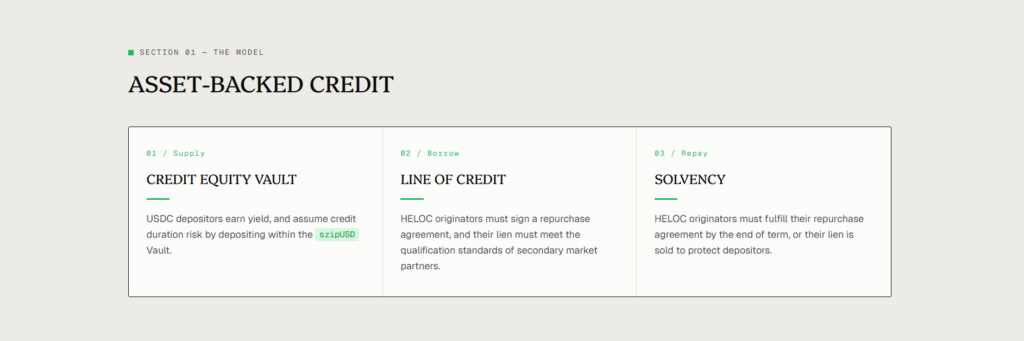
1. Lenders deposit $USDC and receive $zipUSD: A synthetic dollar minted 1:1, designed as a stable utility token for DeFi composability.
2. Most lenders automatically stake into $szipUSD. The yield-bearing version that earns from active credit lines while absorbing duration risk.
3. HELOC originators pass strict qualification before drawing. KYB (Know Your Business) checks, credit review, secondary-market relationships, and a signed repurchase agreement within 90 days.
4. Each line of credit is isolated. Its own vault, its own oracle, and its own collateral, so problems on one line stay contained.
5. The interest rate is ~7.5% APR. Positioned above bank warehouse cost and below consumer HELOC rates, which is the exact spread this segment has been underserved on.
Every loan is backed by a lien held in SPV custody with a repurchase agreement attached, meaning the protocol has real legal recourse against real property if the originator defaults inside the 90-day window.
Why Bittensor Sits at the Center of It
Zipcode’s use of Bittensor is where the subnet stops looking like a traditional DeFi protocol and starts looking like something new. Miners are not producing model outputs. They are competing as risk curators.
1. Miners are curators, not model runners. They compete on two clean metrics: $SN46 buybacks versus incentive spend, and average duration term plus default risk.
2. Bittensor validates the credit oracle. APIs from Plaid, Erebor, and Proof feed underwriting data into SN46, where validators sign off through zkProofs.
3. Chainlink CRE bridges the oracle to EVM. The verified data reaches Euler-based credit vaults on the settlement layer.
4. Emissions align with credit quality. Miners who bring higher-quality credit lines and stronger buyback ratios earn more.
The result is a subnet whose incentive layer pays curators for producing the exact behavior a well-run private credit protocol needs: Real revenue, low default risk, and steady deposit growth. Zipcode’s broader vision across the documentation is that this is the Bank of Bittensor being built one silo at a time.
Where the Protocol Goes From Here
The published documentation is not the launch. It is the specification, with two concrete milestones next and a candid list of the risks the protocol is designed against.
Next steps:
1. Fill the first vault: Bring initial $USDC into the credit warehouse, ready for allocation.
2. Open curator competition: Invite DeFi risk curators to compete alongside SN46 miners for the strongest credit line performance.
3. Extend into TradFi partnerships: Offer the infrastructure to traditional funds that want to run an on-chain credit warehouse.
Risks named directly in the documentation:
1. Secondary market shutdowns: Zipcode’s answer is underwriting tied to what secondary markets currently accept, plus tokenization through Securitize.
2. Limited liquidity in credit warehouses: CoW Limit Orderbook exits and staged redemption queues absorb the pressure.
3. Security and key compromise: A 2-day timelock and Zodiac Roles narrowly restrict admin actions during the build phase.
4. External audit still needed: Working with Octane, LOI signed with Sherlock, submission in with Arbitrum’s Security Grant program.
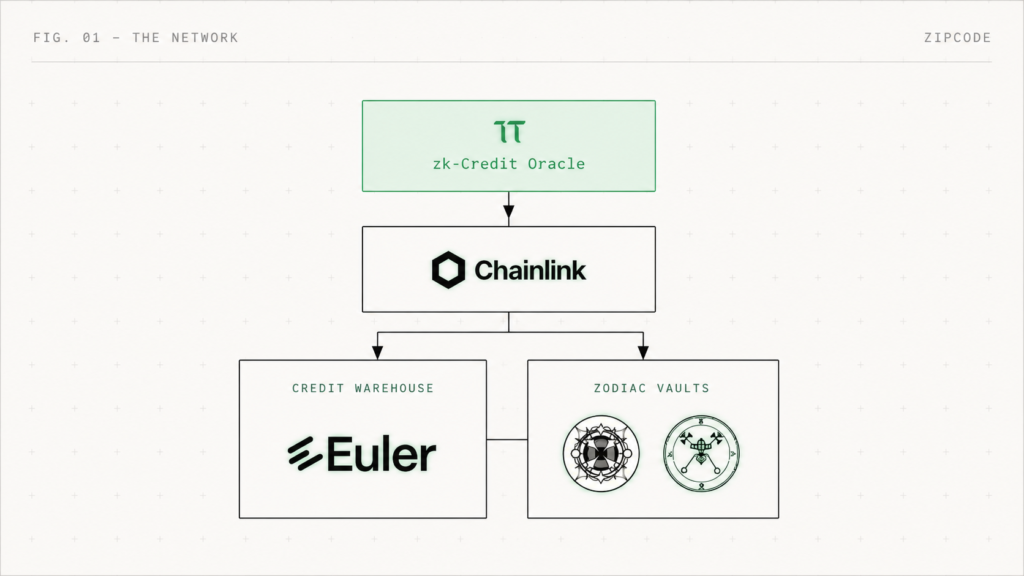
The design leans hard on established infrastructure: Euler v2 for the credit vaults, Gnosis Safe Zodiac for treasury operations, Chainlink CRE for the oracle relay, and Bittensor for the risk intelligence layer.
That means Zipcode is not building the primitives itself but composing them into a specific product for a specific customer.
The Bank of Bittensor, Documented
Zipcode’s documentation is one of the most concrete answers Bittensor has produced to the question of what decentralized AI actually does in the real economy. Real estate intelligence produced on SN46 becomes the oracle for real property-backed credit, and the yields from that credit flow back into $SN46 through buybacks.
HELOC originators get access to warehouse capital at rates that undercut banks. Depositors get yield backed by real liens under real legal enforcement. Miners get paid to keep the credit book healthy. For anyone tracking how Bittensor moves from experimental subnets into infrastructure the real economy plugs into, this is the sharpest example the ecosystem has documented so far.
➛ Read Zipcode Finance Docs Here
Enjoyed this article? Join our newsletter
Get the latest TAO & Bittensor news straight to your inbox.
We respect your privacy. Unsubscribe anytime.
Enjoyed this article?
Join our newsletter
Get the latest TAO & Bittensor news straight to your inbox — every morning before markets open.

No comments yet — be the first.