

On January 8, 2026, Iran shut down access to the global internet, cutting families off and blocking the flow of information.
That same month, URNetwork’s VPN product hit its all time high in monthly active users, and a user in Tehran called it the only tool that worked.
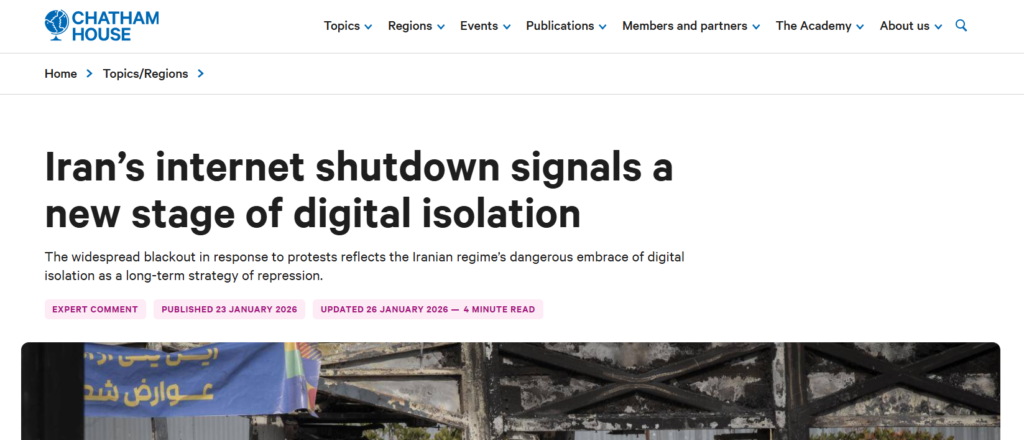
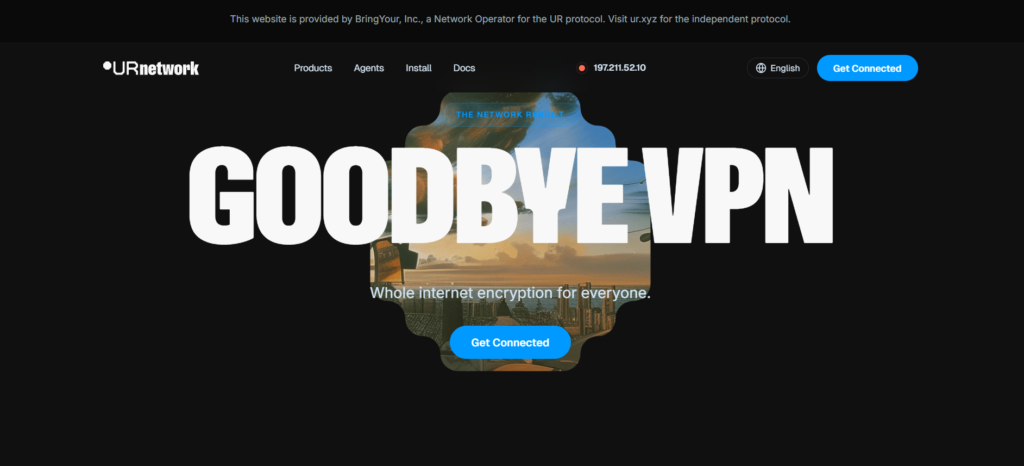
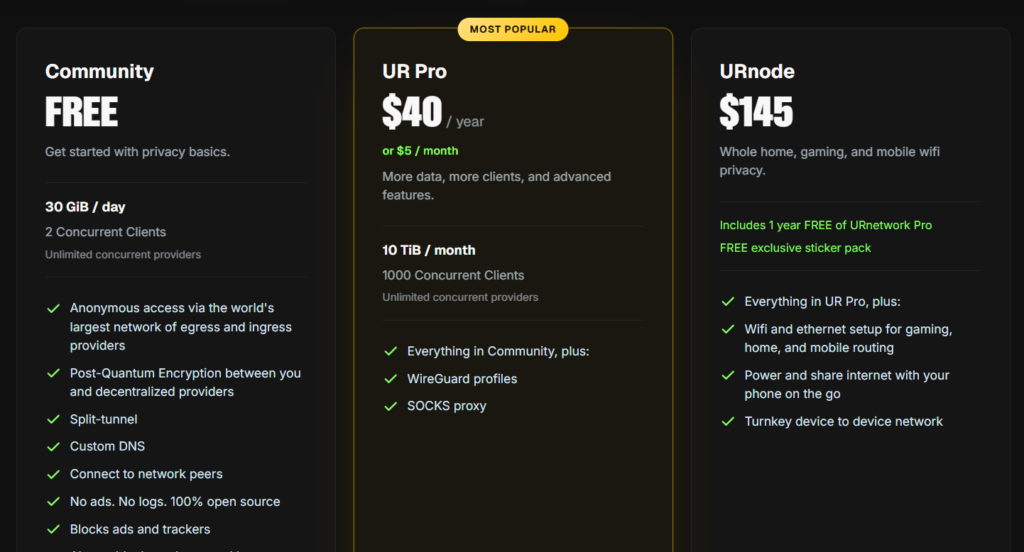
The team has now launched UR as Subnet 25 on Bittensor, bringing 80,000+ residential network providers and a live user base into the ecosystem’s incentive layer.
UR creates a supply side marketplace where residential IP addresses become the raw material for a genuinely private and censorship resistant internet.
The Team Behind the Launch
UR (SN25) arrives with a leadership group whose backgrounds and prior work give the launch immediate credibility across both the privacy community and the Bittensor ecosystem.

1. Brien Colwell carries the technical weight, having built URnetwork’s 80,000+ provider communities serving 350,000+ MAUs before the subnet existed. He spent 18 months at Palantir working on Gov V1, shaping his focus on building technology that empowers people rather than watching people there.
2. Jack Ai-Leung joined the founding trio after meeting Brien in Stockholm three months ago, later writing the public letter announcing the launch for the team. He frames UR as both a business and a mission, focused on protecting internet access where governments actively restrict it.
3. Keith Singery completes the launch team and is credited for providing the platform that made UR’s Bittensor move possible. His optimism for the network ultimately helped steer the project toward Subtensor rather than a competing chain.
What UR Does
The subnet coordinates a global fleet of residential IP providers into a working privacy layer, and the mechanics of how that fleet gets used matter more than any marketing claim about anonymity.
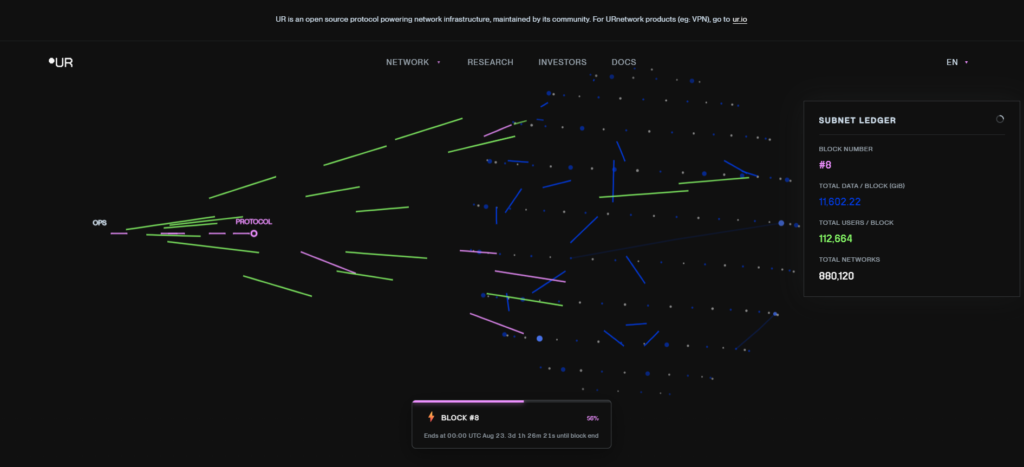
1. User traffic flows through multiple hops across independent miners, with layered encryption ensuring that no single miner ever holds both the identity of the user and the destination of their traffic simultaneously.
2. The transport is engineered to look like ordinary HTTPS, using N-layer TLS encryption, SNI spoofing, and traffic indistinguishability so the network remains reachable almost everywhere on Earth including in regions where standard VPN protocols are being blocked.
3. The first Network Operator on the subnet is ur.io itself, already serving 350,000+ monthly active users across 100+ countries, giving UR immediate demand from day one rather than requiring a bootstrap phase.
4. Three research programs already run on top of the subnet, with Project Bastion targeting enterprise network connectivity, Project Stargate exploring whether one open index can support both model training and live retrieval, and Project Meridian building dedicated identity infrastructure for AI agents.
How UR Compares to Traditional Options
Most VPNs and anonymity networks fall short in specific, patterned ways. UR is designed against those exact failure points, and the comparison below shows where the differences sit.
| Dimension | Traditional VPN | Tor | UR (SN25) |
| Ownership | Corporate, centralized | Nonprofit foundation | Community-owned network |
| Exit nodes | Datacenter IPs, easily blocked | Volunteer relays | 80K+ residential IPs across 100+ countries |
| Logs | Company-controlled, subpoena-exposed | No logs, but usable evidence trails | No single party sees identity + destination |
| Provider incentive | None, they are the company | Volunteer only | Direct on-chain payments per capacity |
| Reachability | Blocked in restrictive regimes | Blocked in restrictive regimes | HTTPS-shaped traffic, reachable almost everywhere |
| Open source | Rarely, or partially | Yes | Fully open, reproducible builds |
| Governance | Corporate board | Foundation | On-chain, decentralizing in stages |
The Three Roles That Coordinate Everything
UR runs on a three-role structure where every participant has a distinct job and gets paid for doing that job well, coordinated through Bittensor’s on-chain incentive layer.
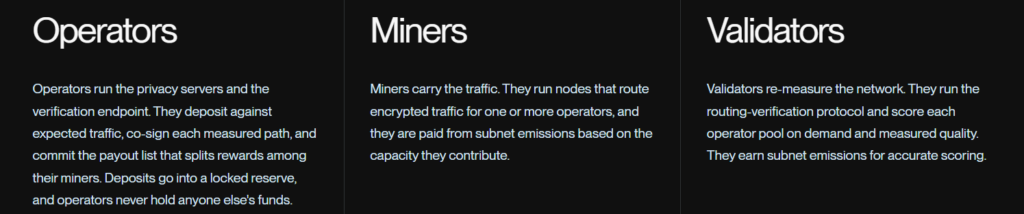
1. Network Operators own the demand side of the subnet: They own the users, the product, the brand, and the billing infrastructure, and they purchase capacity from SN25 to facilitate their services. Operators get billed on two axes: monthly active users served and gigabytes moved per day, both paid to the subnet in alpha.
2. Miners provide the residential IP addresses that make the network valuable: They run UR software on phones, laptops, Raspberry Pis, or any other hardware they already own, and their home connection becomes an exit node for encrypted traffic passing through the network from users anywhere in the world.
3. Validators verify that miners are doing real work rather than gaming the system: They walk operator-assigned chains of miners to confirm real-time transit, score each operator’s pool on demand and measured quality, and get paid Bittensor-native dividends for accurate consensus-aligned scoring.
The Two-Tier Miner Economy
A single operator can serve well over 100,000 miners, which far exceeds the roughly 256 on-chain slots any subnet has available, so UR handles the mismatch through a two-tier structure where miners can climb between tiers based on performance.
1. The pool tier is the on-ramp for new miners: Every operator holds one on-chain slot for all of its miners collectively, validators weight that pool by demand and measured quality, and each miner claims its share of the pool directly from the settlement contract using a cryptographic proof.
2. Top-level miners sit at the apex of the network: The roughly 200 largest fleets, ranked by how many distinct routable exit IPs they serve rather than by raw traffic volume, each claim their own on-chain slot and get paid natively by the network with no operator in the payout path.
The two tiers function as one tournament, with miners moving from the pool into top slots as their routable IP coverage grows. They return to the pool when coverage falls below the threshold, while governance controls emissions between the head and tail.
How the Token Works
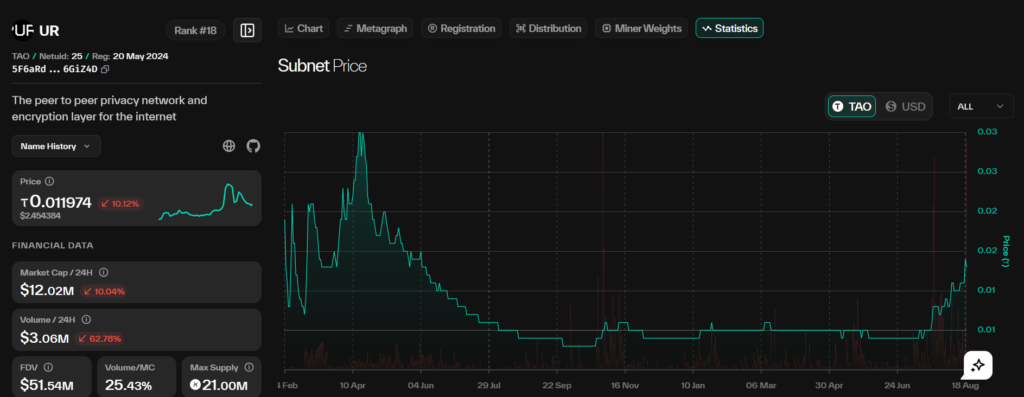
SN25 is the subnet’s native token and functions as the unit of account for deposits, emissions, and settlement across the entire network, with mechanics designed to reward real usage rather than pure speculation.
1. Operators permanently reduce liquid supply by depositing UR against real usage at a published rate, with every token entering a locked reserve that compounds and never returns to circulation.
2. Committed operators earn easier onboarding as cumulative locked stake lowers the reference rate they must post, letting participants expand with less upfront capital as usage stays consistent.
3. Miners earn from Bittensor emissions rather than operator deposits, with new UR created each cycle and distributed according to validated capacity under fixed schedule with halvings over time.
4. SN25 alpha functions as a utility token for coordinating and paying for network resources, with no claim on profits, income, returns, equity, ownership, or any rights in the underlying business model.
5. The billing model creates network effects as coverage attracts traffic, traffic generates operator revenue, revenue drives subnet demand, and demand attracts operators to build on the network.
Custody, Settlement, and Path to Decentralization
The settlement architecture deliberately prevents any single party from ever holding another party’s funds, which matters enormously for a privacy network handling real user traffic and real economic value.
1. Settlement runs on a seven-day cycle handled entirely by a smart contract on the Subtensor EVM: The contract accrues each pool’s emission across the period, then opens claims that miners pull directly rather than receiving pushed transfers.
2. The settlement contract is the sole custodian of in-transit UR: Operators never take custody of miner rewards, top-level miners get paid natively to their own keys, and the subnet owner has no path to touch any participant’s earned tokens.
3. Earned claims become permanently final once a settlement period closes: No administrative upgrade, pause, or intervention can block or reverse a finalized claim, and the locked reserve follows the same one-way standard where no function exists to remove funds from it.
4. Control decentralizes across defined stages: The launch phase runs with an owner multisig for bounded early bug fixes, then hardens through a public timelock on every change, a pause-only guardian that can freeze exploits but never move funds or block claims, and eventually full on-chain governance with an immutable settlement core.
A Telco Owned by the People
The clearest way to picture UR is as a global telecommunications company owned by the people who provide its infrastructure, rather than shareholders extracting rent from users.
Its 80,000+ IP providers become participants in an incentive market, while the network serving 350,000+ users expands toward deeper coverage.
That matters as internet access becomes more contested, with Cloudflare already announcing plans to block AI crawlers by default and charge for access.
If open internet access becomes controlled by a handful of gatekeepers, UR offers a concrete Bittensor answer to a simple question: who owns the pipes?
Enjoyed this article? Join our newsletter
Get the latest TAO & Bittensor news straight to your inbox.
We respect your privacy. Unsubscribe anytime.
Enjoyed this article?
Join our newsletter
Get the latest TAO & Bittensor news straight to your inbox — every morning before markets open.

[…] team at UR (SN25) discussed the importance of keeping internet access open and globally available. His argument […]