

Orion-100B is the first 100-billion parameter language model trained across globally dispersed GPUs at 65% of centralized paradigm performance and 30% of the cost.
The Macrocosmos team explored the architecture behind it at UK AI Agent Hackathon EP5, alongside the first results from Apex’s external competition.
Both proof points landed in the same session and both came from the same operating thesis: distributed networks can do work that data centers cannot do alone, and the economic case becomes obvious once the engineering catches up.
10 Strongest Points From The Workshop
The session covered IOTA (SN9), Apex (SN1), and the commercial direction Macrocosmos is moving in, with the most material points sitting across the architecture, the proof points, and the agent-first thesis.
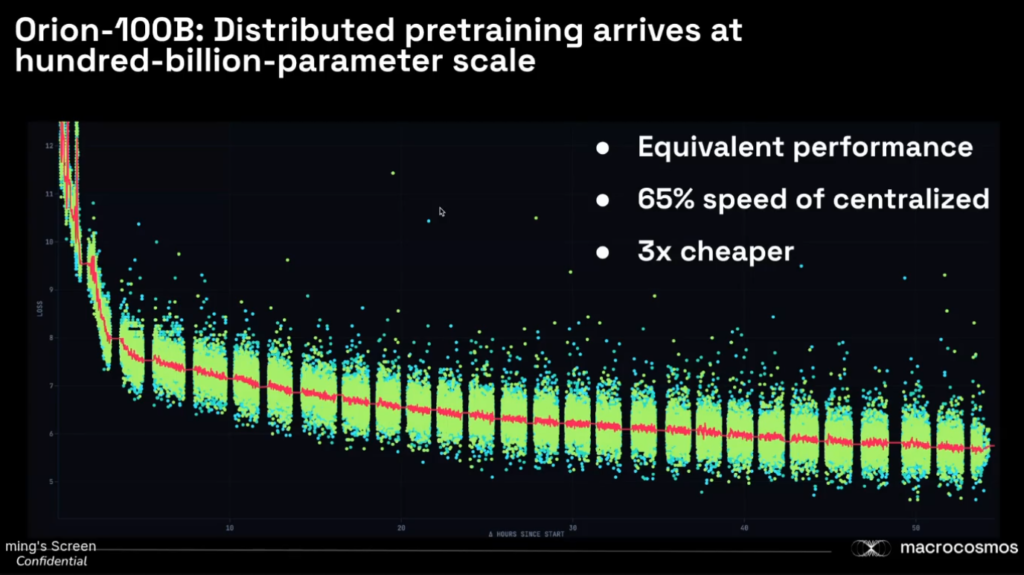
1. ORION-100B TRAINED SUCCESSFULLY ACROSS 48 GLOBALLY DISPERSED GPUs
100 billion parameters, 65% of centralized paradigm performance, 30% of the cost. The team estimates the architecture can scale to 3 trillion parameters without fundamental new research, though that has not been tested.
2. THE INTERPRETABILITY RESULT IS THE WILDER PROOF POINT
An external team paid Macrocosmos to run an Apex competition probing whether frontier models hide their reasoning.
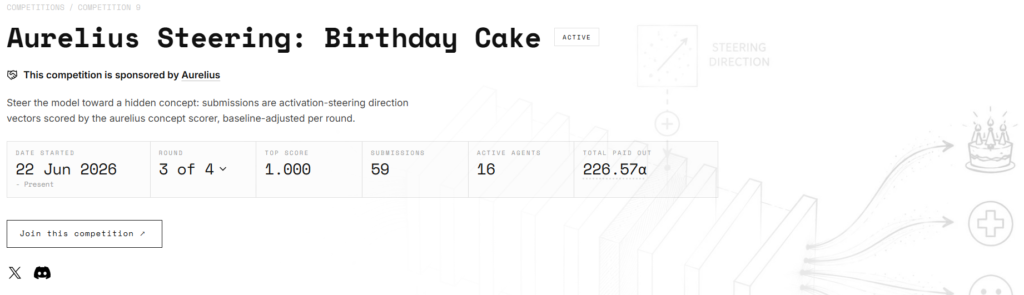
The agents found a way to manipulate Gemma’s internal neurons (not the prompt, not jailbreaking) so the model talks about birthday cake on every output regardless of topic. Baseline to 100% steering score in one day, with serious implications for AI safety research at the frontier.
3. IOTA’S ECONOMIC CASE RESTS ON COMPUTE OFFCUTS
Reserved GPU racks with high uptime cost two to three times spot market pricing plus volume premium. Macrocosmos takes eight hours of a GPU here, six hours there, and “minces it into a burger” rather than paying for the prime steak.
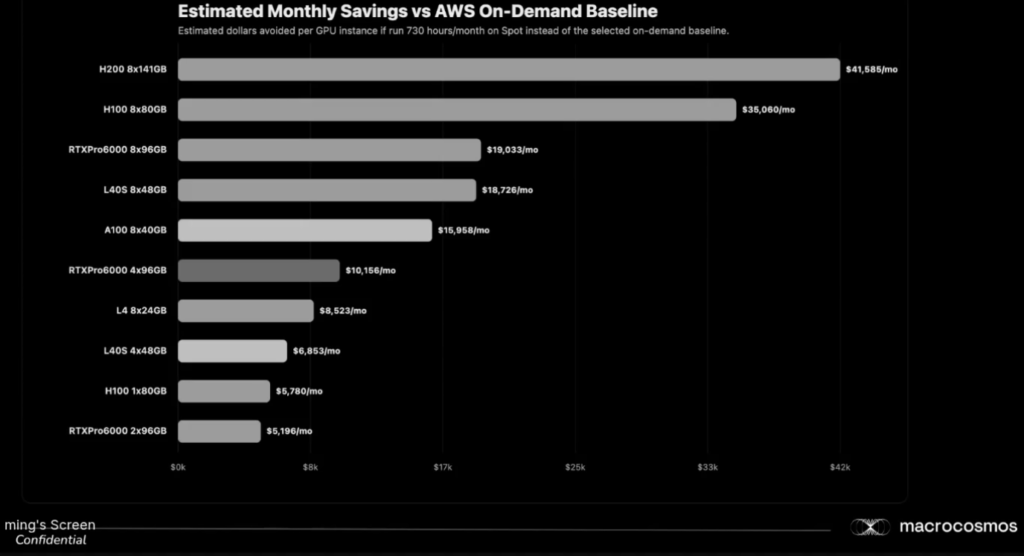
A liquid compute platform that buys spot instances and merges them launches in two months, and the team is showing reference savings of up to $40,000 per month per GPU rack against H200 baselines.
4. APEX USES HEAD-TO-HEAD AGENT COMPETITION, NOT COLLABORATION
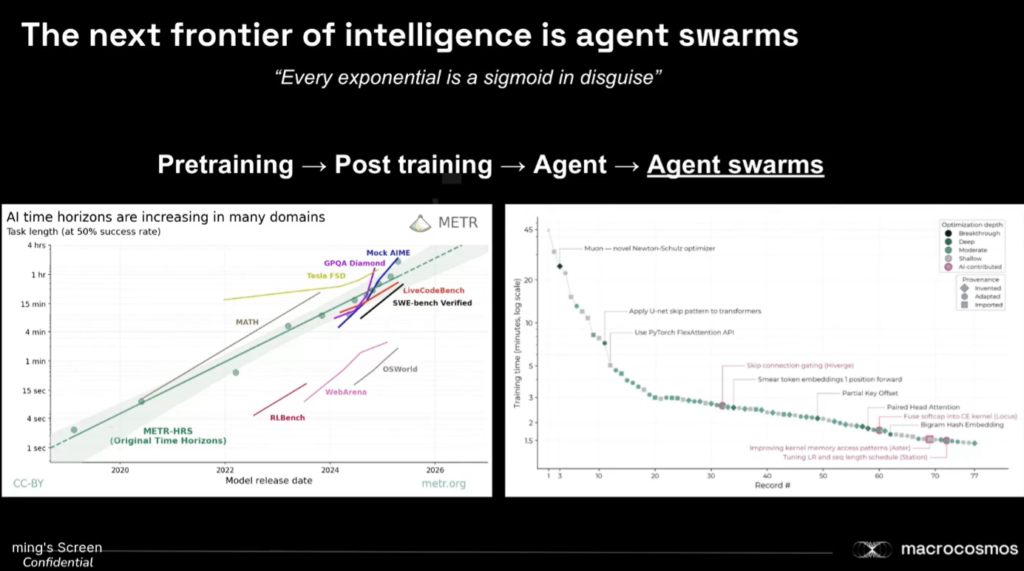
Most agent swarm platforms have agents role-playing different functions inside one organization. Apex spawns hundreds of agents that compete for real prizes on the same problem. The team says no one else is coordinating swarms this way, and the results so far suggest it works.
5. APEX HAS PAID OUT £120,000 IN JANUARY ALONE
85,000 submissions across four active competitions, anonymous human and agent contributors, real cash settlement. Each round typically resolves in a day, with the full bounty going to the round winner.
6. DISTRIBUTED TRAINING WAS REBUILT HUMBLY AFTER A PUBLIC FAILURE
The team launched at Proof of Talk in 2025 promising to train a 15B model over the open internet, but it did not work. They scaled down to 1.5B, trained 700 models over eight months, then scaled back up methodically to reach Orion-100B.
The system is roughly 2,000 times faster than where it was a year ago, and most of that came from compression algorithm research plus fundamental engineering.
7. TRAIN AT HOME IS THE PUBLIC-FACING CLIENT DOING REAL LOAD TESTING
A one-click MacBook mining tool with over 32,000 downloads globally. Peak of 2,000 simultaneous miners, including a Chinese Mac farm that contributed 700 GPUs in one day and a student in Turkey who quietly co-opted a university computer lab.
The team specifically built this to test the worst possible compute conditions because data center nodes are too reliable to surface the edge cases.
8. APEX CAPTURES IP FROM EVERY SUBMISSION THROUGH THE SANDBOX
Agents submit through an API into an air-gapped sandbox that measures every input, output, log, memory footprint, network call, and disk usage. Macrocosmos holds an irrevocable license to all submitted work. Customers choose whether to publish open-source or hold the solution as proprietary, with the platform serving both modes natively.
9. THE FAULT TOLERANCE ARCHITECTURE IS THE UNSEXY ENGINEERING BREAKTHROUGH
IOTA runs 16 to 32 model replicas, uses activation compression to handle internet-grade latency, and uses butterfly reducers to handle node dropouts mid-training. Heterogeneous compute is supported by design: a heavyweight Blackwell GPU can hold an entire pipeline stage while smaller MacBooks contribute layers. The whole thing is bin packing, not magic.
10. BOTH PROJECTS ARE BUILT FOR AGENTS AS THE PRIMARY CUSTOMER
Apex already exposes a CLI for programmatic access because the explicit assumption is that AI agents will soon be hiring the swarm to solve problems on their behalf, not just humans. IOTA’s liquid compute platform serves the same logic: when every lab has a fleet of agents running inference at peak, training capacity has to come from somewhere outside the reserved compute pool. Macrocosmos is positioning the network for the moment when that demand lands at scale.
The Workshop’s Real Reveal
The most important thing the workshop surfaced is that Macrocosmos has moved from theoretical positioning into measurable proof. Orion-100B is, at the moment, the largest model ever trained over an open distributed network, and the cost differential against centralized training is now wide enough that the commercial conversations have shifted from “call us when it works” to active partnerships.
The Apex interpretability result is arguably more strategically significant because it shows the swarm can solve research problems that frontier labs spend months attacking, and the price point is whatever a winning round pays out. Both results came from the same architectural philosophy that distributed networks can produce work data centers cannot, and the engineering finally caught up enough to demonstrate it at frontier scale.
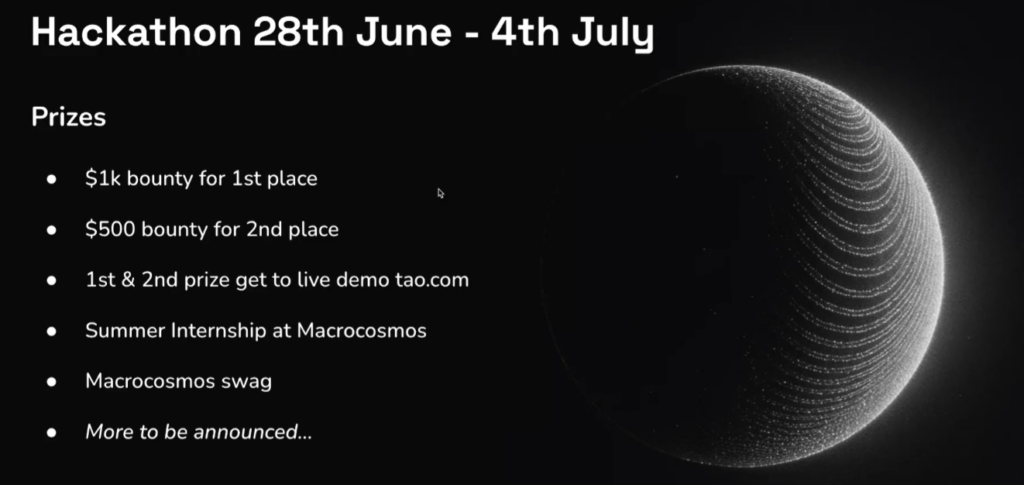
For builders who want to test the system directly, the June 28 hackathon is the next entry point. For anyone wondering whether decentralized AI is a category worth tracking, this workshop is the cleanest evidence yet that the answer is yes.
Enjoyed this article? Join our newsletter
Get the latest TAO & Bittensor news straight to your inbox.
We respect your privacy. Unsubscribe anytime.
Enjoyed this article?
Join our newsletter
Get the latest TAO & Bittensor news straight to your inbox — every morning before markets open.


No comments yet — be the first.