


Dr. Alan Aboudib’s interview with Macrocosmos was recorded in a French Alps cafe, with the mountains in the window and a coffee within reach. The conversation that followed was one of the more substantive the team has published this year.

He is the AI Research Lead at Macrocosmos, the architect behind ResBM, and the person whose work made Orion-100B technically possible.
He calls himself a hybrid that does not fit into modern academia or modern industry, which is part of why his trajectory has cut through some of the most influential AI labs without settling inside any one of them.
The Key Points From the Conversation
What the interview surfaces about Alan, the work he led, and his read on where AI is heading:
a. HIS CAREER PATH THREADS THROUGH THE LABS THAT SHAPED THE FIELD: PhD and postdoc at Collège de France under Gérard Berry, French Academy of Sciences member and Légion d’Honneur holder. He arrived one year after Yann LeCun finished teaching there. His Brown University research stay placed him under Thomas Serre, the HMAX inventor.
b. THE PIONEERS-CONFERENCE ANECDOTE CAPTURES THE ERA: Berry organized a closed-door gathering before Alan’s postdoc, attendees included LeCun, Bengio, and CIFAR researchers.
Alan turned to the person beside him and asked if they were a fellow PhD student. The reply: “I’m one of the inventors of VAEs.”
c. HIS BROWN WORK WAS PRESCIENT: He integrated memory and attention into AlexNet years before either concept became foundational to modern LLM design.
d. HE ARRIVED AT BITTENSOR WITH A DECADE OF DECENTRALIZED AI WORK ALREADY BEHIND HIM: From 2019 he ran the Paris OpenMined meetup, led the natural language and cognition team there, and built SyferText, which was eventually absorbed into PySyft.
e. THE SELF-DESCRIPTION THAT ORGANIZES EVERYTHING ELSE: He is “the perfect middle-point between researcher and engineer.” Theory alone bored him, and pure engineering left him hungry. The hybrid is what pulled him into applied distributed AI.
f. HE THINKS IN PICTURES, NOT EQUATIONS: Theorems and mathematical solutions are “too nebulous” without intuition. He builds a mental image, rotates it, manipulates it. The visualization habit is what let him redesign the transformer instead of patch it.
g. THE BOTTLENECK PROBLEM, STATED PLAINLY: Transformer architecture assumes centralized hardware connected through NVLinks and InfiniBand, which run hundreds of times faster than commodity internet.
The intermediate tensors that flow between transformer layers are too large to move efficiently across the open internet.
h. ResBM IS A FIRST-PRINCIPLES REBUILD: His working question was what the original transformer inventors would have built if internet bandwidth had been the binding constraint from the start.
The answer is the architecture that ships in IOTA today.
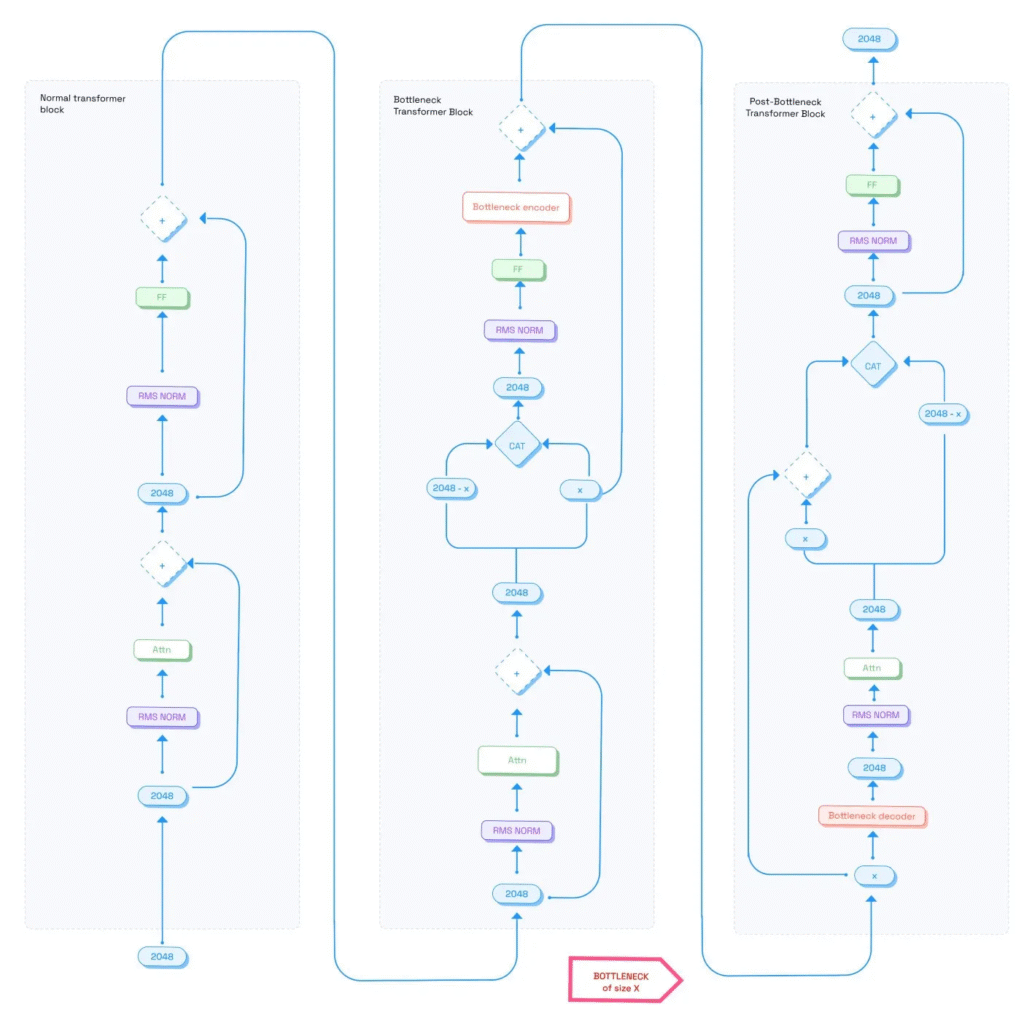
i. IDENTITY MAPPING WAS THE CONSTRAINT THAT RULED OUT MOST OFF-THE-SHELF APPROACHES: Transformers depend on residual skip-connections, and most compression schemes accidentally break them.
ResBM is engineered to preserve those pathways while still delivering the bandwidth savings of distributed training needs.
j. ORION-100B IS THE VALIDATION: ResBM enabled the 100B-parameter run to hit roughly 65% of centralized training speed, beating Covenant-72B on both model size and economics.
k. HE THINKS THE AI FUTURE IS CLOSER THAN THE HYPE SUGGESTS: Strip out the exaggeration and the trajectory still holds. The science-fiction version of the next decade is arriving on a real timeline.
l. HIS SHARPEST CONCERN IS STRUCTURAL, NOT TECHNICAL: AI is replacing workers, and the social contract that exchanges human productivity for shared benefits does not survive when the productivity stops being human. The question of who collects AI’s output when humans no longer produce it remains structurally unanswered.
m. POLICY IS MOVING THE WRONG WAY: France is rolling back social protections during the exact period when technological pressure on workers is intensifying. The mismatch is one governments should be addressing and almost none are.
n. HIS CLOSING PRINCIPLE IS DIRECT: AI is only worth getting excited about if its benefits are distributed. Without that, technological progress and declining living standards run in parallel.
The Through-Line
Alan closed the conversation asking who is going to protect the people. The thing he did not seem to register is that by building open distributed AI architecture rather than closed proprietary systems, he is already part of the answer. The combination of deep research instinct, applied engineering discipline, and a clear-eyed read on AI’s social impact does not commonly sit inside one person. ResBM raised what decentralized training can technically achieve. Orion-100B proved it at a hundred-billion-parameter scale. The next architectural ceiling Alan moves is the one worth watching.
➛ Read the Full Interview Here
Enjoyed this article? Join our newsletter
Get the latest TAO & Bittensor news straight to your inbox.
We respect your privacy. Unsubscribe anytime.
Enjoyed this article?
Join our newsletter
Get the latest TAO & Bittensor news straight to your inbox — every morning before markets open.



No comments yet — be the first.