

Every time you stream a movie, send a clip, or back up a security camera, somebody is paying to move and store that video.
The bill is enormous and almost invisible. Netflix alone reportedly spends around a billion dollars a year on cloud infrastructure with AWS, and most of that cost comes down to one stubborn problem: video files are gigantic, and shrinking them without making them look worse is genuinely hard.
Vidaio, which runs as Subnet 85 on the Bittensor network, just put up benchmark numbers that say it solves that problem better than anyone else currently does. Not better than a few startups. Better than the biggest names in the industry. And just like that, a small decentralized subnet has built the most efficient video compression available right now, and the way they got there is something only Bittensor makes possible.
The problem nobody outside the industry thinks about
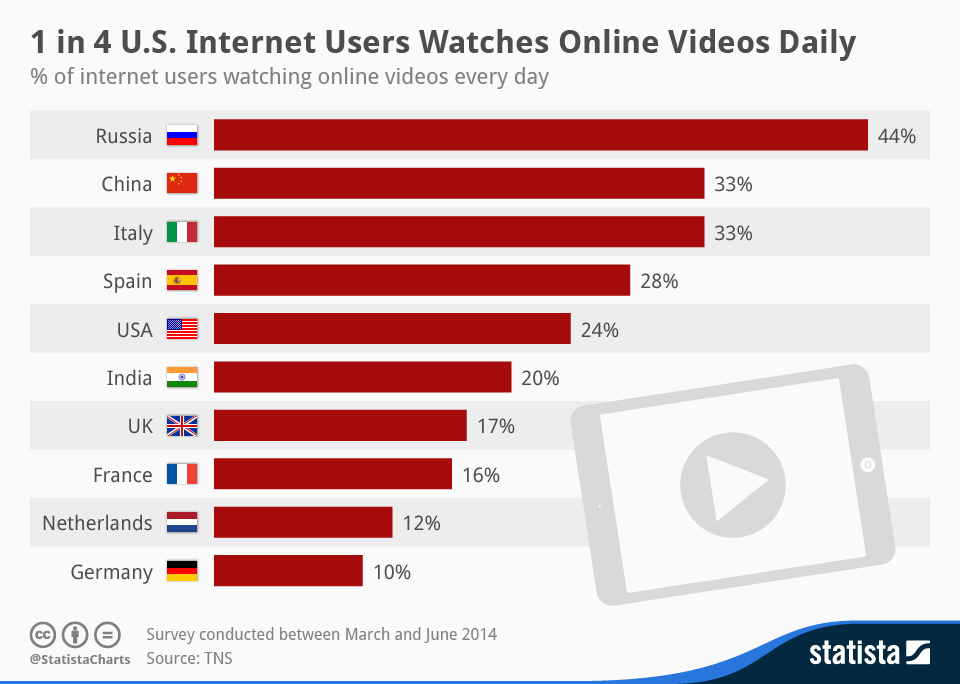
Video is the heaviest thing on the internet. It already makes up the overwhelming majority of all internet traffic, and the volume keeps climbing as more of it gets created, uploaded, and streamed.
AI has poured gasoline on this. With a single prompt, someone can now generate a ninety minute film and push it to the cloud, and the infrastructure underneath was never designed for that kind of flood.
The founder behind Vidaio spent more than two decades in traditional video, working across post production and distribution for the likes of Sony, Sky, Canal +, etc. He saw the same wall everywhere. He also ran into it firsthand building the first video-on-demand platform in Nigeria, where bad bandwidth and limited storage made streaming high-quality video almost impossible. The fix he wanted, high quality content at a tiny file size, did not exist yet because the technology was not there.
This problem is simple to imagine and brutally hard to solve. You want a smaller file, but you do not want the viewer to notice any drop in quality. Push compression too far and the picture turns blocky and smeared. Stop too early and you are still paying to store and stream bytes you did not need. The entire solution is finding the smallest possible file that the human eye still reads as flawless.
How quality actually gets measured
To know whether compression is any good, you need an honest way to measure quality that matches how people perceive video. The industry standard for this is VMAF, a scoring system Netflix built that blends human perception modeling with machine learning to rate a video on a quality scale.
A VMAF score around 93 is essentially perfect to the human eye. You will not be able to spot any degradation at that level.
So the real test is this: lock every compression method to the same VMAF score, meaning every output looks equally good, then see whose file is smallest. Same perceived quality for everyone, and the winner is whoever gets there with the fewest bytes. That is the apples to apples comparison, and it is exactly the test Vidaio ran.
The benchmark that turns heads
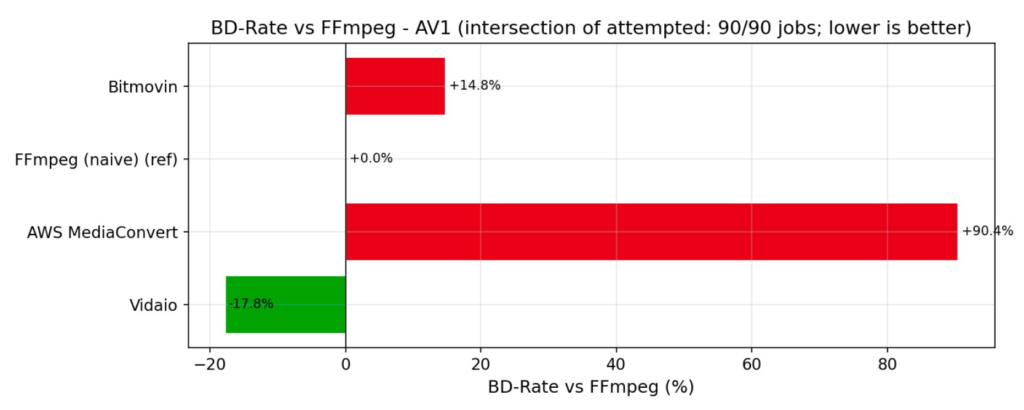
Vidaio benchmarked its compression against FFmpeg, the open source workhorse that powers a huge slice of the world’s video processing, and used it as the baseline. Then it lined up against two heavyweight commercial services: AWS Elemental MediaConvert and Bitmovin, both serious enterprise-grade encoders.
Every result was pinned to the same VMAF quality score, so the only thing that changed between them was file size. Vidaio’s file came in 17.8 percent smaller than the FFmpeg baseline at that matched quality. AWS, running the same test at the same quality target, produced a file that was 90.4 percent larger than the baseline.
Read those two numbers next to each other and the gap is hard to overstate. For the exact same picture quality, one of the largest cloud video services on the planet was producing files nearly twice the size of the open source baseline, while Vidaio was producing files almost a quarter smaller than it.
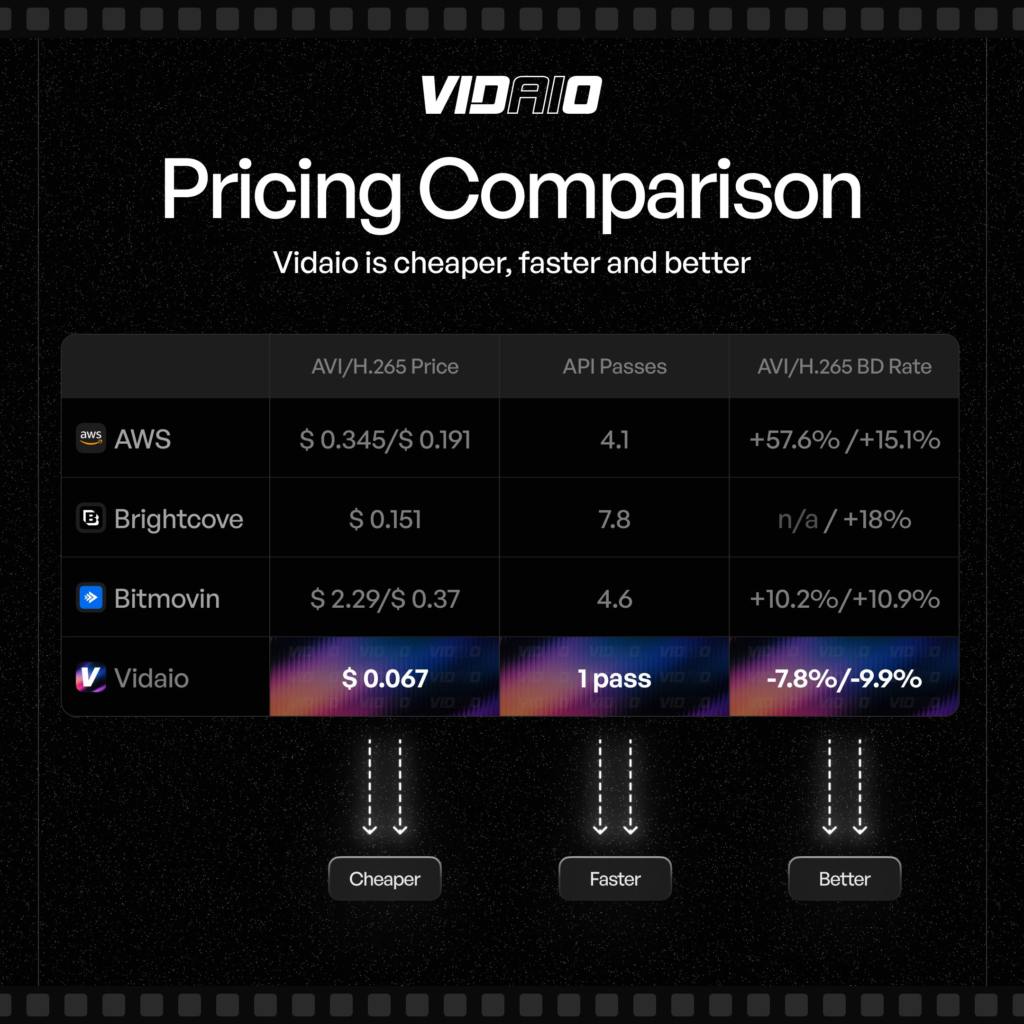
Vidaio also edges out on pricing. In a separate benchmark test across 30 clips, 5 providers, and both the AV1 and H.265 codecs at fixed quality targets, Vidaio ranked first for compression efficiency in both codecs and came in far cheaper per encode than the cloud encoders it was tested against, roughly 7 cents against AWS at 19 to 34 cents and Bitmovin as high as 2.29 dollars.
Estimated at over 1,000 hours of content a year, the encoding bill worked out to roughly 4,000 dollars for Vidaio against around 145,000 dollars for the competition. Vidaio is optimizing for both quality and affordability, and the results prove it.
Now translate those numbers into a practical business case. If you are a giant content owner spending a billion a year on infrastructure, shaving roughly a quarter off your storage and delivery footprint at no visible quality cost is a no-brainer. It is a line item that justifies tearing out whatever you were using before. And the saving compounds, because it applies year after year across an entire growing library.
Why this could only happen on Bittensor
Building world-class video AI the traditional way takes a fortune. You need a large machine learning (ML) team, expensive research and development, serious compute, and an endless cycle of testing, benchmarking, and reoptimizing. Most companies can fund one internal team and hope it stays ahead of everyone else.
Bittensor flips that model. On Subnet 85, the work of improving the models is not done by one in-house team. It is done by a network of independent miners, effectively hundreds of machine learning engineers, all competing to produce the best video processing model, and the reward goes to the top performers. Validators score the outputs; the best work gets paid, weak work gets penalized, and the product improves because everyone in the network is financially motivated to outdo each other.
That competitive structure is the whole advantage. The team can introduce a new challenge, a better compression target, a sharper upscaling task, and the miners race to solve it. Improvements that would take a single company months of internal R&D get crowdsourced from a global pool of talent that shows up on its own, picks the subnet it wants to work on, and competes for the reward.
As the founder, Gareth Howells, put it on a recent podcast, you essentially get a few hundred machine learning engineers trying to outdo each other on your product, and there is nowhere else in the world you can assemble that on demand. That is why the subnet can beat AWS at its own game.
Check Gareth on LinkedIn here.
From a tool to an operating system
Vidaio started narrow, with compression and upscaling as two separate services. You uploaded a file, the network processed it, and you got it back. The product has since grown into what the team calls Vidaio OS, an agentic layer that sits across an entire video archive rather than handling one file at a time.
The idea is that the agent connects to your storage, reads everything you have, and tells you exactly where it can help. It can flag which files can be compressed and by how much, which standard definition footage can be upscaled to 4K, which clips need noise cleaned up, and which content could be localized into other languages.
For a platform with new uploads pouring in every day, the agent sits across both the existing library and the incoming stream, continuously optimizing as content arrives. It even learns how a given client likes their content to look and adapts to that.
The team has also signed a partnership with Pip Studios, a localization and dubbing specialist whose client roster includes Netflix, Amazon, Apple, and Paramount. The arrangement puts Vidaio’s technology inside Pip’s workflows under Pip’s branding, which is a path toward getting the subnet’s compression and localization tools in front of exactly the enterprise clients who feel the cost problem most acutely.
Why the timing matters
Vidaio recently listed its alpha token on MEXC, one of the first subnets to push toward making its token easy for ordinary investors to access without first having to understand the maze of Bittensor’s native tooling. The logic is to lay the rails now so that when video AI breaks out of the crypto echo chamber and institutional money goes looking for a way in, the door is already open.
That is the bull case through and through. A subnet with a genuine technical lead, a founder who knows this industry from the inside, a partnership pipeline into the biggest content companies in the world, and an incentive engine that keeps the product improving faster than any single competitor can match.
It’s no doubt that Vidaio (SN85) is currently sitting at the front of the pack, and it got there in a way no centralized company can easily copy.
Enjoyed this article? Join our newsletter
Get the latest TAO & Bittensor news straight to your inbox.
We respect your privacy. Unsubscribe anytime.
Enjoyed this article?
Join our newsletter
Get the latest TAO & Bittensor news straight to your inbox — every morning before markets open.



No comments yet — be the first.