

The fragmentation problem in Bittensor participation has had no real solution until now. Researching a subnet, configuring a wallet, running mining workflows, debugging a validator, shipping code, and managing infrastructure each lived in different tools, and stitching them together was the participant’s problem.
Katana is Ninja’s answer, launched as an agentic IDE (Integrated Development Environment) built from the ground up to function as a native Bittensor workspace rather than a generic dev environment. The tool brings the network’s commodities into one place and treats subnet participation as a first-class workflow, with the explicit goal of evolving alongside Bittensor itself.
What Katana Bundles In
Katana was built learning from Codex, Claude Code, and Cursor, but the difference is that it ships preloaded with access to the Bittensor stack rather than treating the network as an afterthought.
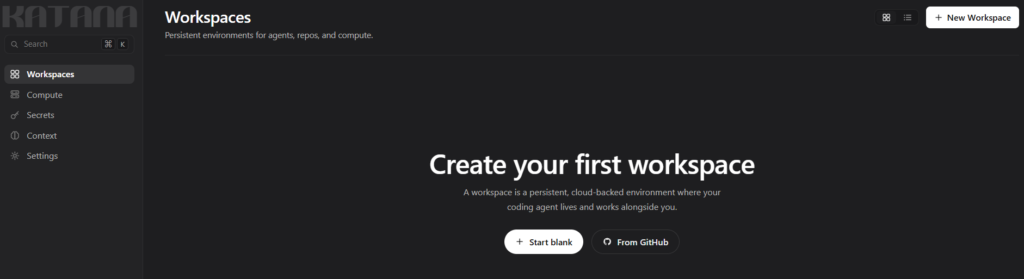
The commodities Katana bundles:
1. Chutes (SN64) for decentralized inference,
2. Targon (SN4) for compute,
3. Lium (SN51) for GPU rentals,
4. Ninja (SN66) as the host subnet,
5. Affine (SN120) for RL environments,
6. Ditto (SN118) for memory and subnet knowledge graphs, and
7. Hippius (SN75) for storage.
Each workspace is configured for the workflows participants actually run on Bittensor: subnet research, wallet configuration, mining workflows, validator debugging, code shipping, and infrastructure management, all in the same surface rather than scattered across browser tabs and external scripts.
How the Workspace Functions
The core unit of Katana is a workspace, which behaves like a proper development environment with a real filesystem rather than a stripped-down web tool.
1. Persistent cloud sandboxes: Workspaces stay alive between sessions, so participants resume rather than rebuild state every time.
2. External machine attachment: Beefy local hardware can be attached to a workspace for real experiments and active mining operations.
3. Shared memory and context: Memory from the sandbox and any attached machines is shared, so a single prompt resumes work regardless of where the last action happened.
4. Granular environment and secret management: Environments and secrets can be scoped globally, per workspace, or per member within a workspace, which matters for any team running infrastructure with real keys involved.
Katana supports multiple agent harnesses inside the same workspace, including pi, Codex, Claude Code, Cursor, and xninja, and ships with first-class support for Ditto’s subnet knowledge graphs that Ninja describes as ushering in a new era of mining on the network.
Less Fragmented, More Seamless
The real measure of Katana will be whether it actually reduces the friction Bittensor participants face today.
Persistent cloud sandboxes, external hardware attachment, shared memory across environments, granular secret management, and native access to the network’s core commodities are the architectural pieces, and the promise is researching, mining, validating, and shipping all in one workspace.
More updates would be shipping, and Ninja has committed to keeping Katana current with the network’s developments rather than letting it calcify into a snapshot of launch day.
➛ Try Out Katana Here
Enjoyed this article? Join our newsletter
Get the latest TAO & Bittensor news straight to your inbox.
We respect your privacy. Unsubscribe anytime.
Enjoyed this article?
Join our newsletter
Get the latest TAO & Bittensor news straight to your inbox — every morning before markets open.



No comments yet — be the first.