


Bittensor is itself a subnet, designed from the ground up to be recursive and fractal, and the chain upgrade shipped this week makes that observation operational by giving Bittensor its own reward function written explicitly at the protocol level.
The structure follows the same two-term shape that Affine (SN120), Lium (SN51), and Chutes (SN64) already use, with root proportion multiplied by price as the linear term and validator-operated miner burn as the boolean. The combination defines what the chain now optimizes for at every tempo.
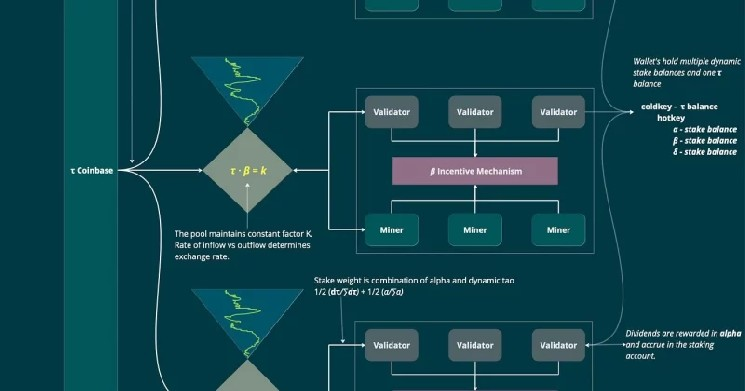
The upgrade only affects subnet owners and dynamic $TAO (dTAO) traders, leaving holders, wallet interfaces, and everything user-facing untouched.
The Two-Term Structure
The argument behind the upgrade is that every well-designed reward function breaks into two distinct terms doing different jobs: a linear term miners push upward and get rewarded proportionally for maximizing, and a boolean pass-fail gate that must be cleared for the linear term to count at all.
Existing subnets following this shape:
1. Affine (SN120)
Linear: Performance across 5 RL (Reinforcement Learning) Environments. Boolean: Qwen Architecture, Tokenizer, and 33B Parameters.
2. Lium (SN51)
Linear: Number of GPUs. Boolean: Passes the Reliability Filter.
3. Chutes (SN64)
Linear: Inference Bandwidth. Boolean: TEE (Trusted Execution Environment) proof.
Separating the two terms matters because some properties need to be required without being rewarded for exceeding a minimum. A GPU on Lium needs 50Mb of bandwidth to qualify, but the network does not want to pay for more, so bandwidth lives in the boolean rather than the linear.
Miners push against the gate while maximizing the quality, and that tension produces good incentive behavior. Bittensor being a subnet itself needs the same structural shape applied to its own emission, which the new upgrade enforces.
The New Linear Term
The quality Bittensor now optimizes is root proportion multiplied by price:
1. Price is the most natural metric for the chain to optimize: Directly proportional to the value attained for the dilution of $TAO, and the metric dTAO investors care about most. The chain uses the subnet’s exponential moving price rather than the spot tick, smoothing out short-term noise.
2. Root proportion ties optimization to $TAO holders’ return: Calculated as tao_weight divided by the sum of tao_weight and alpha_issuance, representing the per-block share of a subnet’s dilution sold back to $TAO holders. Multiplying it through ensures the chain’s optimization target is value actually returning to $TAO.
There is a deliberate second-order effect built into root proportion. Because it falls as a subnet’s alpha issuance grows over time, emission naturally eases toward newer subnets and decays as a subnet matures, giving new entrants an easier on-ramp while requiring incumbents to keep earning their share on price.
The New Boolean
The gate is (1 – miner_burn), operated by validators rather than measured by the chain:
1. miner_burn is the proportion of miner emission withheld from miners: Emissions routed to the owner or burn key get burned rather than paid out.
2. Burning miner emission now costs chain emission: Previously the burn affected only internal subnet emission, but the same action now pulls down the subnet’s share of network-wide emission in lock step.
3. Active mining keeps full emission, faked mechanisms can be switched off: Measuring “good mining” on-chain is treated as a fool’s errand, so the chain hands judgment to validators, alongside new oversight tooling from the triumvirate for cases where the validator set is itself inactive.
The lever has two honest users the chain is deliberately agnostic about:
1. A subnet team can manage its own emission by burning rather than over-diluting, paying in immediate chain emission rather than long-term token supply pressure.
2. A validator or the triumvirate can burn a subnet faking its mechanism, producing the same outcome through a different path.
Both move the boolean in the same direction. The outcome is identical regardless of who acts: less active mining means less emission. This also makes the chain’s commitment to the mining side of Bittensor explicit, since mining subnets no longer sit at a structural disadvantage to non-mining ones.
Closing the TAOFlow Arbitrage
The upgrade also fixes a structural flaw in the previous mechanism. TAOFlow measured performance on a moving average of netflow, and moving averages carry memory that decays over time, which created a clean arbitrage cycle:
1. Buy one of your own subnets to collect the emission boost.
2. Sell out into a negative EMA (Exponential Moving Average.)
3. Rotate capital to the next subnet you own.
4. Come back to the first pool once its EMA has decayed enough for the cycle to begin again.
Price-based emission removes the cycle entirely because Bittensor’s v2 pools are fully symmetric in how they reflect buys and sells, meaning a purchase and a sale move the emission vector in equal and opposite proportion regardless of when they happen.
The boolean inherits the same property because miner_burn is computed fresh each tempo with no historical decay, so a subnet that stops burning recovers its full emission immediately on the next tempo with no waiting period to game.
Tempo by Tempo
The chain upgrade lands inside an explicit commitment to keep tuning the mechanism as sidestepping attempts emerge over the coming months. The relentless tide of miners against the mechanism is described in the source as both the network’s greatest strength and a continued fight, and teams will look for ways to avoid running ignited mechanisms while still claiming chain emission.
The answer the chain commits to is governance and validation rather than an on-chain mining detector that would only need constant patching. This is the cleanest version of Bittensor’s reward function the chain has ever shipped at the protocol level, and the next several tempos will show how subnet owners adapt.
➛ View Full Code Here
Enjoyed this article? Join our newsletter
Get the latest TAO & Bittensor news straight to your inbox.
We respect your privacy. Unsubscribe anytime.
Enjoyed this article?
Join our newsletter
Get the latest TAO & Bittensor news straight to your inbox — every morning before markets open.


No comments yet — be the first.