

If you followed our previous article about TPN’s pivot from VPN infrastructure to distributed LLM compression, you’ve already seen the what.
This conversation is about the who, and the slightly unglamorous truth that one of Bittensor’s interesting subnets started life as a decentralized VPN service.
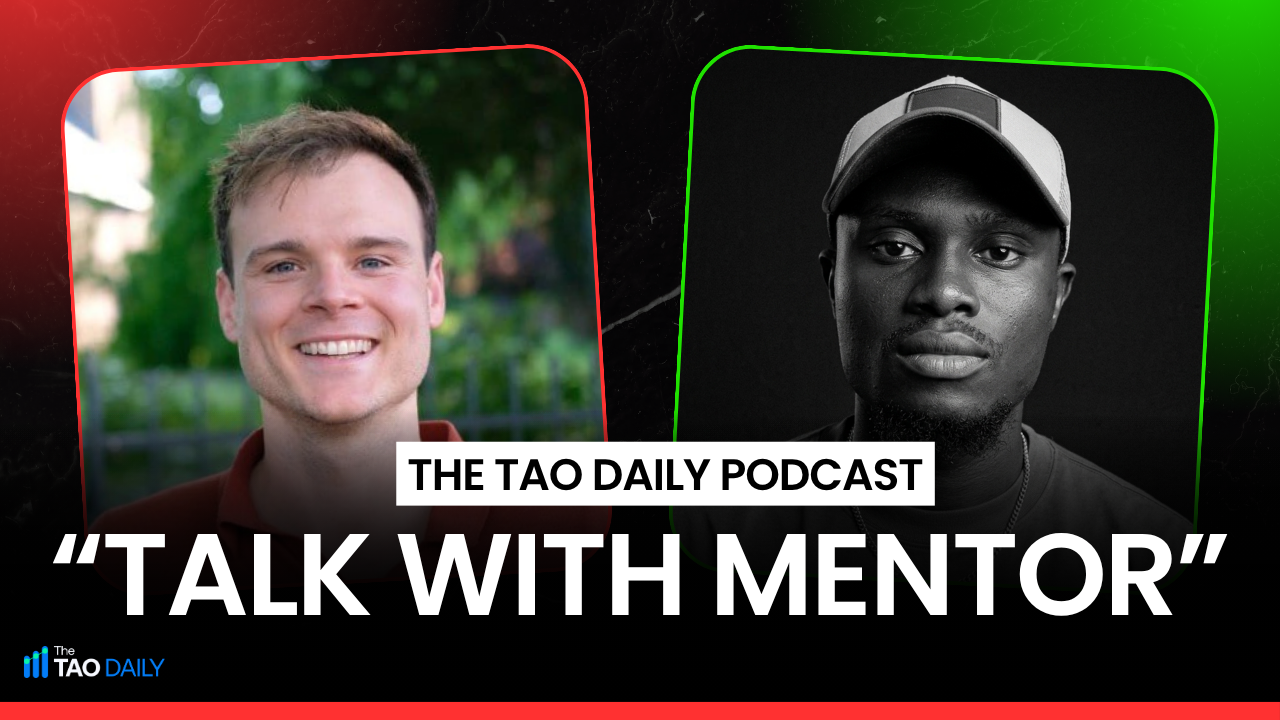
The TAO Daily team sat down with Mentor, one of the four original co-founders of TPN (SN65), to hear how a VPN became an LLM optimization network, and why the team is convinced this is the version that sticks.
Background: Ethereum kids who grew up on-chain
Mentor is a programmer with a background in biology and AI. He and his three co-founders came up through the Ethereum ecosystem, starting young, they were students at the time, and spent their formative years inside what was then the Bitcoin and Ethereum world.
Peep at Mentor’s LinkedIn here.
That early gave them something a lot of subnet builders don’t have: a deep, lived familiarity with multiple blockchains. Two of the co-founders, Mentor and Mikel, are brothers who’d always intended to work together. Bittensor became the place to do it.
“We have the benefit of having backgrounds in both Ethereum and the Polkadot ecosystem, on both the technical and the financial sides.”
They fell down the Bittensor rabbit hole about two and a half years ago when they decided they wanted to build together and went looking for the right place to start.
The pivot nobody planned
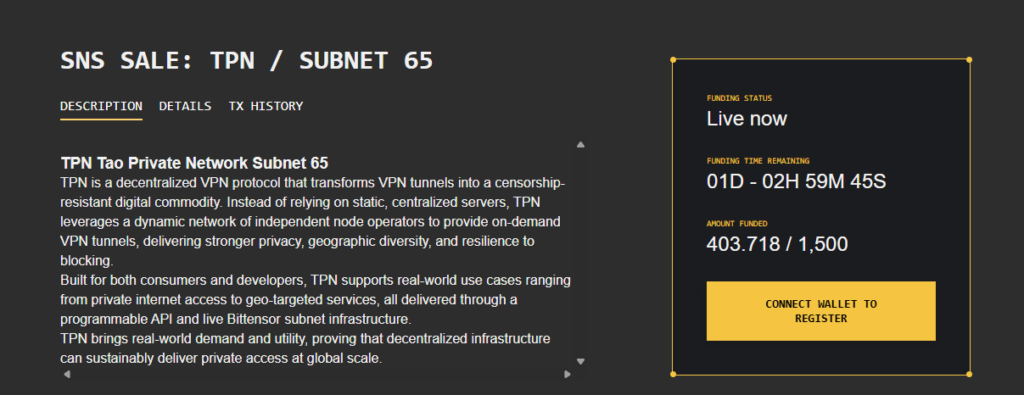
Here’s where the TPN story gets interesting. The subnet wasn’t supposed to be a VPN at all.
The team’s original product was Taofu, a fundraising platform that tokenized the owner’s share of subnets and let those tokenized shares be sold. To demo it, they spun up their own subnet, and because Mentor had a background in VPNs, they made it a VPN subnet. The fundraising platform never found product-market fit. The demo subnet, ironically, did.
“We did not specifically plan for having a VPN subnet. It was more of a demo for our previous product.”
Then, a couple of weeks before this interview, the subnet came close to deregistration. That brush with the edge turned into a strategic reset. The team had a decision to make: keep going with a VPN they’d never set out to build, let the slot deregister, or take what they had and turn it into something more Bittensor-aligned.
They had real assets worth protecting: a strong slot at Subnet 65, good liquidity, and the distinction of being one of the first subnets registered after the dTAO upgrade. So they chose option three. Looking at what they were genuinely excited about and actually good at, LLM compression rose to the top: fun for the team, and squarely within their competencies.
When asked what carries over from the old TPN, Mentor says, “Honestly, not much.”
“What carries over is basically the subnet slot and the liquidity. On a technical level, we’re deprecating the entire tech stack.”
For now, they plan to keep the TPN name, but now it means “TAO Performance Network”, rather than “TAO Private Network”.
The problem: you can’t predict what compression breaks
Mentor explains the mission in terms of decentralization and democratization.
Powerful LLMs are usually too big to run on phones or laptops. Established techniques like quantization can shrink a model down to run locally and privately: no internet, no one watching what you do, and depending on your hardware, fast.
The catch is the part nobody can shortcut. When you compress a model, you can’t know in advance how the compression will dent its abilities.
“You will not know whether it will lose 10% coding capacity and 20% poetry capacity. These are not things you can easily calculate beforehand.”
Quantization itself is cheap; you can do it on a laptop. The benchmarking is the expensive, heavy part, and it’s the only way to find out whether a compressed model still meets your requirements. So you end up quantizing a model several different ways and benchmarking each one until something clears the bar.
TPN’s job is to industrialize that loop. A user shows up with constraints, “I want this model to fit on an iPhone, and I care about question-answering, not coding”, picks a benchmark that reflects what they care about, and the subnet’s miners compete to find the best-compressed model for that exact use case.
What miners do on SN65
Miners are handed constraints, most importantly, the hardware a model has to run on, and compete to produce the best-optimized version under those limits.
At launch, that means quantization. But Mentor is quick to point out the difficulty isn’t the quantization itself; it’s quantization plus benchmarking plus hitting a specific hardware target with specific performance guarantees. Over time, the team plans to open the arena up to more advanced techniques like distillation, model merging, and beyond.
Crucially, TPN doesn’t tell miners how to optimize.
“The innovation will come from the miners, which is one of the strengths of Bittensor.”
That’s the whole point: don’t prescribe the method, just define the target and reward whoever gets closest.
Why this needs Bittensor
Mentor’s case for decentralization comes down to coordination. Bittensor is exceptionally good at organizing and paying people who don’t know each other and never will.
Model optimization is a problem where edges are scattered across the world. One person might have a PhD in exactly the right area. Another might live somewhere electricity is cheap enough to run benchmarking at a fraction of the cost. Pulling those disparate contributors together and paying them out is normally a logistical headache.
“Having a decentralized network like Bittensor that can hold competitions within subnets and automatically pay people out unlocks a coordination layer that would otherwise be rather impossible to achieve.”
Proof, benchmarks, and the collaboration angle
Asked about early results and competitors, Mentor says the revamped subnet is still being built, with a first version expected within a couple of weeks. There’s no specific rival they’re benchmarking against for now.
And TPN aims for collaboration within the ecosystem. Bittensor already has strong subnets handling inference, training, and fine-tuning. TPN wants to be another Lego block in that toolkit.
“We’re trying to become another Lego block in the toolkit of Bittensor that is useful and powerful in the AI ecosystem.”
Revenue, the alpha token, and shipping
When users pay to optimize a model under certain constraints, the intent is for that to flow back to the alpha token. They’re still working out the cleanest technical path: options on the table include buying and burning alpha, or doing something on the EVM layer where alpha could be locked, burned, or staked.
“There are many views, but we have a very clear intention to make sure that all the revenue actually goes to the alpha token.”
If there’s one thing Mentor wants the community to take on faith, it’s the team’s track record for execution. The VPN subnet, whatever its origins, proved they ship, and ship regularly. And the team, with their dual background, is comfortable both with the Polkadot SDK that Bittensor is built on and with the Ethereum languages behind the Bittensor EVM.
“As people know from our stint making the VPN subnet, we are very good at shipping. We hope we can keep that trust up in this new subnet form.”
What’s next
Over the weeks following the interview, TPN expects its revamped subnet to go live, focused first on quantization. In the weeks and months after, increasingly powerful optimization mechanisms get layered on.
The end state he describes is a kind of public utility for the ecosystem: anyone building or fine-tuning models comes to TPN to find an optimal quantization that keeps performance within their chosen benchmarks.
“We intend to become a building block in the Bittensor ecosystem where anyone who creates or fine-tunes models can come to find an optimal quantization that keeps performance within certain benchmarks.”
Check the subnet on X to follow all their updates.
Enjoyed this article? Join our newsletter
Get the latest TAO & Bittensor news straight to your inbox.
We respect your privacy. Unsubscribe anytime.
Enjoyed this article?
Join our newsletter
Get the latest TAO & Bittensor news straight to your inbox — every morning before markets open.


No comments yet — be the first.