

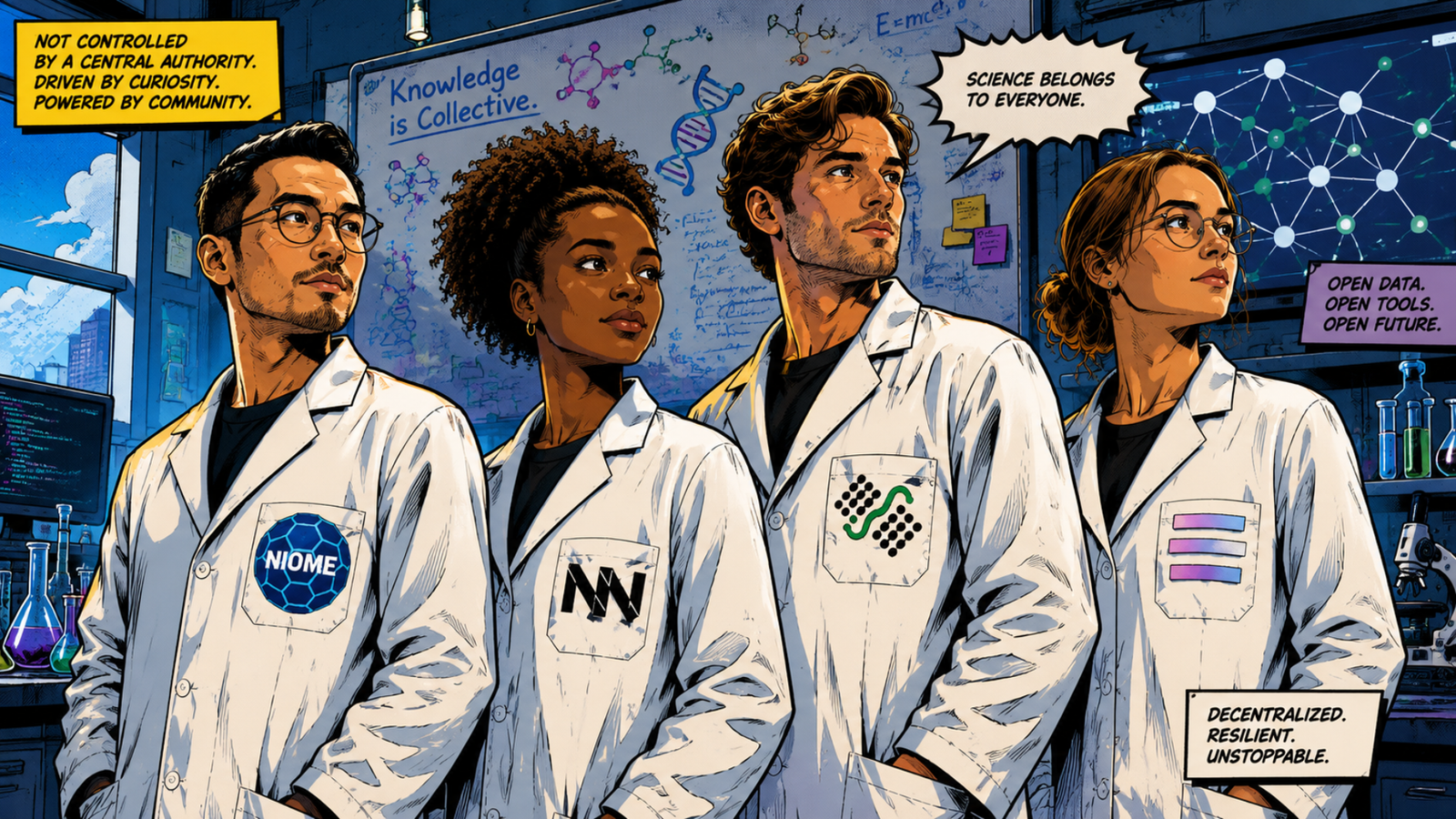
The gap between a promising molecule and an approved drug swallows more than a decade and billions of dollars, and most of that waste sits in the early search, long before a wet lab confirms anything. That search is exactly what Bittensor was built for, where miners attempt the same target, validators measure results, and the best work earns economic weight (and by extension, reward for ‘useful work done’).
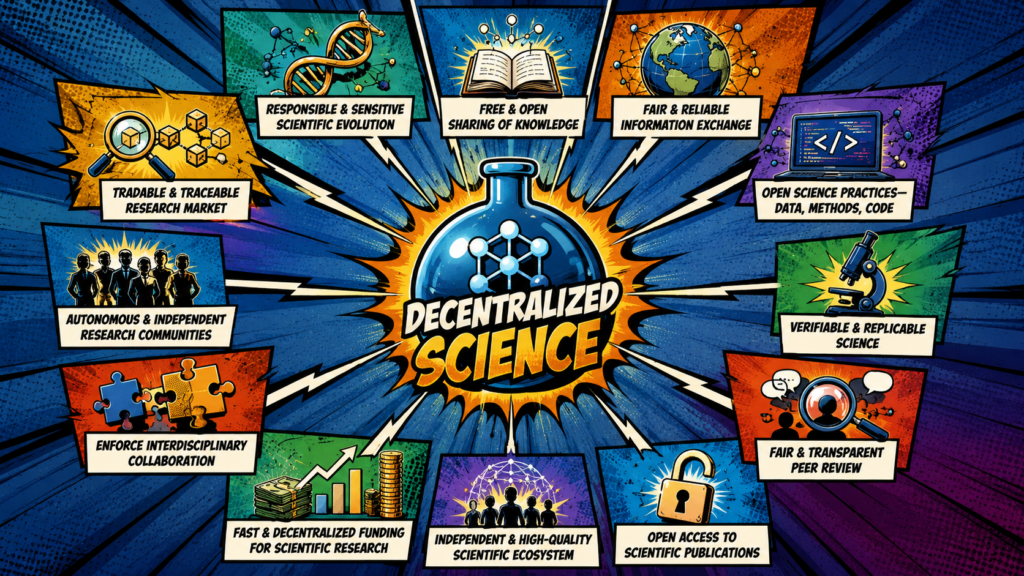
A clear DeSci basket has formed around four subnets doing measurable science rather than borrowing it as branding: NIOME (SN55), NOVA (SN68), Minos (SN107), and Claims (SN111). What decides whether any of them matters is not the token but whether their outputs reach researchers, biotech, and pharma outside the Bittensor ($TAO) circle.
The Search Economics That Make the Case
Pharma concentrates cost, talent, and data in a few hubs, funding labs and failures off one balance sheet. Bittensor attacks the computational search that happens before validation, with a different structure.
| Dimension | Traditional Pharma | Bittensor DeSci |
| Cost | One balance sheet | Distributed via emissions |
| Speed | Internal capacity | Parallel across miners |
| Exploration | What one team can test | Breadth is the point |
| Incentives | Salary, grants, milestones | Direct reward for scored output |
| Benchmarks | Private | Public, hidden-test verified |
| Failure risk | Held by the funder | Spread across the market |
The markets behind this dwarf the DeSci crypto category, which sits near $258 to $307 million today.
| Market | 2025 | Projected |
| AI in drug discovery | $2.35B | $13.77B by 2033 |
| AI in healthcare | $36.7B | $505.6B by 2033 |
| Genomics | $47.07B | $85.09B by 2030 |
| Precision medicine | $116.6B | $405.1B by 2033 |
The figures guarantee nothing, but they explain why capturing even a sliver of useful work would open markets across pharma, biotech, research tooling, and clinical software.
Four Subnets, Four Measurable Problems
Each subnet targets a task narrow enough to score and large enough to matter, and they read best against each other.
| Subnet | Task | Mechanism | Latest signal |
| NIOME (SN55) | Synthetic genomics | Generates synthetic DNA preserving structure, no real patient data | 100M+ datasets targeted by end of 2026 |
| NOVA (SN68) | Drug discovery search | Daily scored competitions across three tracks | Rewards up to $37K + $4K/day; Triple Crown |
| Minos (SN107) | Variant calling | Fresh genome every 72 min, hidden mutations scored vs ground truth | Chromosome 22 next; sub-20-min genome on 8 H200s |
| Claims (SN111) | Structuring literature | Miners extract, validators audit blind, hidden tests police validators | June 29 pipeline; goal of 300M papers |
Claims live or die on incentives, since rewarding shallow extraction turns the graph to junk while catching weak validators gives it a real data layer. NOVA is the easiest story for outsiders, with a live mechanism already paying $4,000 to $37,000 per track.
Minos may be the strongest pure mechanism, since hidden mutations plus validator execution close the loop tightly. NIOME has the right roadmap shape, though synthetic data only counts if it preserves structure researchers trust.
What Has to Go Right, and What Could Break
None of this replaces the pharma machine, and the risks are scientific before financial.
1. Quality: A subnet can produce huge output and still weak science.
2. Validation: Computational winners still need wet labs and outside review.
3. Incentive gaming: Score the wrong thing and miners learn the wrong game.
4. Revenue: Emissions start a market; external buyers decide if it becomes a business.
5. Trust: No pharma team treats an output as credible until method and validation are clear.
Research in that order: is the science real, does the mechanism resist gaming, would an outside buyer use the output, and only then check tools like Taostats, Taoswap, and SubnetRadar for indicators showing liquidity, emissions, and holder concentration. A strong thesis is still a bad entry if liquidity is thin or the narrative is already crowded.
The Bridge that Decides Everything
Bittensor DeSci is early, uneven, and full of execution risk, and its case rests on one crossing: from computational output to validated science someone outside crypto will pay for. It earns attention because the best subnets chose narrow, measurable tasks on real pain points, with Claims structuring the record, NOVA searching chemical space, Minos benchmarking variant calling, and NIOME building privacy-safe genomic data.
A pharma team will never care about an alpha token, but it might care about a cleaner candidate list or a safer dataset. Whether these four can deliver outputs that good is what separates a real scientific market from another narrative that priced in too much too early.
Enjoyed this article? Join our newsletter
Get the latest TAO & Bittensor news straight to your inbox.
We respect your privacy. Unsubscribe anytime.
Enjoyed this article?
Join our newsletter
Get the latest TAO & Bittensor news straight to your inbox — every morning before markets open.


No comments yet — be the first.