

In Bittensor, attention tends to flow toward emissions, narratives, and short-term momentum. Subnets rise and fall on hype cycles, and capital often follows visibility rather than structure.
But beneath all of that, there is a quieter and far more important question that rarely gets asked: Who actually controls the network?
This is the layer most dashboards ignore, and it is exactly where Taoswap is beginning to add real value.
A Familiar Interface, Now With Deeper Insight
Taoswap is a decentralized swap interface built for the Bittensor ecosystem. It allows users to:
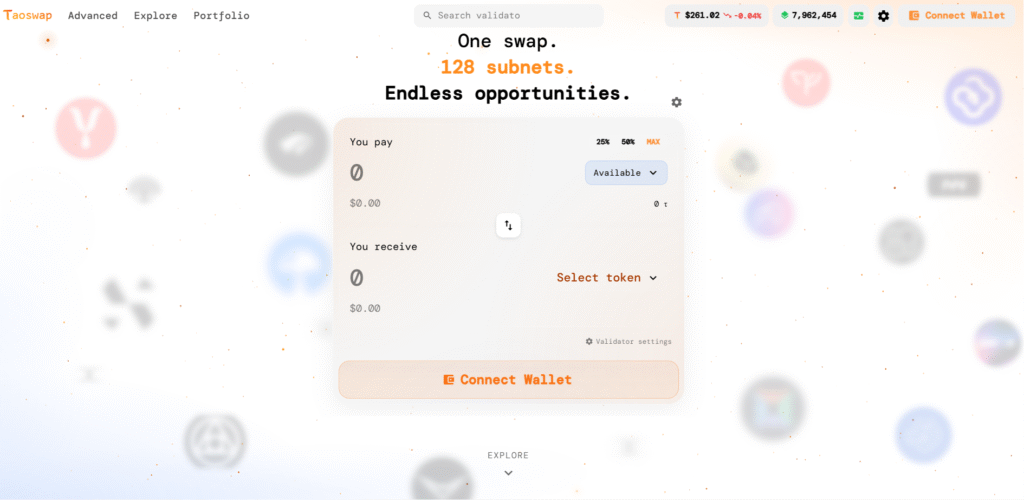
a. Swap $TAO and subnet $ALPHA tokens,
b. Stake across subnets,
c. Explore validators, and
d. Track and manage portfolio positions.
That alone already makes it a useful tool for navigating the ecosystem. But with the introduction of new analytics, Taoswap is moving beyond execution and into decision intelligence.
Introducing the Nakamoto Indicator
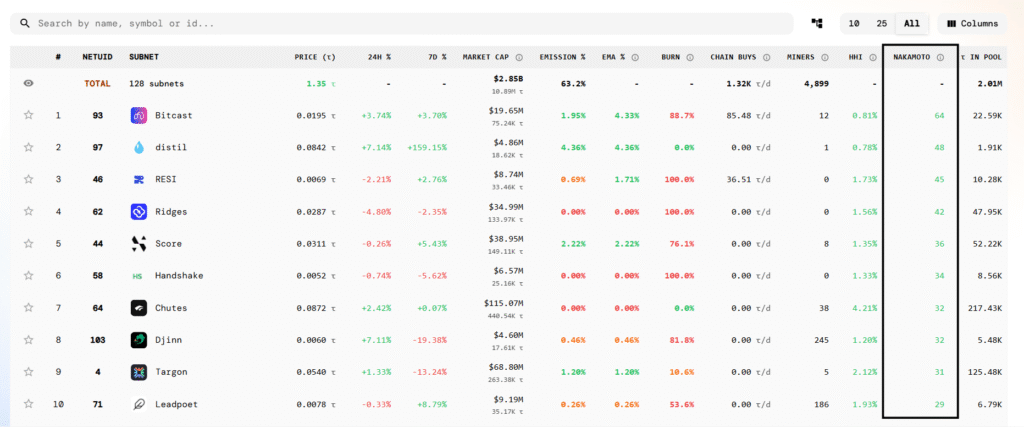
One of the most important additions is the Nakamoto Coefficient, a metric that highlights how distributed stake concentration is within a subnet.
Put simply:
a. It represents the minimum number of holders required to control more than 50% of the total stake,
b. A higher value means more decentralization, and
c. A lower value signals concentration and potential control risk.
This metric excludes burned stake from subnet owners, focusing purely on active distribution.
One standout datapoint in the snapshot above is a subnet (Bitcast – Bittensor Subnet 93) reporting a Nakamoto Coefficient of 64, which implies a relatively broad distribution of control. In practical terms, it would require coordination across dozens of independent holders to reach majority influence.
That is not just a number, it is a structural signal.
Understanding Stake Concentration With HHI
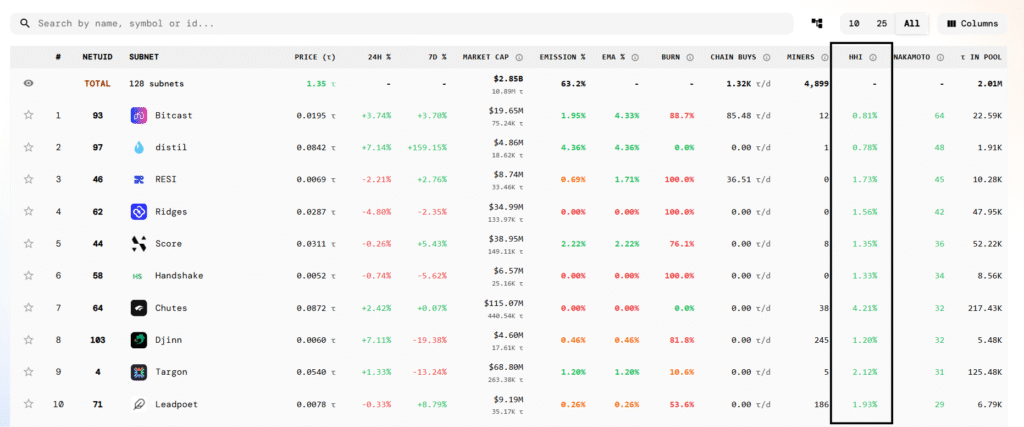
Alongside Nakamoto, Taoswap also surfaces the Herfindahl Hirschman Index (HHI), another widely used measure of concentration.
Here is how to think about it:
a. 0% indicates perfectly even distribution,
b. 100% means a single holder controls everything, and
c. Lower values reflect and implies a healthier spread of ownership.
Again, burned stake is excluded to ensure a clearer picture of active participants. A subnet showing an HHI of 0.82% suggests that stake is distributed across a wide base, with no single entity dominating the landscape.
Why These Metrics Matter More Than You Think
In many cases, users evaluate subnets based on:
a. Emissions,
b. Price performance, and
c. Narrative strength.
While useful, these signals often miss the underlying structure that determines long-term resilience. Metrics like Nakamoto and HHI introduce a different lens:
a. Governance risk becomes measurable,
b. Whale dominance becomes visible, and
c. Network resilience can be assessed more objectively.
A subnet with strong distribution is inherently harder to coordinate, manipulate, or take over. That has direct implications for both security and long-term sustainability.
A Subtle Shift in How Decisions Are Made
What Taoswap is doing here is not loud, but it is important. By embedding these indicators directly into the user experience, it shifts the conversation from “Which subnet is trending?” to “Which subnet is structurally sound?”
This shift matters because over time, capital tends to move toward systems that are not just active, but robust.
Conclusion: From Visibility to Understanding
Bittensor ($TAO) is evolving quickly, and with that growth comes increasing complexity. As more participants enter the ecosystem, the need for better tools becomes unavoidable.
Taoswap is starting to fill that gap, not by adding noise, but by surfacing the signals that actually matter.
Understanding who holds power, how it is distributed, and how resilient a subnet truly is, these are no longer niche concerns. They are becoming central to how informed participants navigate the network.
Quietly, tools like this are redefining what it means to do proper due diligence in Bittensor ($TAO).
Enjoyed this article? Join our newsletter
Get the latest TAO & Bittensor news straight to your inbox.
We respect your privacy. Unsubscribe anytime.
Enjoyed this article?
Join our newsletter
Get the latest TAO & Bittensor news straight to your inbox — every morning before markets open.


No comments yet — be the first.