


SubnetRadar is a free, community-built dashboard that aggregates every signal worth tracking across all 128 Bittensor subnets in one place.
It reads directly from the Bittensor chain, refreshes every 30 seconds, and converts subnet ‘$ALPHA’ token positions into live $TAO and fiat values without inventing numbers when data is missing.
The site has rapidly become the closest thing dTAO has to a Bloomberg terminal: health scores, flow data, Conviction locks, risk polygons, and researched subnet profiles all sitting side by side.
For anyone holding more than a single subnet position, the tool is starting to look mandatory.
The Wallet Tracker Turns Personal Exposure Into a Risk Map
The wallet page is the most practical part of the site. Paste in a wallet address or .tao name, and SubnetRadar reads the full stake map from the Bittensor chain.
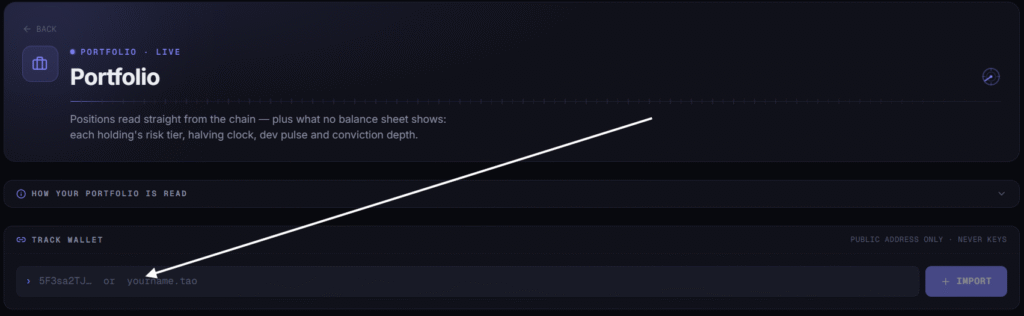
What it shows beside each position:
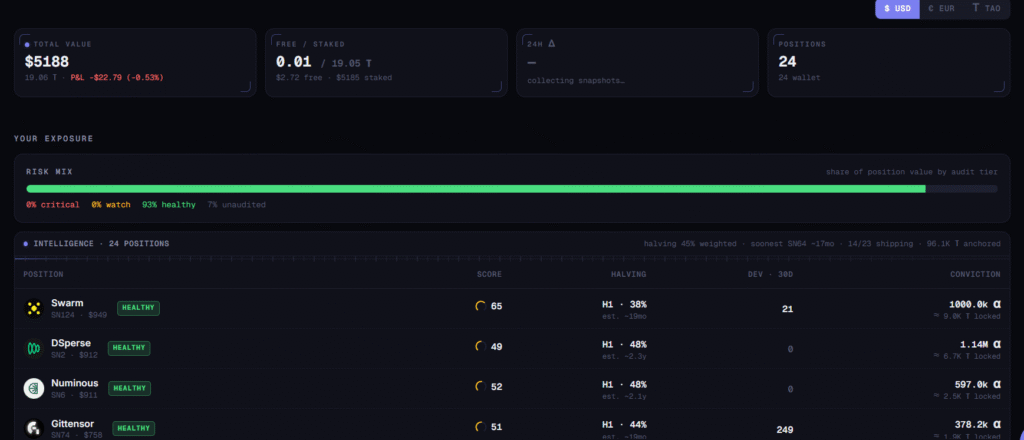
1. Risk Tier: Whether the position sits in a healthy, watchlist, critical, or unaudited subnet.
2. Alpha Score: A composite 0-100 ranking blending chain buys, momentum, dev velocity, health, and smart money signals.
3. Halving Progress: How deep the subnet is into its emission cycle.
4. 30-Day Dev. Activity: Whether the team is actually shipping code.
5. Conviction Depth: How much locked capital sits under the subnet.
6. Live $TAO and Fiat (USD & EUR) Value: $ALPHA converted via live pool price, $TAO converted via live spot price.
That changes how a portfolio looks; while balance is just a number, a position with risk tier, dev activity, halving progress, and conviction beside it becomes a profile. Holders can see whether their exposure leans healthy or critical, and whether the subnets they own are still building.
Chain reads cache every 30 seconds and serves stale up to 15 minutes while revalidating. When data is missing, the column shows blank rather than a guessed number.
The Top-Level Dashboard Reads the Whole Network at a Glance
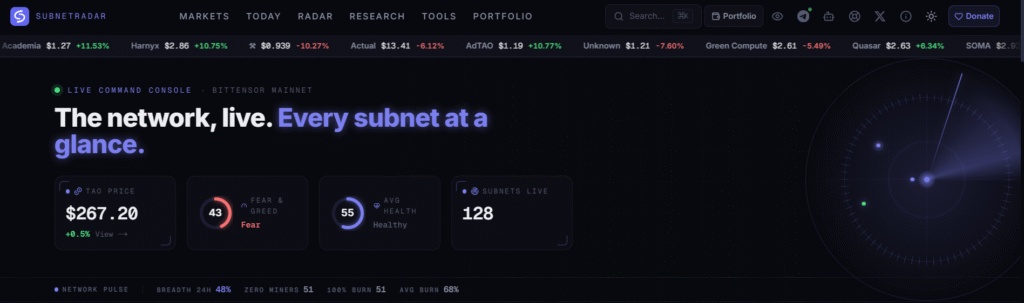
The homepage opens with a live command console covering the entire ecosystem:

1. $TAO price and 24-hour volume.
2. Average health across all 128 subnets.
3. Fear and Greed index.
4. Network market cap (roughly $1.28B across subnets).
5. Validator count, miner count, 100% burn count, average burn, and network breadth.
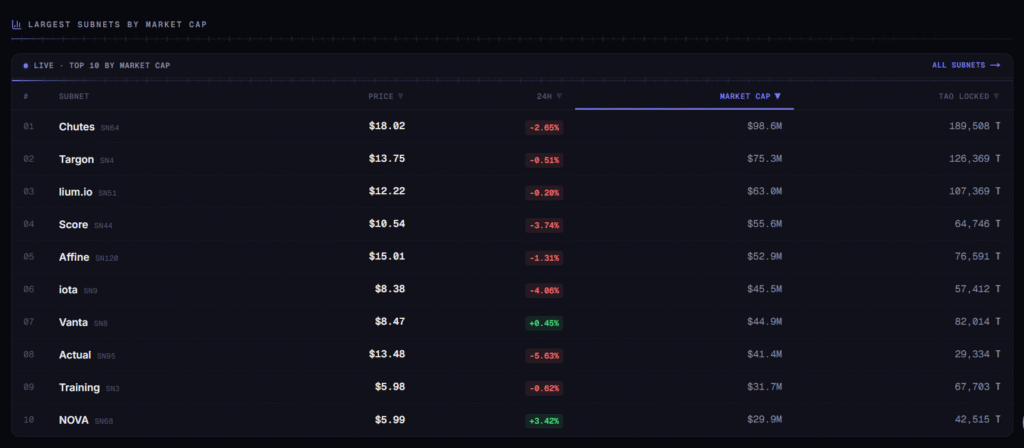
The market page ranks every subnet by $ALPHA market cap. The market cap is where capital has already assigned weight, but it does not say whether the subnet is still strengthening or quietly fading.
Health, Flow, and Risk Are the Three Structural Layers
The middle of the site is where serious subnet analysis starts. Three pages read the same network through different lenses.
1. Health
Looks at liquidity, network strength, emissions, growth, and development. One score per subnet. Vanta, Chutes, IOTA, Score, Liquidity, Actual, Lium, Nova, Ditto, Hone, Zeus, Bitmind, Almanac, and Ridges currently sit near the top.
2. Flow
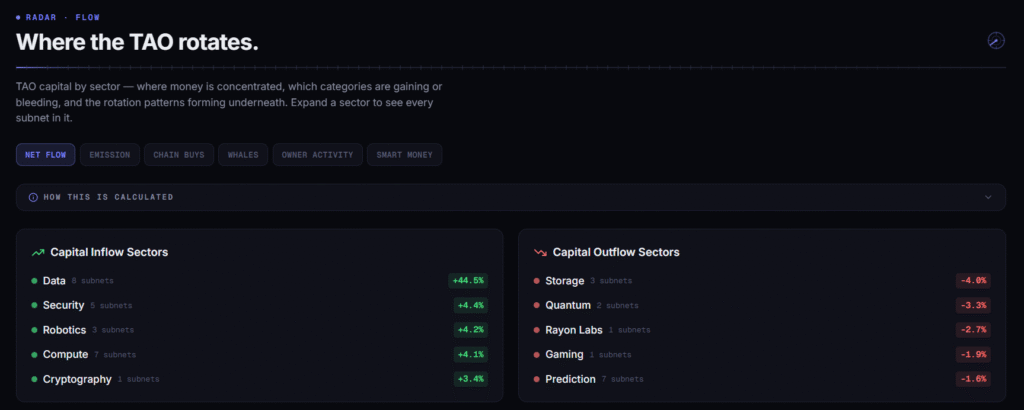
Shows where $TAO is rotating over the last 24 hours. The snapshot shows $TAO net inflow against $TAO net outflow, with a proportion of the subnets pulling in capital, and others bleeding out. That asymmetry is what dTAO is designed to expose.
3. Risk
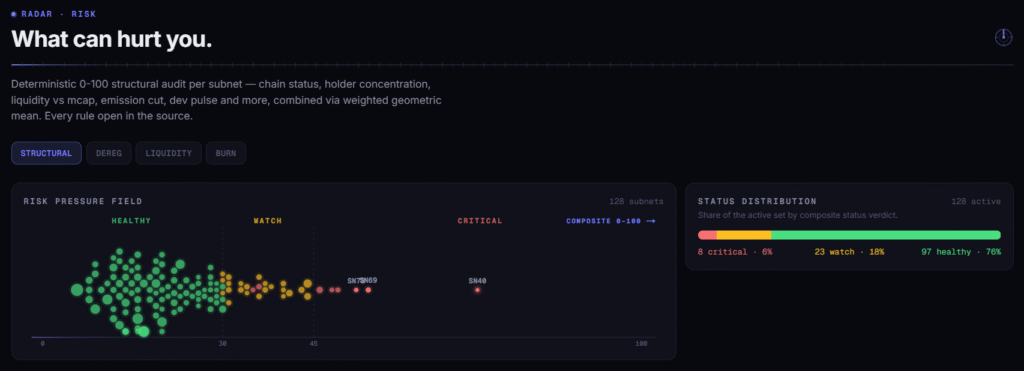
Reads structural red flags: thin liquidity, weak dev activity, emission issues, momentum problems, poor health, and low conviction. The page does not declare a subnet bad, it flags where the market should ask harder questions.
The three pages do not agree by design. A subnet can be high-health and low-flow at the same time, also, a subnet can be high-risk and high-momentum. The point is to compare signals, not pick one.
Conviction Is the Most Important New Signal in dTAO
Conviction tracks on-chain commitment. Lockers commit $ALPHA to a hotkey, the conviction grows over time, and it decays only through visible unlock events. The wallet with the highest conviction on any subnet becomes the Subnet King.
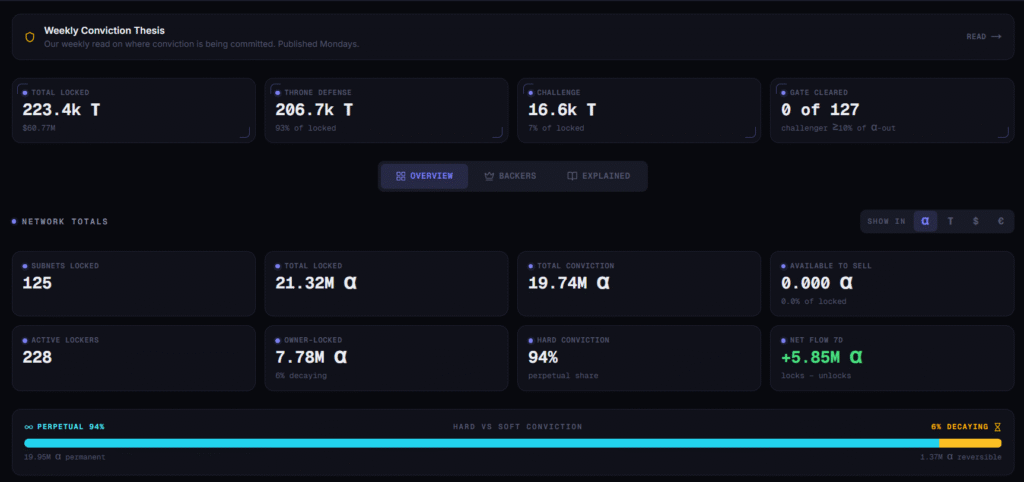
The current state of the network:
1. Roughly 222.4k $TAO worth of conviction. Approximately $57M of locked capital.
2. 93% in throne defense. The largest current holders are reinforcing their positions.
3. 7% in challenges. New entrants attempting to take subnet kingships.
This is what separates traders from holders. Anyone can buy a pump. Locking capital with time pressure attached is harder to fake.
High conviction does not automatically mean a subnet is good (sometimes it just means insiders are defending hard), but high conviction combined with strong health, healthy flow, low risk, and real product is the cleanest bull signal SubnetRadar surfaces.
Power Rankings, the Composite Score, and the Research Layer
Three more pages round out the toolkit.
1. Power Rankings are a pressure gauge for which subnets are firing right now. The page uses chain-verifiable inputs: dev velocity, smart-money flow, emission income, price momentum, and a conviction bonus.
In Investing mode, the weights are 40% dev, 25% emissions, 20% smart money, and 15% momentum, plus the conviction bonus. The latest snapshot put Liquidity, Say GM, OneOneOne, Almanac, Poker44, Soma, an Unknown subnet, CliqueAI, Actual, and IOTA near the top.
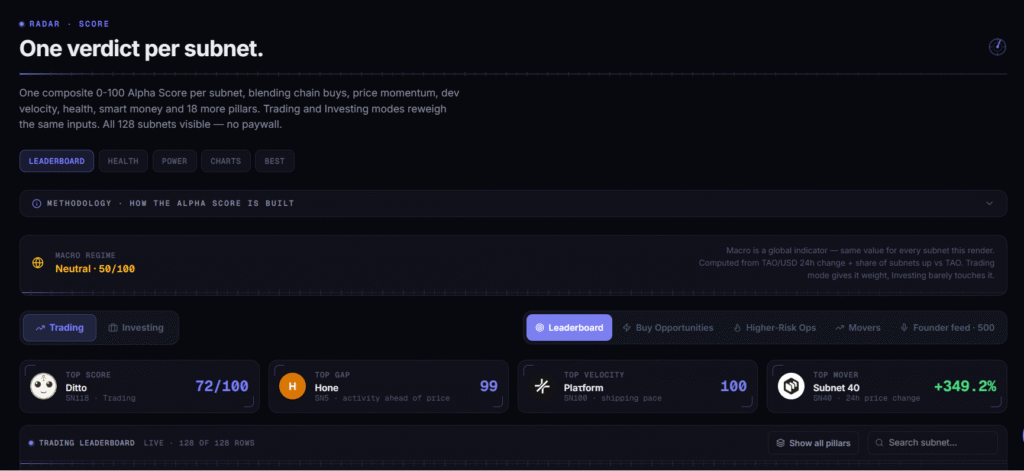
2. The Leaderboard publishes a single 0-100 Alpha Score per subnet blending all the underlying pillars. It is useful as a starting point but not as a final answer.
The edge is in asking why a subnet is ranked where it is.
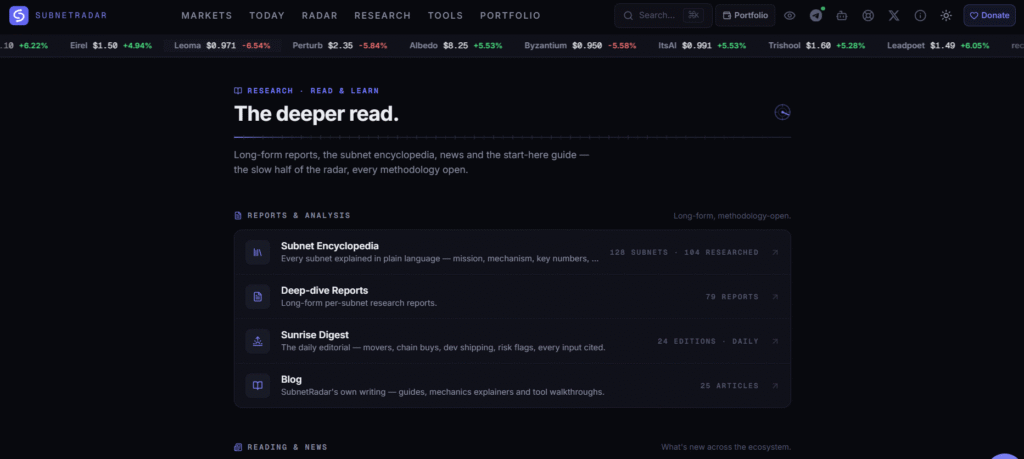
3. The Research Section is a plain-language encyclopedia covering every subnet. Profiles are built from official sources like websites, GitHub, docs, and team posts, rewritten in SubnetRadar’s own words, with sources listed. Self-submitted descriptions are kept separate from researched ones. Categories include compute, inference, training, agents, data, DeFi, DeSci, detection, security, trading, storage, robotics, prediction, and infrastructure.
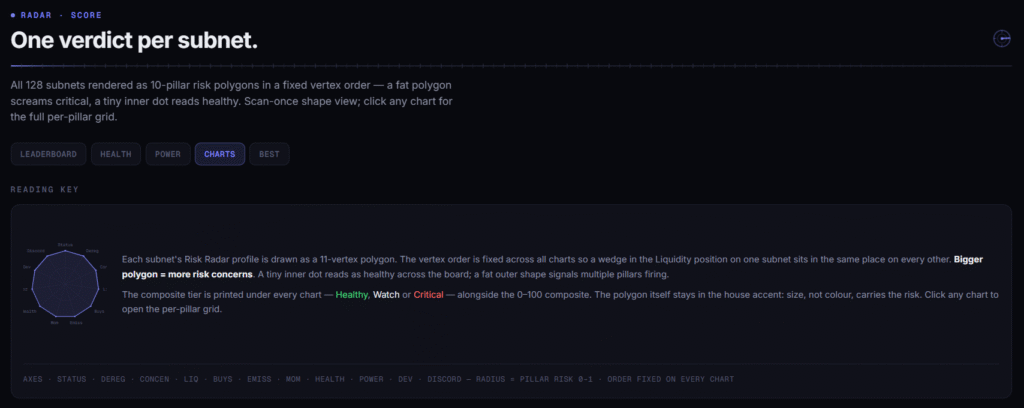
The Charts page sits beside these, plotting every subnet as a risk polygon: small inner shape means cleaner, fat outer shape means more risk concerns are firing across liquidity, development, community, deregistration, conviction, chain buys, emission, momentum, health, and status. That is how 128 subnets become scannable in one view.
How to Actually Use It
The recommended workflow stacks the signals rather than relying on any single page:
1. Start with Health: Is the subnet structurally strong?
2. Check Flow: Is $TAO rotating in or out?
3. Check Risk: Are red flags firing?
4. Check Lock (Conviction): Is committed capital actually present?
5. Check Power: Is the subnet building, earning emissions, and attracting smart money?
6. Check Research: Does the reader actually understand what the subnet does?
7. Check Market Cap: Is the valuation reasonable for what is being built?
The order matters because each layer surfaces a different question: Health is structure, Flow is attention, Risk is warning lights, Conviction is commitment, Power is momentum, Research is comprehension, and Market cap is pricing.
Skipping any of them is how people get caught long on subnets that look strong in one dimension and weak in five others.
The Visibility Play
dTAO has always had the problem that the network is too complex to follow casually. 128 subnets, different categories, different emissions, different teams, different products, different risk profiles.
Without good dashboards, the market gets mispriced and the loudest narrative wins. SubnetRadar turns that complexity into something readable: every subnet has a health score, a flow direction, a risk polygon, a conviction depth, a Power Ranking, and a research profile. The market still has to do the work, but the inputs are now public and chain-verified rather than scraped from Twitter threads.
If $TAO is going to function as the reserve asset of a decentralized intelligence economy, the network needs measurement infrastructure to decide which subnets deserve capital and which do not. SubnetRadar is one of the cleanest pieces of that infrastructure shipped to date.
➛ Immerse Yourself in SubnetRadar and View Other Important Tools It Has To Offer Here
Enjoyed this article? Join our newsletter
Get the latest TAO & Bittensor news straight to your inbox.
We respect your privacy. Unsubscribe anytime.
Enjoyed this article?
Join our newsletter
Get the latest TAO & Bittensor news straight to your inbox — every morning before markets open.


No comments yet — be the first.