

This week, the Genomes.io team hosted a community Space focused on NIOME (Subnet 55 on Bittensor) to clarify what the project is, how it sits relative to its parent company, and how the migration from GENOME to NIOME is being structured.
The conversation pulled together the bio data security crisis driving the project, the synthesis premise underneath it, and the operational realities of running a Bittensor subnet that emerged from an already-operating company.
Highlights From the Conversation
The discussion ran from the broader bio data hacking crisis through to the mechanics of the GENOME-to-NIOME migration and the case for synthesizing bio data rather than transferring it. The points worth pulling out are below:
a. BIO DATA IS ONE OF THE MOST ACTIVELY BREACHED CATEGORIES OF PERSONAL INFORMATION ON THE INTERNET.
The numbers shared during the Space were hard to ignore: 133 million people had health data compromised in 2023, 185 million in 2024, and the UK Biobank was breached recently with records on more than 500,000 individuals surfacing on a Chinese dark web forum.
The trajectory is not flattening, and the question of how the industry handles bio data inside AI systems is becoming structurally urgent.
b. NIOME IS SUBNET 55 ON BITTENSOR AND HAS BEEN LIVE SINCE THE START OF MARCH
The team described NIOME as the synthetic bio data layer for the AI era: a project building artificial datasets that preserve the statistical and structural properties of real bio records while stripping out the privacy, security, and regulatory exposure that comes with the originals.
c. THE SUBNET STARTED IN GENOMICS AND NOW SPANS THE WIDER MULTI-OMICS UNIVERSE
The scope covers genomics, microbiome, virome, and adjacent fields under the same naming convention. Genomics was the entry point because the founding team built Genomes.io there, but the broader thesis covers any bio data category that needs to participate in AI without being directly transferred.
d. THE SYNTHESIS PREMISE RESTS ON THREE CONNECTED ARGUMENTS
First, synthesized data is materially safer than live data because there is no real record to leak. Second, decentralized AI is more transparent than centralized AI because developers, validators, and infrastructure are visible on-chain. Third, companies holding sensitive bio data can participate in AI and monetize their data without compromising their privacy posture.
e. THE BACKING IS CREDIBLE AND BITTENSOR-ALIGNED
NIOME is supported by DCG’s Yuma, Pantera Capital (which originally suggested the team open a subnet), and Modular Capital.
The subnet also operates as a formal partner of AMD, using AMD’s SEV encryption stack as part of its security architecture.
f. NIOME HOLDS A RARE DISTINCTION AMONG BITTENSOR SUBNETS
It is one of the few subnets operating under an official government partnership, a relationship the team described as actively producing inbound funding ideas and prospective client introductions.
g. THE PROJECT IS AN EXTENSION OF GENOMES.IO RATHER THAN A CLEAN-SLATE LAUNCH.
Genomes.io is a decentralized vault infrastructure that lets individuals store their genomic data privately and equitably, with notifications when their data is queried and compensation when access is granted. The platform has roughly 10,000 users today and operates as a profitable business.
h. THE PIVOT TO NIOME WAS TRIGGERED BY A SPECIFIC DECISION
An AI company approached Genomes.io with a proposal to dissolve the vault infrastructure, hand over the underlying datasets, and accept a one-time payment in return.
The team declined, recognizing that the proposal violated the ethos the company was built on and reproduced the same security exposures that drive the breaches the project exists to prevent. That moment crystallized the case for a synthesis layer rather than a data transfer layer.
i. REAL-WORLD ADOPTION IS BEING PRIORITIZED OVER CRYPTO-NATIVE MARKETING
NIOME is operating with active pharma and research clients, and the first NIOME Summit is scheduled for June 4 in Aberdeen. This is organized around real adoption stories from the client roster rather than ecosystem positioning.
j. THE ROADMAP IS STRUCTURED RATHER THAN NARRATIVE
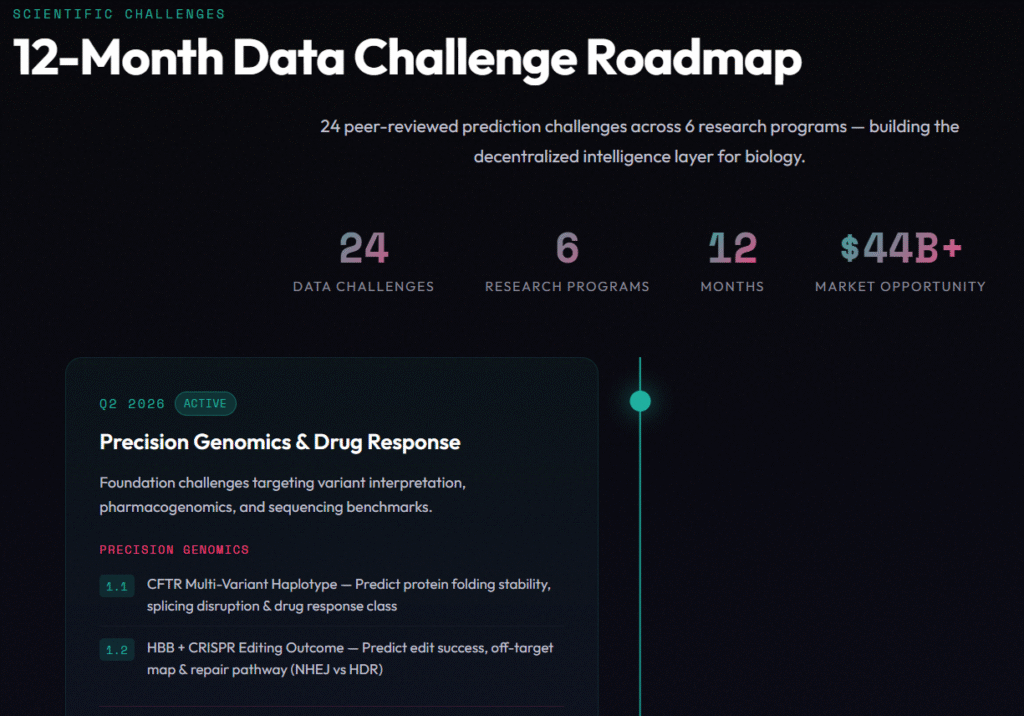
The team is operating against 24 distinct challenges across six research fields, organized into quarterly blocks throughout the year, with active miner participation in validation and execution.
Why This Matters
What separates NIOME from the average Bittensor subnet is that it did not begin life inside the crypto cycle. The team has been building the underlying business for eight years, has paying users, a profitable parent company, and a problem that exists with or without crypto. This created an urgent need for a way to put bio data to work in AI systems without exposing it to the same breach risk that has compromised hundreds of millions of records over the past two years.
NIOME is the architectural answer to that problem, packaged as a subnet because the synthesis layer benefits from the transparency, miner competition, and incentive alignment that Bittensor provides.
The risks remain that the migration timeline remains tied to subnet performance, the synthetic data category is still being validated at enterprise scale, and the competition for pharma and research budgets includes far larger and more entrenched providers.
But the signals worth tracking from here are clear: Migration pool growth, post-Summit client momentum, and the rate at which the synthesis product moves from pilots into recurring contracts. If those signals trend in the right direction, NIOME is on track to be one of the more substantive applied-AI subnets on Bittensor, and one of the few with a path to enterprise revenue that does not depend on crypto market conditions to validate it.
Enjoyed this article? Join our newsletter
Get the latest TAO & Bittensor news straight to your inbox.
We respect your privacy. Unsubscribe anytime.
Enjoyed this article?
Join our newsletter
Get the latest TAO & Bittensor news straight to your inbox — every morning before markets open.


[…] Yuma’s Subnet Spotlight, Aldo de Pape, founder of NIOME (SN55) and Genomes, talked extensively about SN55’s […]