

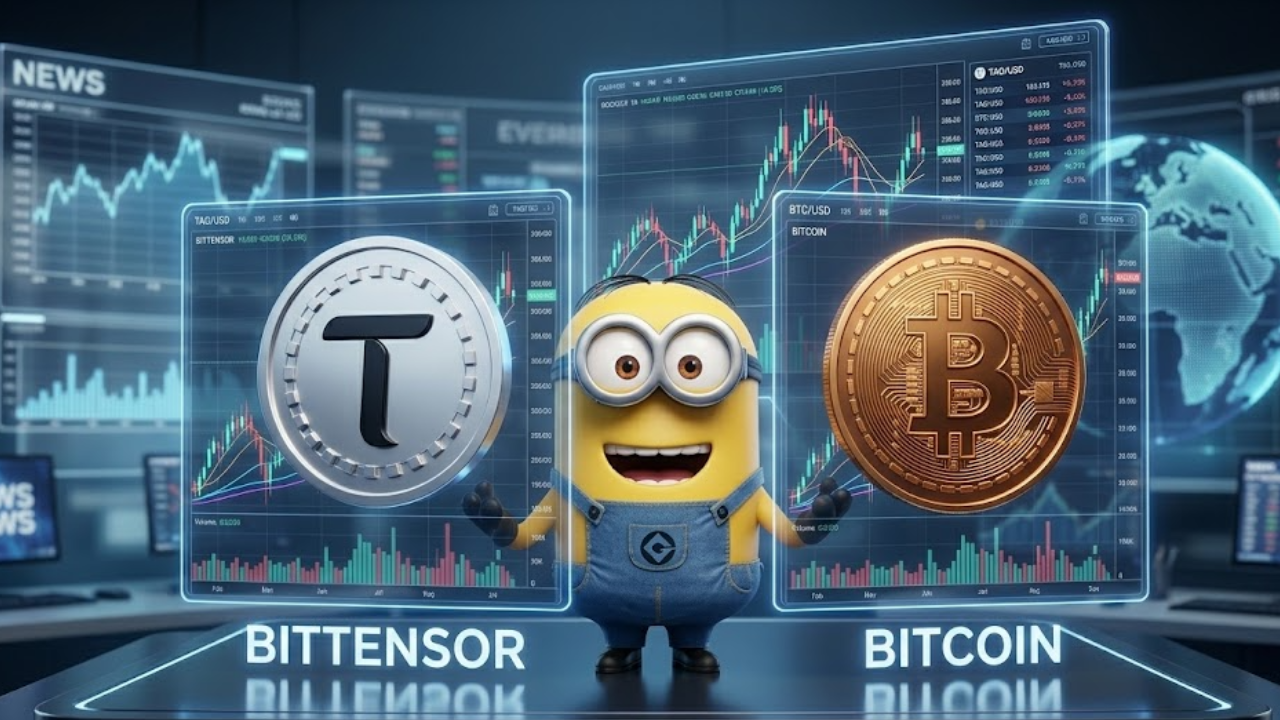
Bitcoin miners generated $17.2 billion in revenue in 2025 and consumed roughly the same amount of electricity as the entire country of Poland to do it. The compute itself produced nothing beyond solving abstract mathematical puzzles to confirm transactions: No scientific output, no intelligence, no commercial product.
The energy was real, the cost was real, and the output ended at “transaction confirmed.” Bittensor looked at that model and asked the obvious question that almost no one had asked seriously before: What if the same incentive design that turned Bitcoin into a global compute network were pointed at something productive instead?
The Core Mechanism Behind $TAO
The answer is a network where mining produces machine intelligence rather than hashes, and where the reward layer is built on the same scarcity principles that made Bitcoin a generational asset:
a. Miners are AI researchers, ML engineers, and data scientists who compete to produce the most valuable model outputs across specialized tasks
b. Validators evaluate quality through the Yuma Consensus algorithm, with rewards flowing toward whoever is producing genuinely useful work
c. 120+ subnets are live today, covering trading signals, language model training, computer vision, code generation, financial forecasting, and more
d. $TAO mirrors $BTC’s tokenomics almost exactly, with a 21 million supply cap, no pre-mine, no VC allocation, and four-year halving cycles
e. The first halving occurred on December 14, 2025, cutting daily emissions in half and setting up the same supply pressure dynamic that drove Bitcoin’s 83x rally in the year following its first halving
The structural similarity to Bitcoin is what makes the comparison serious, but the productive output is what makes TAO a different category of asset entirely.
Why the Smart Money Is Already Positioned
The investors who positioned early in Bitcoin and Ethereum are increasingly visible in TAO, which is one of the cleanest signals available about how the next cycle is shaping up:
a. Barry Silbert, founder of DCG and the firm behind early bets on Bitcoin, Ethereum, Zcash, and Coinbase, has launched Yuma Group as a dedicated subsidiary focused exclusively on accelerating Bittensor adoption.
b. Grayscale holds $TAO in its Decentralized AI Fund and has filed with the SEC to convert the GTAO Trust into a spot ETF, following the same regulatory pathway Bitcoin used.
c. Stillcore Capital, led by Rob Greer, Mark Jeffrey, and Jason Calacanis, is targeting ownership of 1% of all $TAO in existence and projects a $1 trillion TAO market cap by 2030.
d. Jason Calacanis, the angel who turned $25,000 into $100 million on Uber, has personally allocated close to a million dollars to TAO and is publicly calling for a 200x return over five to ten years.
e. Unsupervised Capital projects $TAO will reach $4,800 by December 2027, with a bull case extending to $10,800, and that analysis was completed before the Covenant-72B moment, before Jensen Huang publicly acknowledged Bittensor, and before PwC France signed its formal alliance with a subnet.
The pattern is consistent, and the investors who saw Bitcoin ($BTC) and Ethereum ($ETH) early are the ones now actively building positions in $TAO.
The Subnets Doing Real Work
What separates $TAO from speculative AI tokens is that the underlying subnets are shipping genuine products with real users, real revenue, and real enterprise partnerships. The most consequential ones include:
a. Targon (SN4)
A decentralized, cost-efficient alternative to AWS and Azure for running AI workloads. The SN4’s Targon Virtual Machine (TVM) uses encryption and hardware-backed protection so developers can run sensitive workloads on untrusted hosts, and the team co-authored a confidential compute paper with Intel earlier this year. Already powers Dippy AI’s backend, serving over 8 million users.
b. Vanta (SN8)
A decentralized prop trading firm where traders pay a single evaluation fee, keep 100% of their profits, and have every metric verifiable on-chain.
Vanta turned net profitable on fee revenue versus emissions last month, with 8% returns this year against a 1% drawdown across its index of top traders.
c. Chutes (SN64)
A serverless AI compute platform that lets developers deploy and scale any open-source model at significantly lower cost than AWS.
Currently the number one open source provider on OpenRouter, with over 9.1 trillion tokens processed.
d. RESI (SN46)
An institutional-grade intelligence layer for the $600 trillion global real estate market, delivering remote appraisals at over 98% accuracy.
Closed its first week with 1,000+ appraisals, 120 portal users, and a nationwide lender partnership already signed.
e. Affine (SN120)
Built by Jacob ‘Const’ Steeves, the co-founder of Bittensor and the original author of the $TAO whitepaper. Runs continuous evaluations to identify and fine-tune the best open-source reasoning models, with model hosting routed through Chutes to create a direct value loop between subnets.
f. TAO.com
The access layer for the entire ecosystem, functioning as the most intuitive mobile wallet for buying, holding, staking $TAO, and swapping into subnet ‘$ALPHA’ tokens. Holds one of three multisig keys for ecosystem-level network changes, with Android support launching soon.
g. Honorable Mentions
Score (SN44), the computer vision subnet that just signed a formal alliance with PwC France, distributing its Manako product across PwC’s $60 billion network spanning 137 countries.
Oro (SN15), the autonomous shopping agents subnet whose 45 agents have already outperformed GPT 5.4 on one of the hardest online shopping evaluations to date.
Why the Templar Drama Is the Wrong Thing to Focus On
The Templar incident in April produced the most volatile moment in $TAO’s recent history when its founder exited the ecosystem and dumped roughly $10 million worth of $TAO. The community response is what actually matters, and it has been substantively stronger than the initial dump suggested.
a. Every maturing crypto ecosystem has had its black swan moment. Solana survived FTX. Ethereum survived the DAO hack. The pattern is consistent: bad actors emerge, the ecosystem responds, and the protocol either strengthens or collapses
b. Const’s response was immediate. The Locked Stake mechanism, Conviction, is now being introduced to strengthen subnet ownership and decentralization, addressing the structural gap the Templar exit exposed
c. The covenant-72B model itself remains intact. A 72-billion-parameter model trained on 70+ home GPUs without a data center is one of the most significant technical achievements in decentralized AI, and that work continues under the Teutonic rebrand
d. The community has emerged more rigorous, not less. The post-Templar conversation has driven more demand for accountability, more pressure on subnet owners, and more attention to fundamentals across the network
The episode tested the ecosystem and the ecosystem held. That is the signal worth tracking.
The Asymmetry Worth Sitting With
$TAO currently trades at roughly a $3 billion market cap, OpenAI raised 13x that amount in a single round and is targeting a trillion-dollar IPO. The subnets producing real revenue on Bittensor today, partnering with Intel and PwC, serving millions of users across multiple categories, are doing genuine work in markets that collectively add up to tens of trillions of dollars.
The gap between what has been built and how it is currently priced is one of the most asymmetric setups in crypto right now.
Every major technology shift in modern history has started centralized and ended open: Bitcoin proved decentralized money was viable, Ethereum proved decentralized applications were viable, and TAO is doing the same work for intelligence itself, and the smart money has already made the connection.
Bitcoin was money, Ethereum was apps, and Bittensor is intelligence (and it is still early!)
Enjoyed this article? Join our newsletter
Get the latest TAO & Bittensor news straight to your inbox.
We respect your privacy. Unsubscribe anytime.
Enjoyed this article?
Join our newsletter
Get the latest TAO & Bittensor news straight to your inbox — every morning before markets open.
No comments yet — be the first.