

Most conversations about AI and healthcare get stuck on the same paradox. The data needed to advance personalized medicine is among the most sensitive information any human being possesses, and the institutions currently holding it have proven, repeatedly, that they cannot keep it safe.
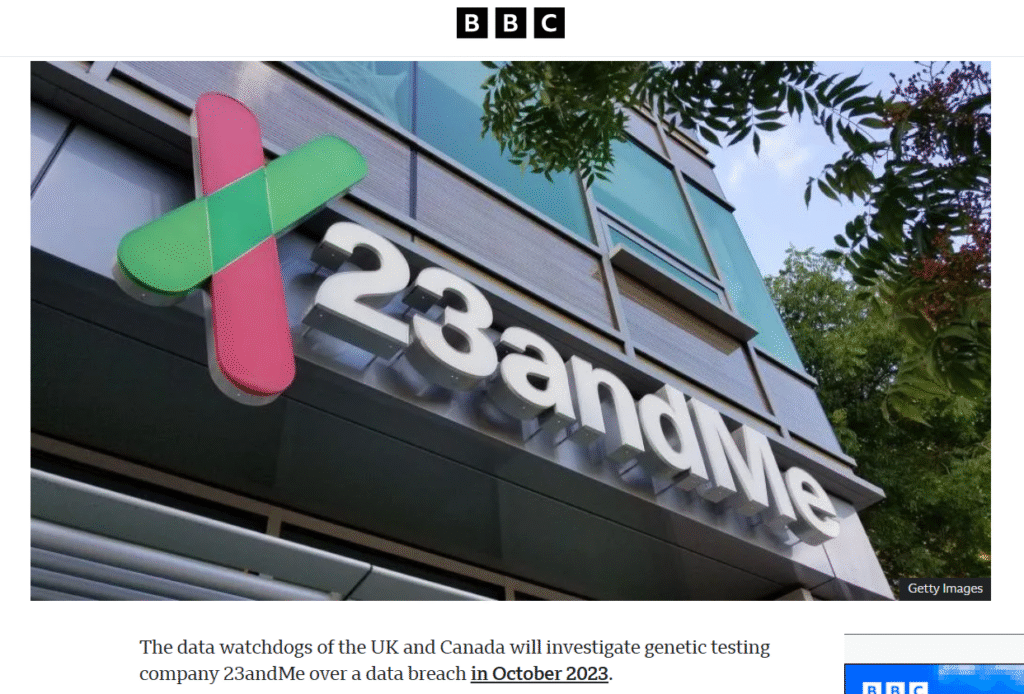
The UK Biobank was hacked just weeks before this episode aired, with British citizens’ biological data ending up on Chinese dark web forums. 23andMe lost over 6.7 million user records in 2023 and eventually filed for bankruptcy. The pattern is not theoretical, and it is not slowing down.
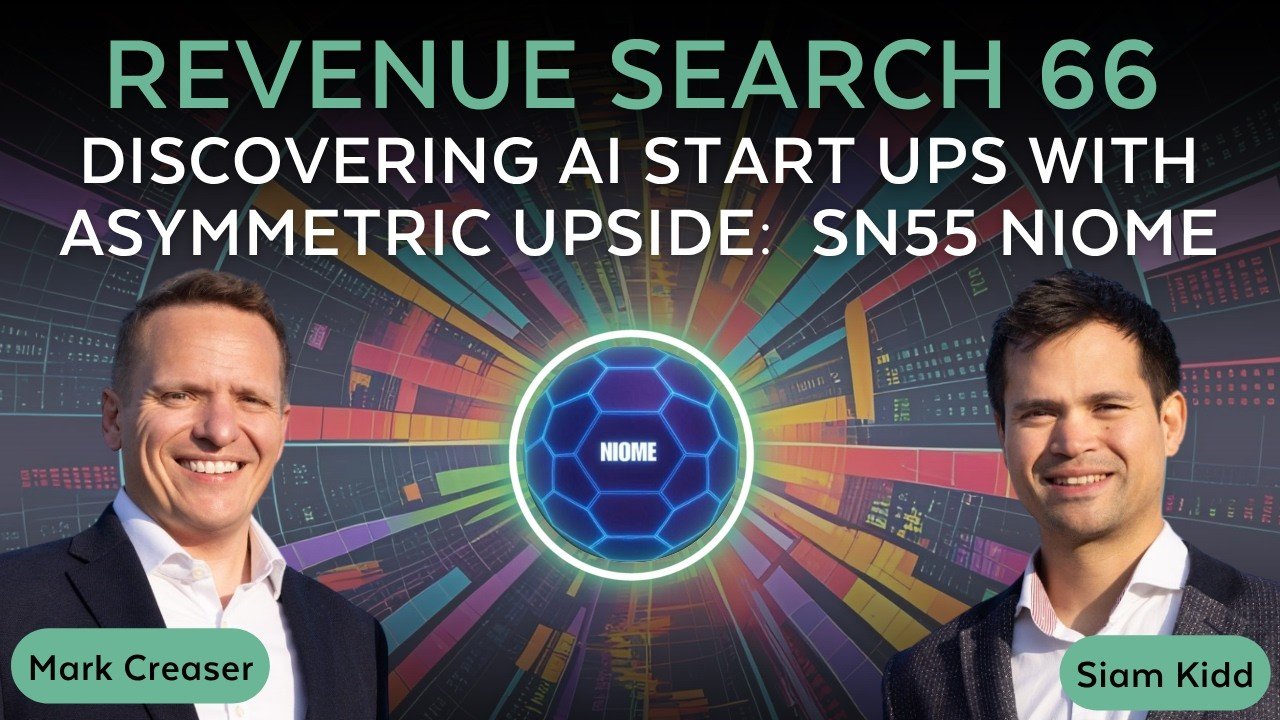
On Episode 66 of Bittensor Revenue Search, hosted by Siam Kidd and Mark Creaser, Aldo de Pape, founder of NIOME (Bittensor Subnet 55) and CEO of Genomes.io, walked through why decentralized, synthesized genomic data is the only realistic answer to a problem the broader industry has been failing at for years.
Snippets From the Conversation
What follows are the points worth pulling out from the conversation, distilled from the perspective of someone who has been working on the genomic safety problem since 2018 and recently brought that work onto Bittensor as a structured, incentive-driven subnet.
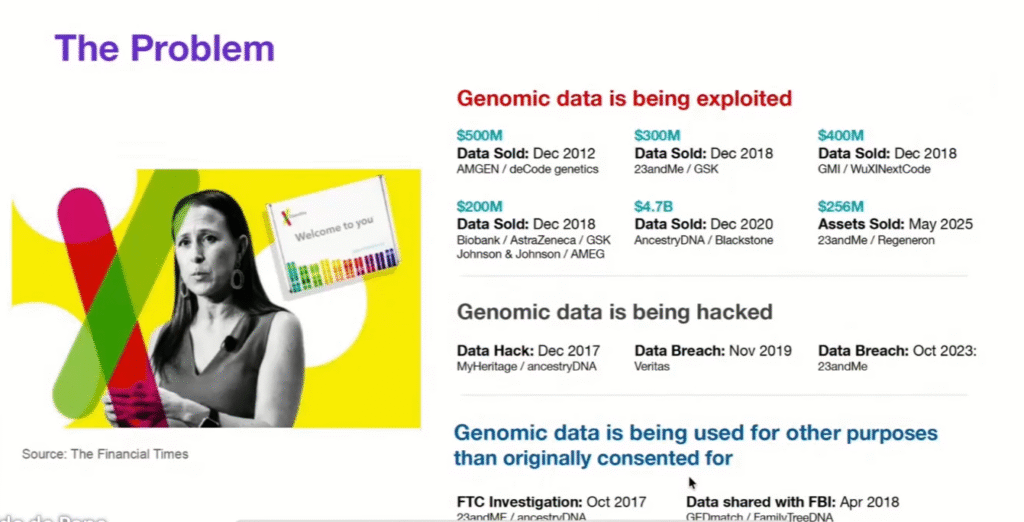
a. The Genomic Data Problem is Structural: In 2023, over 133 million people had their bio data hacked. That number climbed to 185 million in 2024.
The hospitals, pharmaceutical companies, and life insurers aggregating this data are well-intentioned but fundamentally outpaced on cybersecurity, and the gap is widening rather than closing.
b. Compliance is Not the Same as Security: Aldo flagged a distinction most institutions get wrong, particularly in Europe. GDPR (General Data Protection Regulation) addresses privacy law, not cyber resilience, and conflating the two is part of why so many breaches keep happening despite organizations believing they are protected.
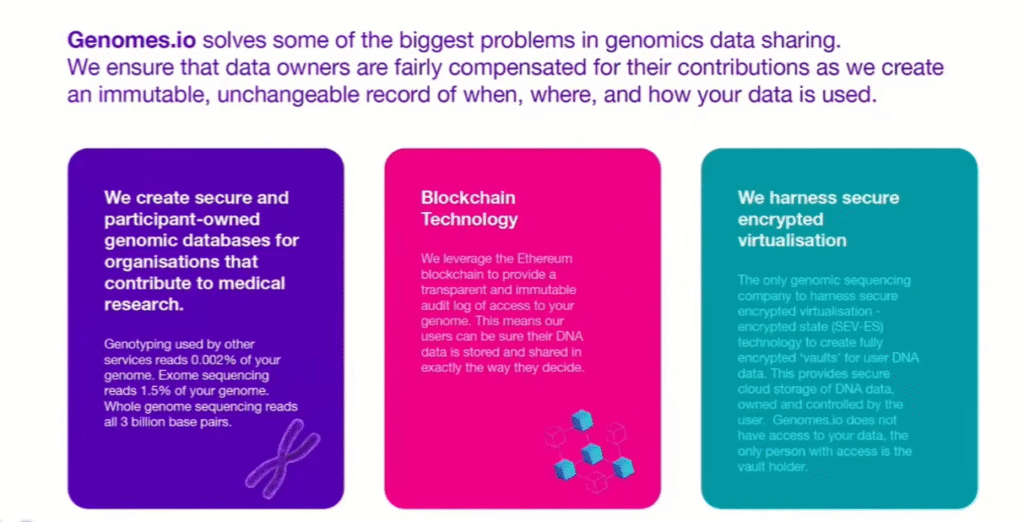
c. The Genomes.io and Subnet 55 Ecosystem Operate as Two Coordinated Revenue Streams That Solve Different Parts of the Same Problem: Genomes.io is the underlying infrastructure, a decentralized network of encrypted vaults where individuals own and retain control over their genomic data.
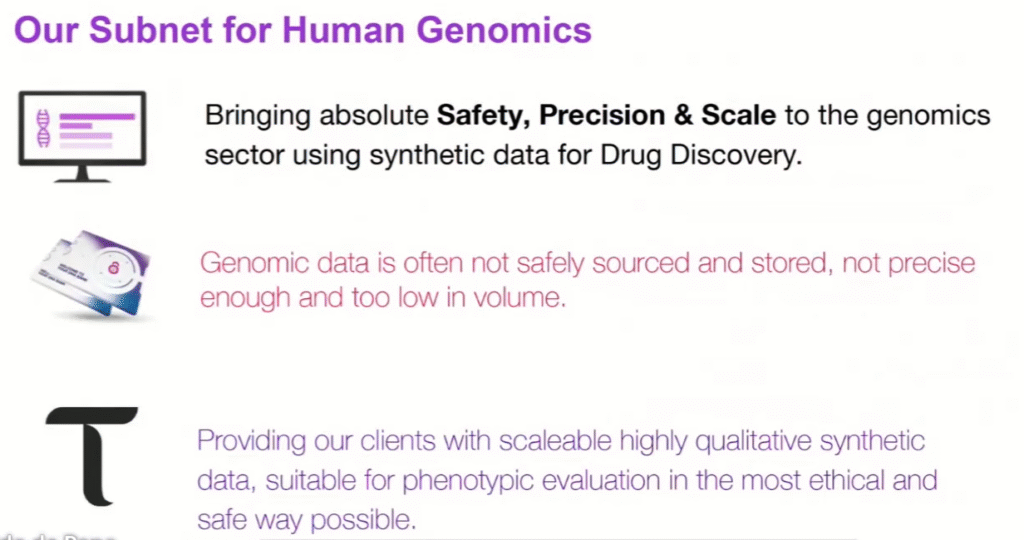
NIOME (operating right on Bittensor Subnet 55) focuses specifically on synthesizing genomic and bio data so it can power AI modeling without exposing real patient records to risk.
d. The miners, validators, and $SN55 token make Subnet 55 function as a Genuine Benchmark Rather Than a Closed Product: Miners compete on 24 predictive challenges across six research fields, ranging from cystic fibrosis genomic inference to drug interaction studies.
Validators score the quality of the synthesized output, and the $SN55 token serves as the incentive layer that keeps the entire system competitive, transparent, and structurally resistant to manipulation.
e. Pharma and Biotech Need Scale That No Isolated Dataset Can Deliver: A research dataset of 23,000 records is too small to drive meaningful drug development. The companies driving real pharmaceutical research need hundreds of thousands to millions of data points speaking to specific conditions, and synthesizing that scale safely is the precise gap Subnet 55 is built to close.
f. The Business Model is Already Producing Multiple Revenue Streams: Custom predictive challenges commissioned directly by clients, licensing of completed challenge results, and data brokerage fees from partners like Floré, which joined the network with 23,000 microbiome datasets to be synthesized and now earns a cut of any downstream commercial usage.
Each stream is tracked separately and routes back to the subnet rather than being blended with Genomes.io revenue.
g. The Pipeline is Real, Even if Early-Stage: The subnet went live in March 2026, and Aldo confirmed approximately $500,000 in projected annual recurring revenue based on current client conversations.
Genomes.io itself generated close to $900,000 in 2025 as a separate infrastructure business, which demonstrates that the team has already proven commercial viability before the subnet existed.
h. The Team and Institutional Environment are More Substantial than Most Bittensor subnet Launches: Twelve people based out of the One BioHub initiative in Aberdeen, a £40 million life sciences hub, with senior scientific leadership that includes a Chief Science Officer holding a PhD in stem cell biology from Imperial College and a lead bioinformatician shaping the underlying data pipeline.
Strategic partnerships with Scottish Enterprise and the Institute of Medical Sciences add layers of institutional credibility most subnets cannot claim.
i. Bittensor’s Openness is Itself a Commercial Selling Point: Aldo noted that many enterprise clients are genuinely afraid of feeding sensitive data into closed AI models because they cannot inspect what happens to it.
Bittensor’s transparency, where anyone can examine how the system actually works, aligns directly with the safety values driving the entire business and gives Subnet 55 something its centralized competitors cannot offer.
j. Precision Medicine is the Long-Term Moat: As medicine continues to shift from grouped, generalized treatment toward individualized therapies based on each person’s genetic makeup, the demand for safe, scalable, and synthesized bio data only expands.
Aldo’s view is that there is essentially no scenario in which this need decreases over the coming decade.
k. The Competitive Landscape is Collaborative More Than Adversarial: Other biotech-adjacent subnets exist on Bittensor, but as Aldo put it, DNA information is to biotech what money is to fintech.
Two subnets working with bio data are not necessarily competitors, and the network’s growth depends on these teams educating the market together rather than fighting for the same narrow slice.
Conclusion
What made this conversation different from most subnet introductions is that the underlying problem is something almost everyone has direct exposure to, even if they have not thought about it that way. Anyone who has ever signed a hospital form, used a consumer genetic test, or had their data shared with a research institution has already participated in a system that demonstrably does not protect them.
Subnet 55 is building the alternative with real infrastructure, real institutional partnerships, and a serious team that has been working on the problem for nearly a decade. Recurring revenue is still in pipeline rather than fully realized, but every condition needed for that to change is already in place. As Aldo put it directly during the episode, this is not a future problem.
It is happening today, and the network being built on Bittensor is one of the few credible answers currently in motion.
Enjoyed this article? Join our newsletter
Get the latest TAO & Bittensor news straight to your inbox.
We respect your privacy. Unsubscribe anytime.
Enjoyed this article?
Join our newsletter
Get the latest TAO & Bittensor news straight to your inbox — every morning before markets open.

No comments yet — be the first.