


In November 2025, Bittensor flipped one of the most consequential switches in its history. The shift from price-based emissions to flow-based emissions, branded Tao Flow, fundamentally rewired how $TAO gets distributed across the subnet economy.
The change has separated the subnets that genuinely attract capital from those that were quietly coasting on inflated token prices, and the data from the past six months tells a story worth paying attention to.
Before we get to the poll, here is what Tao Flow actually is, why it matters, and how to track it yourself.
A Quick Refresher on Tao Flow
Tao Flow is the flow-based emission model that went live across the Bittensor network in November 2025, fully replacing the legacy price-based emissions system by December 2025. The mechanism is straightforward in principle but profound in its consequences:
a. Emissions are Now Driven by Net $TAO Inflows: A subnet earns its share of block emissions based on whether more $TAO is being staked into it than unstaked out of it, smoothed across a 30-day exponential moving average,
b. Subnets with Negative Net Flow Earn Zero: If a subnet sees more capital leaving than entering over the EMA window, it receives no $TAO injection that block, regardless of token price or historical position,
c. Price Manipulation no Longer Pays: The old “$TAO treasury” gaming pattern, where projects pumped their token price to extract emissions while slowly bleeding the price down, is structurally dead under the new model, and
d. Scale Advantages are Gone: Because flow is measured per unit of liquidity, small subnets are no longer disadvantaged against larger ones simply for having less depth in their pools.
This has grown a system that rewards subnets attracting genuine user engagement and ‘penalizes’ those relying on speculative price action.
How to Track Tao Flow Yourself
Anyone watching the Bittensor ecosystem can monitor flow metrics in real time, which is part of what makes this upgrade so commercially significant.
Capital movement is now visible to every participant rather than buried inside opaque emission formulas:
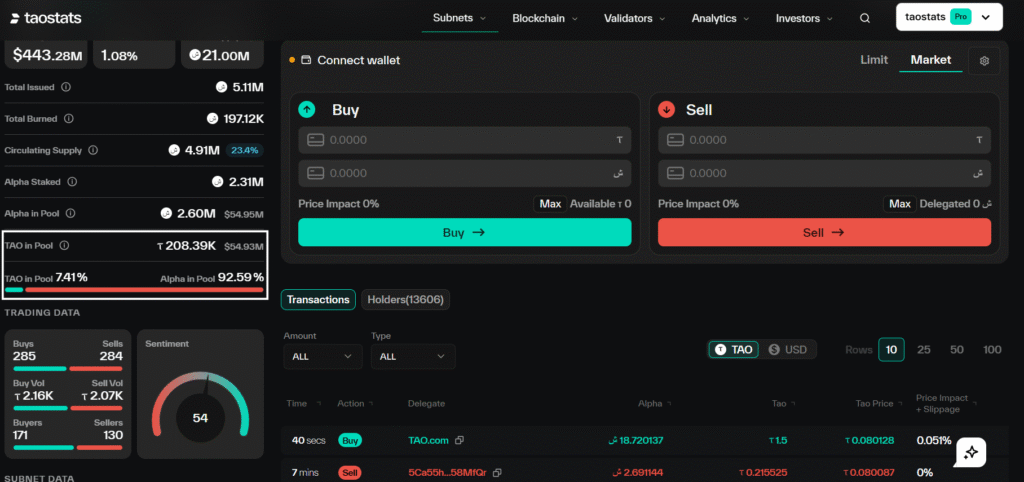
a. Taostats Subnet Statistics: The Subnets tab on Taostats lets you select any specific subnet and view its $TAO Injected versus $TAO in Pool metrics, the two figures that define a subnet’s flow position,
b. Subnet Sentiment Index (SSI). The SSI tracks Tao Flow with a 15% weighting, broken down into a Staked Ratio component (60%) measuring subnet ‘$ALPHA’ tokens staked versus pool size, and a Liquidity Trend component (40%) tracking the 7-day change in pool depth,
c. The “Smart Money” Signal: Capital flow patterns across a full week are significantly harder to fake than a single large trade moving the price short-term.
This why the liquidity trend metric is widely considered one of the cleanest conviction signals in the entire network, and
d. Live subnet performance dashboards. Tools across the ecosystem now surface flow-weighted leaderboards, making it possible to see at a glance which subnets are accumulating capital and which are quietly losing it.
The transparency is the point; Six months in, anyone can watch the network sort itself.
Your Turn: Which Subnet Excites You the Most?
Six months of Tao Flow has produced clear winners, clear losers, and a handful of subnets that have surprised everyone with the kind of capital they have managed to attract.
Now we want to hear from you. Share your thoughts below:
Enjoyed this article? Join our newsletter
Get the latest TAO & Bittensor news straight to your inbox.
We respect your privacy. Unsubscribe anytime.
Enjoyed this article?
Join our newsletter
Get the latest TAO & Bittensor news straight to your inbox — every morning before markets open.


No comments yet — be the first.