

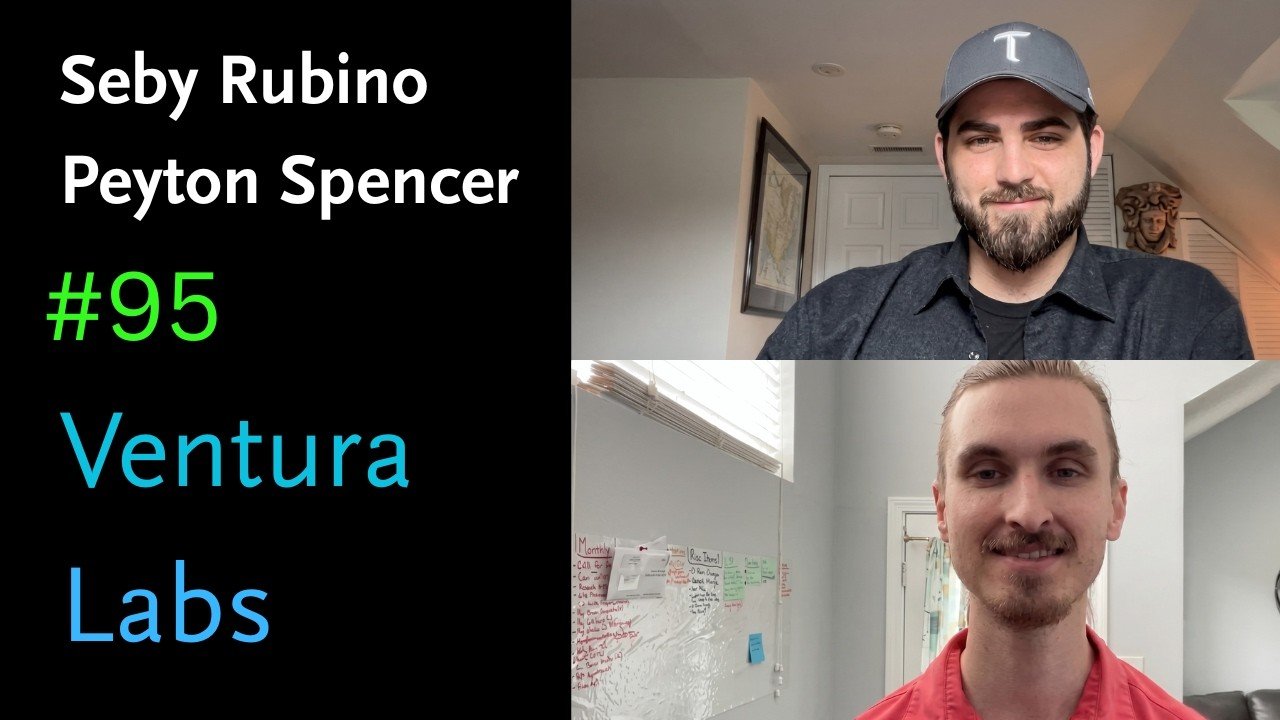
Ditto (Subnet 118) started as a unified memory layer for AI agents. On the latest Ventura Labs pod, founder Peyton Spencer and BigTensor’s Seby Rubino reframed it as something bigger: an agentic operating system you build apps on, monetize, and eventually get paid to run.
Here are the top takeaways from the pod.
1. Ditto isn’t a memory app; it’s an OS where everything is a “file.”
The mental model shift: in Ditto, chats (with humans and agents) and files are the primitives. But a “file” isn’t just a doc; it can be an app, an AI wrapper, a video, or a paid product. Memory is the baseline layer, and the apps are what you build on top of it. Think iOS, where the memory graph is the kernel.
2. You can replace a SaaS stack with one prompt.
With Ditto, you can use one prompt to replace Patreon, Shopify, or Linktree. Set your domain, connect Stripe, and sell gated videos, images, products, or APIs. Ditto makes money the way Linktree does, by letting you strip the “Made with Ditto” branding for a fee, not by gating the core tool.
3. The first subnet competition is a race to build the best agent memory.
Ditto’s launch competition is a code competition (open-source, benchmark-driven) to build the world’s best agent memory harness. ML engineer Nick Anderson reportedly beat the internal benchmark twice and more than doubled retrieval accuracy, optimizing against LongMemEval. This is the classic “open-source baseline + miners climb the benchmark” structure.
4. Two competition tracks, two reward models.
There’s a nuance worth understanding: the harness/model competition is winner-take-few (3–5 winners) for the best memory model. The infrastructure competitions (inference, storage, compute) are redundant and pay multiple participants (“something for every miner”). The infra side is modular, microservice-style. Each component is open-sourced and incentivized separately, provisioned on demand.
5. The endgame: mine Ditto on a Mac mini.
No NVIDIA card required. The vision is a decentralized “Ditto cloud” where idle Mac minis turn into Ditto miners that host user apps, databases, storage, and inference for the network. Seby’s said it’s like an app that pays your phone bill while you sleep. Storage is already handled via a Hippius partnership (free storage, hundreds of MBs already parked there).
6. “Vibe mining.” Your agents can mine for you.
Tell Ditto “I want to mine Subnet 77,” and it reads the system requirements, provisions compute (Targon, H100s), spins up a coding agent, runs the training loop, and submits tasks. Each Ditto agent gets its own Bittensor wallet. It’s not fully autonomous; you supply the ideas and direction, the agent does the plumbing.
7. Knowledge-graph licensing.
The most novel idea on the pod. You dump everything into your Ditto, then build an app that exposes only a filtered slice. For instance, “share my programming knowledge, keep my personal life private.” That walled-garden app becomes a paid agent: $5–10/month, an agentic version of you. Spencer asked: “Who needs Neuralink? You have Ditto.” Meta-apps (apps that build apps for others) are on the table too.
8. Agent-native signup kills onboarding friction.
Paste a prompt to your agent and it creates its own account with no human in the loop and no exposed keys. It starts saving memories immediately, then nudges you with a claim link to bind the agent account to yours. You could onboard a Telegram agent in one paste. Shipping this week, per Spencer.
9. The MCP layer makes Ditto a sync engine across every tool.
Demo’d live: connect app.hey-ditto.ai/mcp to Claude Desktop (also Claude Code, Cursor, Codex, antigravity, Hermes, Open Claw). Tools include search/save/publish/update memory and crawling your memory graph. The payoff: whatever you save in one tool shows up everywhere, and you can read other people’s public publishings too. Pair that with point 7 and you get a marketplace where an agent can pay to license another user’s knowledge rather than regenerate it.
10. BigTensor is a subnet accelerator built to fix how subnets come to market.
BigTensor is Seby’s new creation. Since subnets are the crux of Bittensor, fixing funding and go-to-market allows you to fix which ideas survive. The terms of agreement signal long-term alignment. BigTensor holds tokens for 2 years, vesting through year 3; investors face a ~9-month cliff then linear vesting. Ditto was its H1 launch; the next is targeted for Sept/Oct, with roughly two launches a year, all structured as 100% buyback-and-burn. The positioning is an explicit shot at the incumbent accelerator model (“I’m sick and tired of playing this circle-jerk game”).
The throughline
Ditto is trying to turn Bittensor’s commodity layers (storage, inference, compute) into building blocks for consumer apps people use every day, while BigTensor is restructuring how those apps are funded. Monetizable artifacts are promised by the end of June; the bet is that multiple rounds of iteration will make it the default OS for operators.
Watch the full conversation below:
Enjoyed this article? Join our newsletter
Get the latest TAO & Bittensor news straight to your inbox.
We respect your privacy. Unsubscribe anytime.
Enjoyed this article?
Join our newsletter
Get the latest TAO & Bittensor news straight to your inbox — every morning before markets open.

No comments yet — be the first.