

CONTRIBUTOR CREDIT: School of Crypto
Interchain transactions have been an emerging trend in crypto for the past few years. The digital assets space has broadened its horizons beyond Bitcoin and Ethereum. New ecosystems have emerged between popular layer 2 Ethereum blockchains like Base and Arbitrum, to next-generation layer 1 platforms like Bittensor and Solana.
As more and more assets transact between dozens of blockchains, moving value between ecosystems has become increasingly complex. At first, bridges became the de facto solution for the space. However, after repeated exploits, billions of dollars lost, and fragmented liquidity, the industry needed another solution for interchain commerce. Solver-based cross-chain execution became the method to prevent the downfalls that bridges experienced.
One project that’s attempting to evolve the decentralized solver method is Allways (SN7), a cross-chain swap protocol built on top of Bittensor. Subnet 7 utilizes Bittensor’s novel miner and validator consensus mechanism without the need for bridges or wrapped assets. Its goal is to be the main decentralized cross-chain swap engine in all of crypto.
To understand why this approach matters, it’s imperative to first analyze how cross-chain infrastructure evolved within the crypto space. It went from bridges, to centralized solvers, to today’s decentralized solver networks.
The Vulnerability of Bridges & Stagnant Honeypots
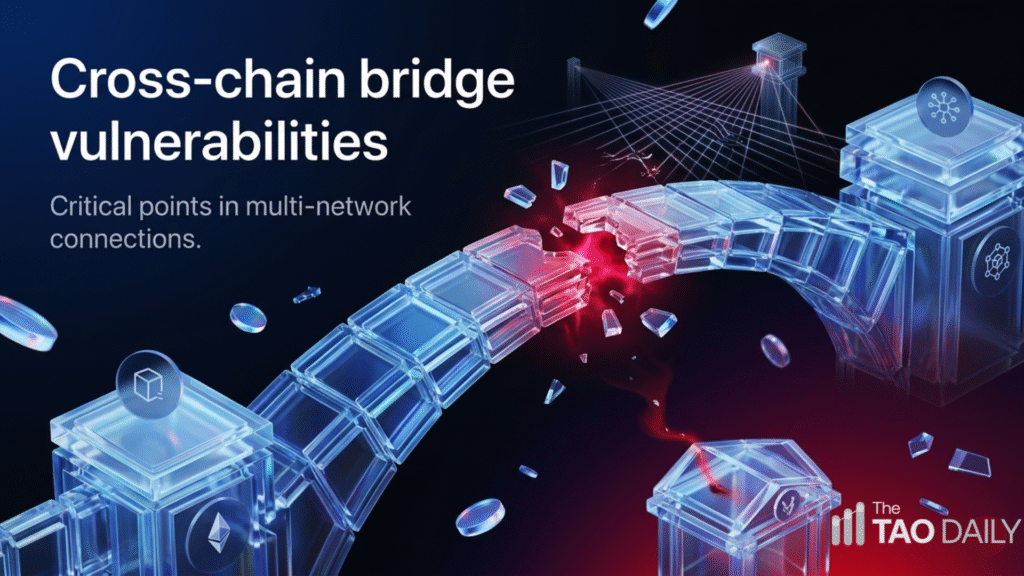
One of the biggest flaws in coordinating cross-chain transfers and swaps is bridges. In the past handful of years, billions of dollars have been lost due to bridge hacks. Smart contract vulnerabilities are the catalyst for these notorious events.
Fragmentation is a critical gap in facilitating liquid cross-chain transactions. Based on this problem, there isn’t enough matching liquidity for pairs to successfully swap tokens on a consistent and efficient basis.
Non-EVM blockchains often lack native cross-chain communication layers. Because of this structural isolation, direct swaps between these networks remain fundamentally infeasible without a universal transaction layer.
The Solver Pivot and the Centralization Trap
Based on the risks of bridges and smart contract failures, cross-chain swaps are now increasingly facilitated through solvers or relayers. The most common examples of this setup are the built-in swap features integrated on popular crypto wallets like MetaMask and Phantom.
When a user initiates an in-app cross-chain trade, these wallets act as centralized meta-aggregators. They use closed-source APIs to route the user’s transaction to a private network of third-party relayers or backend solvers. On top of the standard gas and protocol costs, the wallets extract a heavy convenience fee between 0.3-0.875% just to route the transaction.
Institutional market makers capture most activity in existing solver networks, creating barriers to entry for smaller participants. However, if the actor is malicious or front-runs a transaction, the user is left with empty pockets.
The last pertinent issue with cross-chain swaps is the centralization risk presented by these kinds of DEX aggregators. They use third-party relayers, or “solvers,” to facilitate cross-chain swaps. This introduces centralization risk that some DeFi users seek to avoid.
EVM Specializations with Decentralized Solvers
UniswapX
Decentralization came into the fold with solvers and cross-chain swaps in EVM land. UniswapX is strictly EVM-compatible, strictly coordinating swaps between the Ethereum mainchain and ETH layer 2 chains. The solvers in the network enter a Dutch auction, with the winner filling the order for the user. These solvers draws the liquidity from private market makers, onchain AMM pools, or even centralized exchanges.
The funds are paid out of pocket, with UniswapX using a process called Optimisitc Settlement, which takes hours to confirm, as the network figures out whether the trade was settled properly or not. While UniswapX is open to any solver, it’s usually dominated by institutional desks with massive off-chain balance sheets, according to a study on Execution Welfare Across Solver-based DEXes in 2025. The solvers earn profits by chasing arbitrage and the spread. Any orders without these profitable attributes gets ignored.
Across Protocol
Across Protocol’s cross-chain solver system works similar to UniswapX’s except the process to validate the transaction is slightly different. The protocol uses an “Optimistic Settlement” standard in which the solver automatically pays the user to the destination chain. The solver then submits proof of fulfillment into the Optimisitc Oracle to validate the transaction. Across Protocol assumes the transaction was valid unless it gets disputed in a multi-hour window. If the transaction doesn’t get any disputes, the solver will be reimbursed through the Protocol’s Unified Hubpool.
CoW Swap
CoW Swap has a unique process is it’s cross-chain services. They use batch-auction intent modeling, in which the solvers match user’s requests peer-to-peer off-chain. No direct AMM routing is required in most cases, since execution is handled through order matching. Based on forgoing these channels, internal savings are used to give the users a better price on their swap. Cowswap is highly dependent on overlapping retail volume in order to keep its engine running.
Breaking the Non-EVM Frontier
deBridge
deBridge is a very fast cross-chain swap protocol that’s compatible with Ethereum, Solana, and Tron ecosystems. The solvers instantly deposit the desired tokens into their wallets once the request is sent. The users funds then get put into an escrow account. Once the transaction is fully verified, the solver will be reimbursed.
The network used to have a public open-source code repository that smaller scale solvers and developers could use to run standard solver bots. This repo was archived in August of 2024, and now the network has a vetted list of professional market makers to ensure transfers settle in under 60 seconds without fail. According to a governance post on Arbitrum, solvers need to be equipped to 6-7 figure orders. This is yet another protocol that’s dominated by institutional market makers.
THORChain
THORChain has a different foundation to facilitate crosschain swaps. The platform has individual AMM pools for multiple coins from a diverse set of blockchains. Each pool has 50% of the asset and 50% of the protocol’s native coin, RUNE.
Liquidity is a risk based on the fact that node operators of these pools must bond double the pools liquidity in order to have proper security collateral. The protocol has experienced a number of hacks over the years which led to $25-27 million lost.
Enter Allways (SN7): The Universal Transaction Layer
How Allways works
Allways takes a uniquely different approach compared to solver networks in crypto today.
Most cross-chain protocols ultimately rely on a single solver or market maker to execute a transaction. The user submits a request, the solver fulfills the order, and the protocol assumes and/or confirms everything was executed correctly. While this model is significantly more efficient than bridges, it still introduces trust assumptions around the parties facilitating the swap.
Allways breaks this process into three distinct roles: miners, validators, and smart contracts.
The miners act as the network’s market makers. They continuously post exchange rates, lock TAO collateral into the protocol, and compete to facilitate cross-chain swaps for users using their own liquidity and infrastructure. When a transaction is initiated, the miner fulfills the order using its own liquidity, or sources the funds through external exchanges. The user pays a 1% fee for the transaction.
Validators operate independently and never communicate off-chain. Disagreements are settled automatically on-chain. The smart contract requires a strict majority of validator stake to finalize a swap outcome. Whichever side hits that threshold first wins, and trailing votes are rejected.
If a validator is lagging or desynced, it will abstain from voting so it doesn’t hold up the network. However, a validator that consistently misses these consensus votes will automatically have its scoring weight and rewards penalized.
The final piece of the puzzle is the smart contract itself. Once the validators reach consensus, the protocol automatically enforces the result. Honest miners continue earning rewards and building credibility within the network. Malicious actors, failed transactions, or lengthened timeouts can result in collateral being slashed, and network reputation score being lowered.
Miners are rewarded for providing competitive pricing and fast execution. Validators are rewarded for accurately verifying outcomes. Consequently, users gain an additional layer of security through independent verification.
Unlike traditional solver models, execution, verification, and enforcement are separated across multiple independent actors rather than concentrated into a single entity.
The open-source, permissionless Allways smart contract infrastructure has not undergone a third-party paid security audit. However, protocol risk is structurally minimized because end-users never connect wallets or interact directly with the contract. Instead, the miners are the parties that interact with the smart contract exclusively. This contract manages miner collateral and validator votes. This design allows user funds to move completely peer-to-peer and protected from code-level vulnerabilities.
Why Bittensor Makes Sense
Cross-chain swap protocols in crypto have a coordination problem. Ultimately, users want to utilize cross-chain swap engines to get the best price, with fast settlement and reliable execution.
Most platforms use a select group of high-end market makers to provide the liquidity and infrastructure necessary to facilitate transactions. These actors consequently become the sole dependency of these various solver protocols.
Bittensor is designed to reward miners who execute useful services. The validators are present to independently verify the quality of the work being performed. This framework naturally aligns with the requirements of cross-chain swapping.
Allways allows miners to compete for facilitating swaps, while validators determine who is providing the best service. The result of this dynamic is an open marketplace where pricing, execution speed, and reliability become the primary factors that determine success.
Bittensor’s miner and validator architecture provides a uniquely strong foundation for cross-chain swaps, and Allways is taking advantage of it.
Be Your Own Universal Market Maker
The essence of the Allways subnet is allowing the miner to be the subnet’s universal market maker. All one needs to do is pay a registration fee, spin up a miner, lock in collateral, and you can facilitate cross-chain swaps. If done well, miners earn Alpha rewards for their work.
In mainstream decentralized solver networks, institutional desks and market makers are dominant. The barrier to entry is great and smaller desks or lower-tier market makers can’t participate or compete. On Allways, the miner is only limited to the speed in which he can execute and the liquidity being provided.
Agentic Ready Cross-Chain Compatibility
Allways believes in an agentic commerce future. The protocol has specific parameters built that are impeccably designed for AI Agents to transact. AI agents are able to have open code, public APIs, and live data streams available to be able to instantly read order books, calculate prices, and swap agents autonomously, machine-to-machine.
Security is at the essence of the agent infrastructure built on Allways. There’s a strict smart contract state machine that an agent must go through in order for a transaction to pass through. The three-step process is reserving a rate, initiating the locked collateral, and confirming the transaction is valid through the validators. If anything goes awry, collateral will be instantly slashed, and the user will be refunded.
Lastly, agents are highly trained on using advanced math libraries to prevent rounding errors in price quotes and miner fees. Agents are dynamically monitoring networks like Bitcoin to ensure the miner fees are appropriately quoted, so users don’t have to wait in a queue for a transaction to go through.
Aiming to Become the Universal Decentralized Solver
As stated above, most decentralized solver cross-chain swap protocols are limited to EVM-compatible blockchains, with deBridge offering services in Solana and Tron.
Allways has the chance to be the one-stop cross-chain swap shop for any user that wants to transact from one completely different blockchain to another.
Allways sees decentralized swaps across all blockchains as an essential part of DeFi. Through the novel Yuma consensus model and the role of the miners and validators, Allways strives to be a main player a facilitator for decentralized cross-chain swaps.
Challenges ahead
Currently, Allways has light liquidity in its initial stage. There’s been 19.27 TAO worth of volume transacted on Allways so far, or around $5400. As the project has just become live in the past couple of weeks, there needs to be more miners supplying liquidity and more users utilizing the cross-chain app to bolster activity.
The subnet is currently live with the Bitcoin and Bittensor blockchains. In order for the vision to come to complete fruition, there needs to be EVM and SVM compatibility, along with integration into all the other blockchains in the crypto ecosystem. Once every crypto project can be transacted on Allways, then it will be the go-to decentralized solver machine that is fully functional amongst all major coins.
Allways isn’t the only decentralized solver model in DeFi. As stated before, UniswapX, deBridge, Across Protocol, THORchain, and CoWSwap have major market share in the cross-chain swap sector. It will take a lot of major adoption to be on par with and surpass these industry leaders.
Essentially, the institutional market makers like Wintermute and the high-end apps like deBridge and UniswapX are the major leaders in the category. Its wide distribution within the sector and heavy liquidity give these actors a major advantage in dominating the cross-chain swap space.
Next Go-to Cross-Chain Swap Engine for Users and Independent Market Makers?
Bittensor is a network that’s built as an open arena for anyone to participate in. If you have the skills, know-how, and resources, you can earn on the network. The cross-chain swap industry is now dominated by household names like Uniswap, and heavy-hitter market maker institutional desks like Wintermute. It’s currently a gated community in terms of being able to get a slice of the pie.
As an entrepreneur with crypto assets, anyone can come onto Allways and become a market maker and facilitate cross-chain swaps for users. This open and permissionless network on Bittensor doesn’t only apply to the actors with the most resources and the highest form of clout. The little guy can get a piece of the action if he’s fast enough, can give the best rate, and be honest in facilitating a cross-chain swap.
Allways has the chance to be the only cross-chain swapping protocol to truly have decentralized solvers that can swap native coins across the most ecosystems in the world. The dApps of today are mostly restrained by EVM-compatible chains, with some integrating Solana and Tron.
The miner and validator contingent gives Allways a competitive advantage versus the other projects in the space. The code parameters and systematic work of the miner and validators ensure that both parties are highly incentivized to execute transactions and prevent malicious activity.
Allways is pushing cross-chain execution away from trusted intermediaries and toward an incentive-driven system.
Inside Bittensor, it is one attempt to extend that model through open coordination between miners and validators.
Read more on Allways:
Enjoyed this article? Join our newsletter
Get the latest TAO & Bittensor news straight to your inbox.
We respect your privacy. Unsubscribe anytime.
Enjoyed this article?
Join our newsletter
Get the latest TAO & Bittensor news straight to your inbox — every morning before markets open.



[…] Allways (SN7) from Ventura Labs closes that gap with a browser-based exchange that gives the Solana community a direct path to $TAO, while covering selected chains just as easily. […]