

For years, decentralized AI has existed more as a promise than a product. The vision was compelling: Open access to intelligence, permissionless compute, and a global network coordinating without centralized control.
Yet for most participants, the experience remained fragmented and largely experimental. That dynamic is beginning to change.
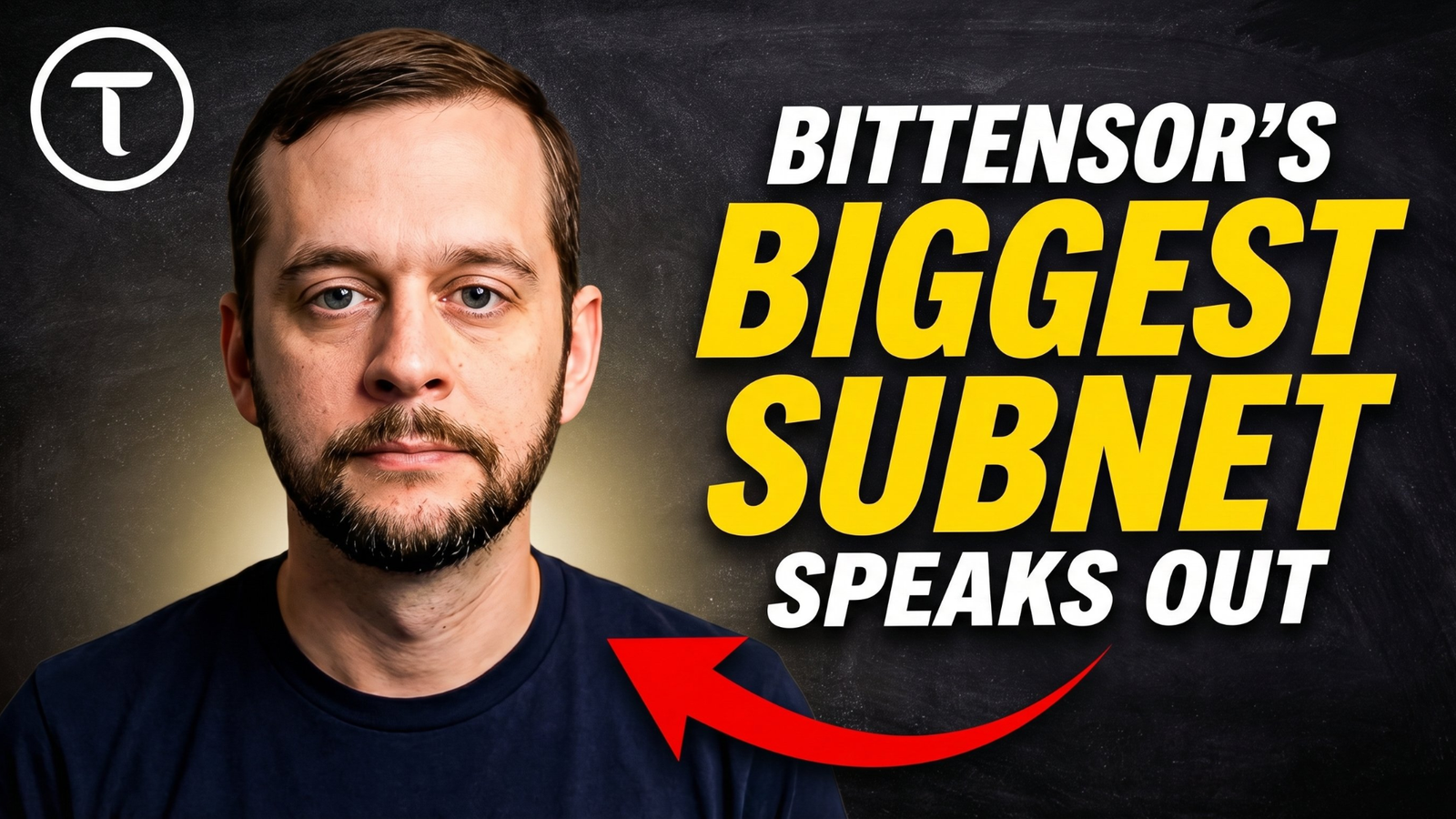
Speaking with Jesus Martinez, Jon Durbin of Chutes (Subnet 64) gave a clearer picture of what the next phase of Bittensor looks like. At the center of that transition is Chutes, currently the largest subnet in the network, and increasingly one of the most structurally mature.
This is a story about trust, sustainability, and the design decisions required to move decentralized AI from theory into production.
A Defining Moment for the Ecosystem
The discussion opens in the aftermath of Covenant AI’s exit from Bittensor, an event that triggered widespread concern across the network.
Rather than focusing on speculation, the conversation frames a more fundamental reality. In permissionless systems, unpredictability is not a flaw. It is an inherent property: Participants can leave, systems can be stressed, and incentives can be misaligned.
The real challenge, then, is not eliminating these risks but designing systems that remain resilient despite them.
This is the lens through which Chutes approaches its architecture.
Designing for Trust Minimization
Chutes does not attempt to solve trust through messaging or reputation. Instead, it reduces the need for trust at the system level.
The core mechanism it is adopting is both straightforward and effective:
a. Subnet emissions are routed into a smart contract rather than controlled by individuals,
b. The contract automatically distributes rewards to contributing entities, and
c. No single party has unilateral control over funds.
Additional safeguards that reinforce this structure include institutionalized systems like critical actions requiring multiple approvals, time delays preventing sudden or impulsive withdrawals, and the entire system being open source and verifiable.
This results in a model where constraints replace discretion. In practical terms, this significantly reduces the risk of catastrophic failure scenarios such as fund mismanagement or coordinated exits.
Organizational Decentralization as a Structural Layer
Beyond protocol design, Jon noted that Chutes extends decentralization into its organizational model.
Instead of operating as a single entity, it is structured as a network of independent contributors coordinated under a shared framework:
a. A central entity oversees high-level coordination,
b. Multiple independent contractor groups handle execution, and
c. Responsibilities are distributed across backend, infrastructure, and operations.
This approach introduces internal checks and balances while maintaining operational speed. Although not a full DAO (Decentralized Autonomous Organization), it represents a transitional model that aligns with decentralized principles without sacrificing efficiency.
What Chutes Actually Provides
Chutes’ fundamentally a decentralized compute layer. However, its functionality extends beyond basic infrastructure, it provides a full environment for deploying and scaling AI workloads in a permissionless context.
Through Chutes, users can:
a. Deploy models and applications using containerized environments,
b. Scale workloads dynamically across distributed nodes,
c. Access both private and shared AI services, and
d. Pay using crypto or fiat without geographic restrictions.
The defining characteristic is accessibility. Unlike centralized providers, access is not subject to regional policies or platform-level restrictions.
Privacy as a Foundational Principle
One of the more technically significant aspects of Chutes is its approach to privacy. Rather than treating privacy as an optional feature, it is embedded directly into the system architecture.
Its key components include:
a. End-to-end encryption of all user payloads,
b. Execution within Trusted Execution Environments, and
c. Confidential GPU (Graphics Processing Unit) compute with encrypted memory.
In practice, this means that even node operators cannot access user data. Prompts, outputs, and model states remain inaccessible outside secure enclaves.
This design shifts the trust model entirely. Users are no longer required to trust operators, as the system itself enforces data isolation.
From Free Access to Sustainable Economics
Like many early-stage systems, Chutes initially prioritized adoption over monetization. This led to rapid growth, with usage reaching extremely high throughput levels. However, the absence of revenue made the model unsustainable.
The transition to a viable business required deliberate shifts:
a. Introduction of payment gates to filter usage,
b. Removal of free tiers to reduce abuse, and
c. Implementation of structured subscription models.
While these changes reduced overall usage, they significantly improved financial performance. Revenue scaled from under $10,000 per day to peaks exceeding $20,000, while infrastructure costs were reduced through efficiency improvements.
Current Economic Position
Chutes is not yet fully self-sustaining, but it is approaching that threshold. At present:
a. Approximately two thirds of operational costs are covered by revenue,
b. The remaining portion is supplemented by token emissions, and
c. The project operates without venture capital funding.
This last point is particularly relevant. Without external capital pressures, the team retains control over product direction and monetization strategy.
Aligning Value Through Burn Mechanisms
A notable feature of the Chutes model is how it handles revenue at the protocol level. Payments received in $TAO or its subnet ‘$SN64’ token are staked into the network, and subsequently burned, removing them from circulation.
This mechanism creates a direct link between usage and token scarcity. Rather than extracting value from the system, it reinforces it.
Positioning Against Centralized Providers
In comparisons with traditional providers such as AWS, pricing is only part of the equation. While Chutes can offer competitive rates, its primary advantage lies in its structural differences.
Centralized platforms retain the ability to:
a. Restrict access based on policy or geography,
b. Enforce compliance requirements, and
c. Control distribution of compute resources.
Chutes, by design, do not. This distinction becomes increasingly important as AI becomes a critical layer of global infrastructure.
The Challenge of Scaling Intelligence
Looking forward, the conversation shifts toward the broader challenge facing decentralized AI. Training frontier models requires significant capital investment, large scale hardware coordination, and access to scarce computational resources.
Chutes is actively exploring alternative approaches to this problem, including more efficient training methods and distributed coordination mechanisms.
While still early, these efforts represent an attempt to bridge the gap between decentralized systems and frontier scale AI development.
Expanding Beyond the Crypto Ecosystem
One of the clearest themes from the discussion is the need to move beyond internal ecosystems. For Bittensor to achieve long-term relevance, its outputs must reach external markets.
This can be achieved through:
a. Building products that serve real users,
b. Integrating with broader AI infrastructure, and
c. Demonstrating value outside of crypto-native environments.
Chutes is already making progress in this direction through integrations and production-level usage.
Conclusion: From Concept to Capability
Chutes represent a meaningful step in the evolution of decentralized AI. It demonstrates that:
a. Trust can be minimized through design rather than assumption,
b. Sustainable revenue models are achievable within decentralized systems, and
c. Real world utility can emerge from open, permissionless infrastructure
The system is not complete, and challenges remain. However, the trajectory is clear.
Decentralized AI is moving from concept to capability, and Chutes is one of the first examples of what that transition looks like in practice.
Enjoyed this article? Join our newsletter
Get the latest TAO & Bittensor news straight to your inbox.
We respect your privacy. Unsubscribe anytime.
Enjoyed this article?
Join our newsletter
Get the latest TAO & Bittensor news straight to your inbox — every morning before markets open.


No comments yet — be the first.