


Greg Schvey, the COO of Yuma (DCG’s operating arm inside Bittensor), joined The Supercycle podcast to give a detailed overview of the state of the Bittensor network.
The conversation covered his Wall Street and crypto-infrastructure background, Yuma’s three active business lines, the asset-management lens on subnet tokens, and his current picks across the subnet landscape.
The argument is that AI has passed the point of no return, that centralized models are being captured by political interests, and that Bittensor is the only credible open alternative at scale.
The conversation tied that argument to the practical work Yuma is doing across validation, accelerator, and asset management.
The Key Points From the Conversation
1. GREG’S BACKGROUND
He started on Wall Street, then built TradeBlock from 2013 as the first institutional data and indexing platform for crypto. DCG acquired TradeBlock at the end of 2019. He then built Axoni, a post-trade data infrastructure firm, which the London Stock Exchange Group acquired in 2024. He got into Bittensor through the DCG summit roughly two years ago.
2. YUMA’S THREE BUSINESS LINES
Yuma runs three distinct business lines that touch different parts of the Bittensor stack:
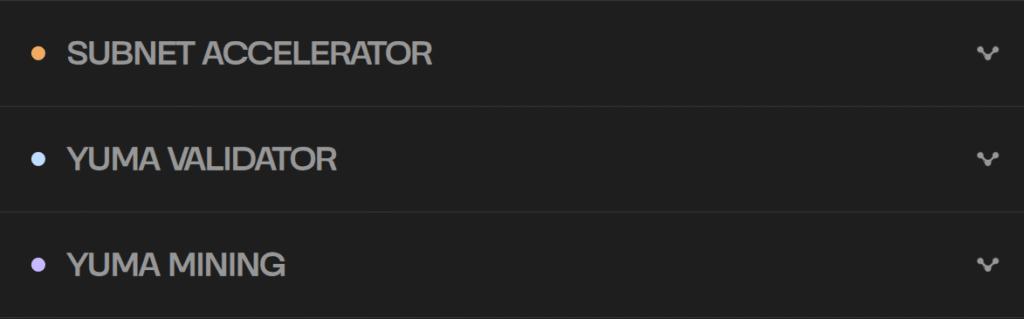
a. Validator: One of the largest validators on the network, participating in consensus across more than 120 open competitions.
b. Accelerator Program: Direct work with subnet builders and entrepreneurs on funding, marketing, and access to the network.
c. Asset Management: A range of investment products talking to high-net-worth individuals and institutions every day.
The exposure across all three is what gives Yuma a near-360-degree view of the ecosystem. Technical at the validator layer, pseudo-technical at the accelerator layer, and education-focused at the asset management layer.
3. THE CORE THESIS
AI has passed the point of no return, and intelligence is moving toward non-human functions at a speed that requires building trust in the intelligence layer immediately. Centralized models are being captured by political interests, visible in Anthropic and OpenAI government contract activity and US export controls on state-of-the-art hardware.
Bittensor is the open alternative at a scale that can compete.
4. THE CRYPTO COMPONENT IS AN AFTERTHOUGHT
Greg opine that the crypto infrastructure in Bittensor is a pragmatic tool rather than the point, just because it exists to coordinate the incentives that develop the open AI infrastructure.
The same economic primitives that worked for Bitcoin (21 million token cap, no pre-mine, no presale, no central party doling out emissions) are what give Bittensor its credibility with investors who already understand Bitcoin.
5. INVESTOR DEMOGRAPHICS
Yuma takes checks ranging into seven and eight figures. The buyers are sophisticated allocators who understand that the return profile compensates for the work required to develop a thesis on something more complex than blue-chip exposure.
6. THE THREE YUMA FUNDS.
Yuma now runs three investment products for clients writing seven- and eight-figure checks:
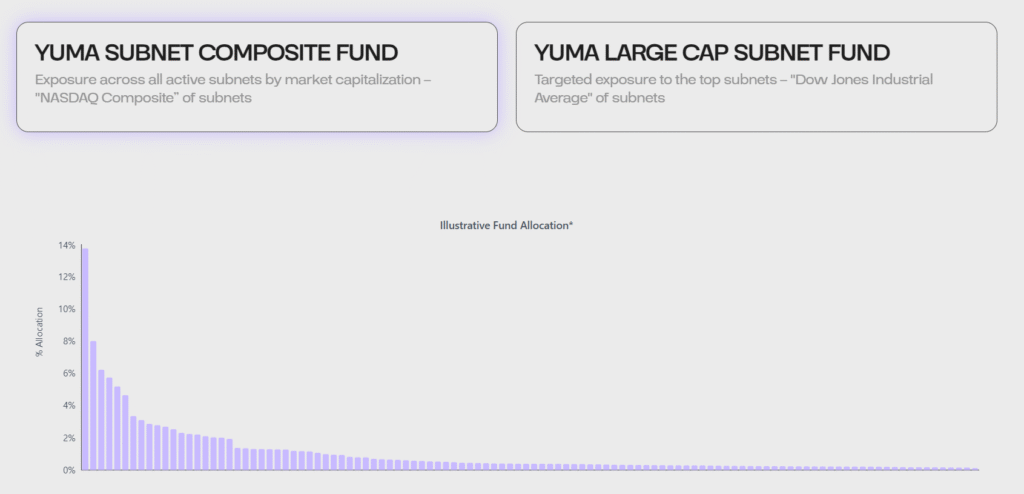
a. Composite Fund: Market cap weighted exposure across all subnets. Captures the yield and the seeking returns across the full subnet landscape with diversified risk.
b. Large Cap Fund: Exposure concentrated on the top 10 subnets i.e. The blue-chip allocation within the space.
c. Fund Three: Recently launched with roughly 80% $TAO and 20% subnet exposure for investors who want the base asset weighting but with some subnet upside.
All three handle custody, rebalancing, trading, and reporting on the investor’s behalf.
7. TAO IS OIL. SUBNET TOKENS ARE SPECIALIZED FUELS
Greg’s mental model for new investors: $TAO is the base commodity, and each subnet token is a refined fuel for a specific machine. Subnet tokens are derivatives of $TAO in the sense that they share the same fueling function for an underlying intelligence production network.
8. THE ECONOMIC LOOP IS THE METRIC THAT MATTERS
Value flows into the network through two streams: investors gaining financial exposure, and parties using subnet intelligence in commercial products cycling revenue back to keep token prices supportive of mining incentives. The signal Greg watches most closely is whether that loop is closing on individual subnets, where outside commercial revenue is being cycled back into the network.
9. TECHNICAL EXCITEMENT BREAKS INTO TWO CATEGORIES
On generalized frontier models, the network is not there yet but the building blocks are coming together: distributed training, fault-tolerant GPU coordination, and distributed bandwidth coordination.
On specialized models, the network is already producing world-class output that exceeds industry benchmarks.
10. GREG’S SUBNET PICKS.
Greg named specific subnets across three categories:
a. Technical Achievement: Resi (SN46) with real estate price forecasting at 98% accuracy, Nova (SN68) for drug discovery, Zeus (SN18) weather forecasting beating top industry benchmarks, and Niome (SN55) targeting synthetic DNA production.
b. Agentic Workflows: RedTeam (SN61) solely for real-time security analysis, and also one of the cleanest examples of the closed economic loop, taking commercial revenue and buying back its own subnet tokens.
c. Distributed Mega-Model Primitives: Beam (SN105) for bandwidth access, IOTA (SN9) for distributed training, which Greg considers one of the most technically complicated problems in the market.
d. Collaborative Subnets: Chutes (SN64) for inference infrastructure and Hippius (SN75) for distributed data storage. These subnets power other subnets, which keeps value flowing inside the ecosystem rather than exiting it.
11. HOLDERS HAVE GROWN 10x SINCE dTAO LAUNCH
Median holders per subnet token are up roughly tenfold. While all holders are not users, holders gain financial exposure; users gain utility. Both matter, but they signal different things about a subnet’s health.
12. WHAT BITTENSOR NEEDS NEXT
Greater abstraction and tooling. Right now, to participate as a subnet builder, you need to understand technical infrastructure, nuanced tokenomic models, miner and investor marketing, and your own field of expertise.
Greg’s analogy: to drive the car right now, you have to be a mechanic. The path to breakout subnets runs through making the network accessible to domain experts who do not have to learn every layer of the protocol.
13. THE BRIDGING ROLE YUMA PLAYS
Yuma sits between the technologists driving the core value and the institutional allocators who care about return opportunities. Communication is critical. Yuma works with portfolio companies on pitch decks, messaging, and investor introductions. The work of bridging those two populations is half the job at the asset management layer.
The Open Alternative
The clearest argument Greg made on the podcast was that Bittensor’s importance is not technical curiosity, it is geopolitical. Centralized AI is being captured; Export controls, government contracts, and the political alignment of the major labs all point to a single direction of travel. Bittensor’s economic model is the same set of primitives that made Bitcoin durable, applied to the production of intelligence rather than the issuance of money.
Yuma’s role inside that picture is to make the network usable by capital that does not want to navigate the full technical stack. The validator, the accelerator, and the three funds are each a different layer of that bridging work. If the network gets the abstraction layer Greg is pointing to, the breakout subnets follow. If it does not, the access bottleneck holds the ceiling lower than the underlying technology deserves.
Enjoyed this article? Join our newsletter
Get the latest TAO & Bittensor news straight to your inbox.
We respect your privacy. Unsubscribe anytime.
Enjoyed this article?
Join our newsletter
Get the latest TAO & Bittensor news straight to your inbox — every morning before markets open.


Be the first to comment