


Beam (SN105) has officially deployed Prism, its new orchestrator scoring system, and made the code public for community audit.
The launch represents the most decentralized version of the network released to date, replacing static weights and opaque allocation logic with a transparent, multi-factor model that ties orchestrator rewards directly to verified work.
A short buffer period remains in effect through Friday, May 15, giving orchestrators time to deploy, update, and configure their infrastructure under the new system before live transfer activity ramps up to full capacity.
What Beam Is

Beam is an open coordination layer for bandwidth. The protocol transforms data transfer into a performance-driven market by enabling routing decisions to be made dynamically based on real-time performance rather than fixed infrastructure such as cloud providers or content delivery networks.
Independent operators contribute bandwidth and compete to deliver data efficiently, with the network coordinating who handles what work in real time.
The five core roles inside Beam are intentionally separated so that coordination, execution, and verification remain independent:
a. Clients originate transfer requests and delegate execution to the network.
b. BeamCore is the coordination layer that assigns work and tracks transfers without touching the data itself.
c. Orchestrators turn requests into execution strategies and manage pools of workers.
d. Workers are the off-chain execution layer that moves data and submits proof of bandwidth.
e. Validators verify delivery integrity and enforce economic fairness.
Prism specifically governs the orchestrator layer, which sits between BeamCore’s coordination and the workers actually moving data across the network.
The Prism Score Formula
Every orchestrator on Beam is continuously evaluated against a composite scoring formula: Prism Score = Exposure × Quality × Confidence × Penalty
Each component captures a different dimension of orchestrator performance:
a. Exposure measures real delivery volume and throughput capacity, weighting orchestrators that are actively handling network traffic.
b. Quality evaluates performance metrics such as speed, uptime, and latency.
c. Confidence captures statistical reliability and historical consistency, rewarding orchestrators that perform predictably over time.
d. Penalty applies negative modifiers when an orchestrator triggers fraud detection, non-compliance flags, or service-level agreement failures.
The model blends real delivery volume, performance metrics, and statistical reliability while penalizing fraud or non-compliance, producing weights that are fair and audit-aligned rather than discretionary.
The Two-Pool Architecture
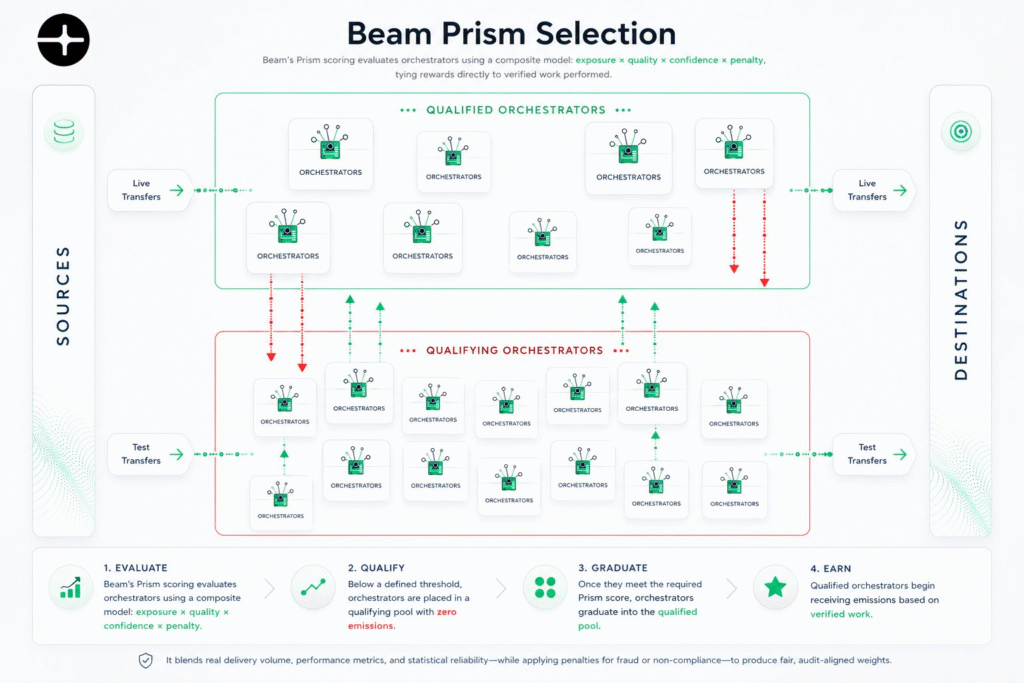
Orchestrators on Beam are split into two distinct pools based on whether their Prism score clears a defined threshold:
a. The Qualifying Pool holds new orchestrators and nodes whose scores have dropped below threshold. These orchestrators only handle test transfers, which allows them to prove their capabilities in a sandboxed environment without exposure to live user data.
They earn zero emissions while in this pool.
b. The Qualified Pool holds orchestrators that have proven themselves or maintained high Prism scores. These orchestrators handle live transfers and are eligible to receive network emissions tied directly to the verified work they perform.
The split ensures that emissions flow only to operators who have demonstrated they can actually deliver, while giving new entrants a structured path to earn their way into the live network.
Promotion and Demotion
Prism operates as a fluid loop rather than a permanent status assignment, with orchestrators moving between pools based on ongoing performance:
a. Graduation: When a node in the qualifying pool handles test transfers efficiently enough to push its composite score above the network threshold, it ascends into the qualified pool and becomes eligible for emissions.
b. Demotion: When a qualified node fails to maintain performance or triggers fraud penalties, its score drops and the node is moved back into the qualifying pool, losing access to live traffic and emissions until performance recovers.
The dynamic loop keeps the network self-correcting. Orchestrators that drift in quality are filtered out of the emission flow automatically, while new operators earn their way in through demonstrated competence rather than positioning or relationships.
Conclusion
Prism is the layer that turns Beam from a coordination protocol into a market. By replacing static weights and hidden allocation logic with a transparent scoring formula tied to verified work, the network now distributes emissions only to orchestrators who have proven they can deliver.
The system is dynamic by design, with promotion and demotion both driven by the same composite score, and the public release of the repository and documentation puts the entire mechanism under community audit. The buffer period closes on Friday, May 15, after which transfer activity scales to full capacity under the new system.
Enjoyed this article? Join our newsletter
Get the latest TAO & Bittensor news straight to your inbox.
We respect your privacy. Unsubscribe anytime.
Enjoyed this article?
Join our newsletter
Get the latest TAO & Bittensor news straight to your inbox — every morning before markets open.



No comments yet — be the first.