


Bittensor’s subnet ecosystem has crossed a new commercial milestone, with annualized revenue from paying external customers now exceeding $50 million.
That is up more than 40% from the $32 million to $35 million range recorded just one month earlier. The growth reflects a broader shift across the network as subnets turn useful intelligence into products and services customers are willing to pay for.
As more of that revenue flows into alpha token buybacks, Bittensor’s economic model is also beginning to evolve.
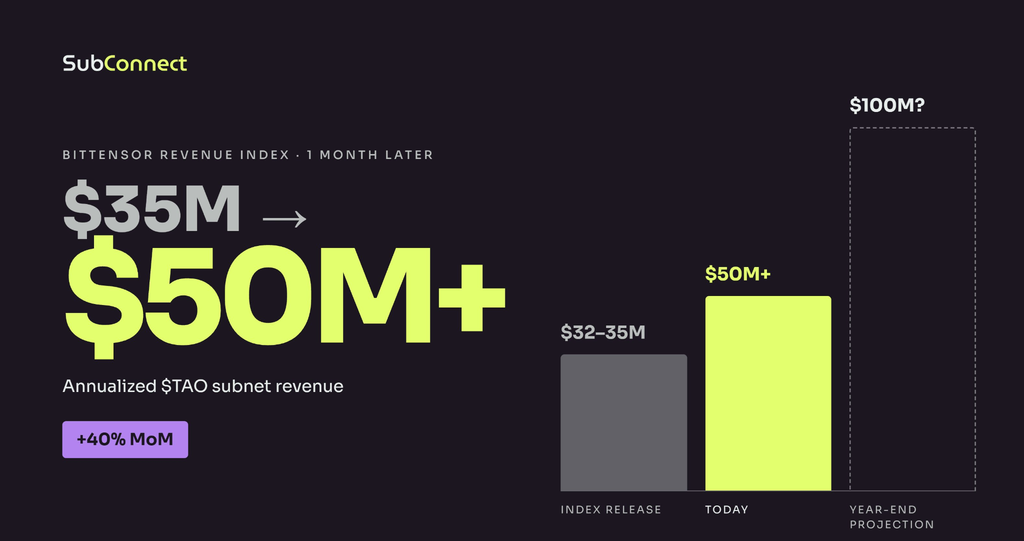
The latest figures come from SubConnect’s Bittensor Revenue Index, which began tracking off-network revenue across the ecosystem in late August.
Its first report identified roughly two dozen subnets generating between $28 million and $35 million in annualized revenue. Most of that activity was concentrated in compute and infrastructure. Lium (SN51) was estimated at $8 – $10 million, Targon (SN4) at $5.5 – $6 million, and Chutes (SN64) at $4 – $5 million. Together, the three accounted for close to half of the verified total. 14 revenue-generating subnets were also already using part of their earnings for alpha buybacks.
Since then, much of the growth has come from continued expansion at Lium (SN51) and Targon (SN4), alongside revenue from Engy (SN53). Bitcast (SN93) and Almanac (SN41) have also maintained strong growth, while Score (SN44) and Vanta (SN8) have started revenue-funded alpha buyback programs.
The pace is now running ahead of SubConnect’s earlier expectations. Its previous projection placed Bittensor subnet revenue at around $100 million annualized by the end of the year. If the current rate continues, that target could arrive sooner.
This shows the emergence of a stronger commercial layer around Bittensor. External demand for compute, inference, enterprise tools, and other AI services is creating revenue outside the network’s emission system.
Some of that money is then flowing back into subnet tokens through buybacks. This gives successful subnets another source of economic support.
Bittensor’s earlier phase showed that decentralized competition could produce useful intelligence. The next phase is increasingly about turning that intelligence into businesses with real customers and real revenue.
➛ Read More on SubConnect’s Bittensor Revenue Index Debut:
Enjoyed this article? Join our newsletter
Get the latest TAO & Bittensor news straight to your inbox.
We respect your privacy. Unsubscribe anytime.
Enjoyed this article?
Join our newsletter
Get the latest TAO & Bittensor news straight to your inbox — every morning before markets open.



No comments yet — be the first.