

Robotics hardware is getting better at walking, lifting, gripping and performing complex movements, but teaching those machines to understand and act reliably in the real world remains much harder. That challenge was at the center of OpenRoboto (SN80)’s appearance on Novelty Search.
Since launching at the end of July, the subnet has focused on using Bittensor miners to improve open robotics models. Now, it is expanding into a broader robotics pipeline covering real-world data collection, stronger benchmarks, and physical robot testing.
The Next Bottleneck Is Real-World Robot Data
Large language models had decades of internet text to learn from, while robotics still lacks a comparable dataset showing how people interact with objects and environments. Traditional robotics data collection often requires humans to manually control robot arms, which becomes slow and expensive at scale.
A newer approach is egocentric data, or first-person footage showing people performing physical tasks with their hands visible. This makes it possible to collect useful training data while people carry out normal work instead of operating a robot for every example. OpenRoboto (SN80) is now building its own network around that model.
OpenRoboto Shift Takes Data Collection Into Real Workplaces
OpenRoboto Shift uses wearable devices called OR-S1 and OR-S2 to collect first-person robotics data. The devices were developed with General Intelligence Labs for use in workplaces like factories, warehouses and stores.
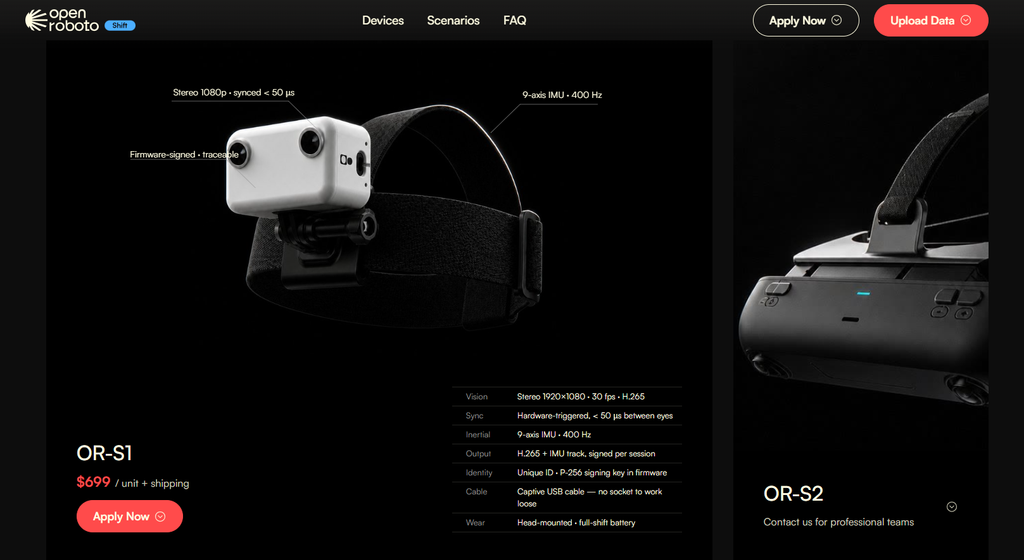
Participants wear the devices while doing their normal work and are rewarded through Bittensor emissions for effective collection hours. OpenRoboto disclosed that about eight devices were already active, with roughly 20 more preparing to come online, and around 67 hours of data collected that week.
The devices use multiple cameras to capture depth alongside video, giving robotics models richer data than standard phone footage. They also record sensor data in a consistent format, making the resulting datasets easier to verify, process and use for robotics training.
The Data Is Designed to Feed Both Revenue and Research
OpenRoboto plans to connect the new data collection track directly to both revenue generation and model training. The SN80 team described it as two linked loops, where commercial demand for robotics data eventually feeds back into the subnet’s research.
1. Workers collect real-world activity data.
2. OpenRoboto packages the resulting datasets.
3. Data buyers purchase access.
4. The data later enters the open research pool.
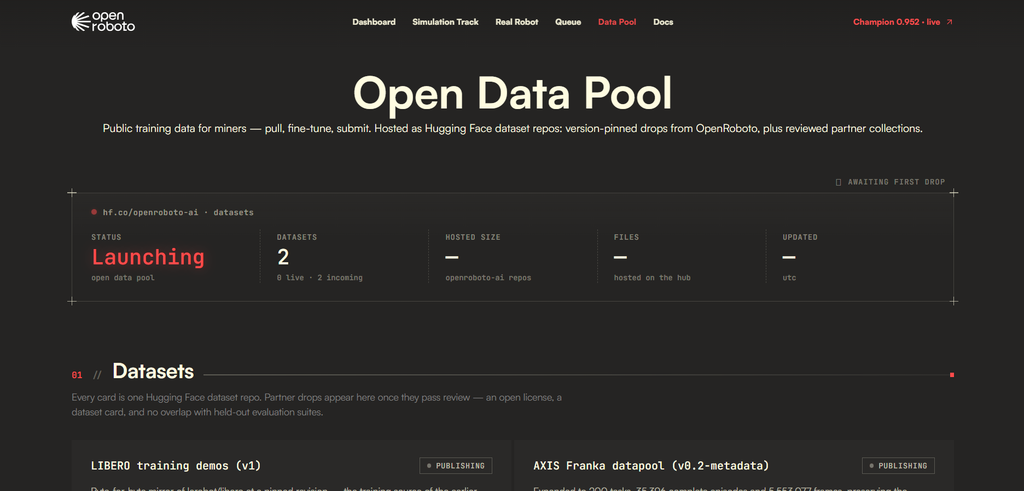
5. Miners use it to train better robotics models.
OpenRoboto describes this as a system where the revenue loop helps fuel the research loop, giving the subnet a commercial path while expanding the data available to miners.
OpenRoboto Is Also Moving Beyond Simulation
Better data alone does not guarantee better robots, which is why OpenRoboto is now testing models on physical hardware as well as in simulation. Strong simulation results can fail in the real world because of small differences in physics, lighting, positioning, friction, and hardware, a problem known as the sim-to-real gap.
OpenRoboto has built a physical testing station around a UFactory xArm 6 and launched a separate real-robot track.
In its first season, only two models reached the qualification stage, while several models submitted from simulation failed to perform successfully on the physical robot. The new track gives OpenRoboto a more practical way to test whether leaderboard improvements actually translate into useful robot behavior.
Miners Already Forced OpenRoboto to Build a Harder Benchmark
OpenRoboto originally used LIBERO-Pro, a robotics benchmark containing 160 simulated tasks with built-in randomization. Miners progressed through it quickly, showing how fast the subnet could improve models when they were competing against the same evaluation set.
Within roughly 30 days, OpenRoboto recorded:
1. 187 model submissions
2. 11 generations of champion models
3. An improvement from roughly 55% success to nearly 90% on the benchmark
That progress also meant the benchmark was starting to become too easy. OpenRoboto then worked with Axis Robotics to build Open Axis, a much larger evaluation environment designed to keep testing whether models can handle new and unfamiliar situations.
OpenRoboto Is Connecting the Pieces
What started as a competition for improving open robotics models is becoming a much broader system. OpenRoboto now brings together miners improving models, workers collecting real-world data, larger benchmarks testing generalization, and physical robots checking whether simulation gains hold up in the real world.
Each part feeds the next, with better data supporting stronger models, harder tests exposing weaknesses, and commercial demand helping fund more data collection. Just over two months after launch, OpenRoboto is moving beyond a robotics leaderboard toward infrastructure that can continuously train, test, and improve open robot intelligence.
Enjoyed this article? Join our newsletter
Get the latest TAO & Bittensor news straight to your inbox.
We respect your privacy. Unsubscribe anytime.
Enjoyed this article?
Join our newsletter
Get the latest TAO & Bittensor news straight to your inbox — every morning before markets open.

No comments yet — be the first.