

On Bittensor, validator choice often matters more than subnet choice, and most stakers never notice. The default behavior across the ecosystem is to spend time choosing which subnet to stake into, then accept whichever validator the interface presents first or the one with the largest visible name.
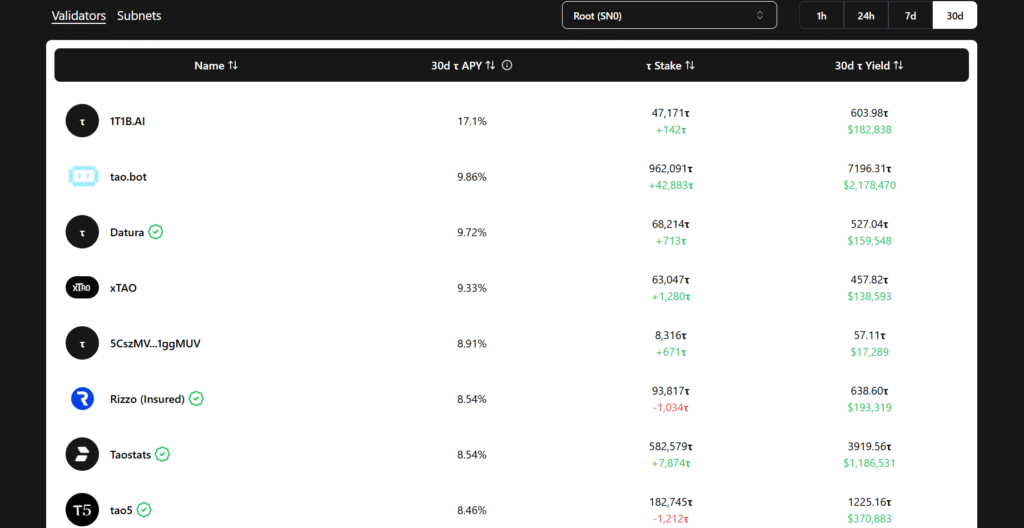
On any subnet, the default approach has a measurable cost. Let’s assume that the top validator on a subnet is paying 125% APY (Annual Percentage Yield) over the trailing month, while the bottom validator on the same subnet, with the same underlying $SN15 and the same infrastructure underneath, is paying 85%.
The 40-point spread compounds quietly across the year, and most stakers never run the numbers.
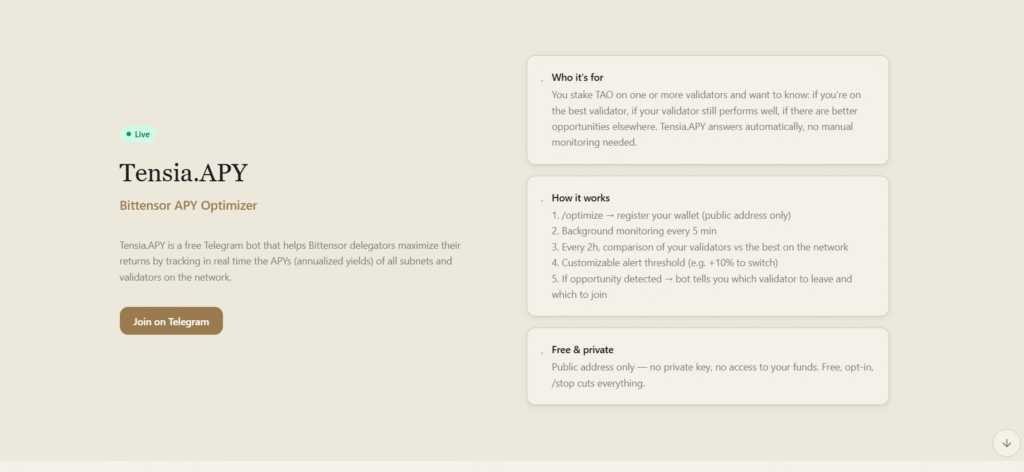
Tensia APY is the new Telegram bot built to surface that spread in real time and turns validator optimization into a process rather than a guess.
The Math Behind the Spread
Take 10 $TAO staked on this subnet for a year, and the cost of an inattentive validator choice becomes concrete:
a. At 125% APY, the position grows to roughly 22.5 $TAO.
b. At 85% APY, the same position grows to 18.5 $TAO.
c. The cost of the wrong validator is 4 $TAO of yield lost to a decision most stakers spend less than a minute making.
APY also functions as a structural shield against drawdowns and as an amplifier on the upside, which is the part most stakers underweight.
Across a six-month window where the $ALPHA price drops 30%:
a. On the lower-yield validator, the position converts back to 9.98 $TAO at the lower price and ends flat after six months of capital lockup.
b. On the higher-yield validator, the same position converts to 11.38 $TAO, with the yield absorbing the drawdown entirely.
c. If the subnet returns to its starting price, the higher-yield position is up 62% on the original capital, purely from compounded yield captured during the dip.
d. If the subnet pushes 50% above starting price, which is not unusual on Bittensor, the same ten TAO converts to roughly 24.4 $TAO, a 2.4x on the initial stake.
The informed move during the drawdown is not to exit but to stay, keep accumulating $ALPHA at the higher APY while the price is depressed, and treat the bleed as an accumulation phase rather than a loss.
The validator decision determines how fast that accumulation happens and how aggressively the position compounds on the way back up.
Two Windows Worth Exploiting
There are two market conditions where APY behavior diverges sharply from what most stakers expect, and both create opportunities for anyone watching closely:
a. Desertion of an Established Subnet: When stakers move $TAO back to root, the total stake on the subnet drops while $ALPHA emissions keep flowing at the same rate. Individual APYs rise mechanically because fewer participants are sharing the same emission pool.
The market often reads desertion as a negative signal and accelerates the exit, which further inflates the APY for anyone willing to stay. Both the high yield captured during the exit phase and the eventual price recovery when stake flows back reward the staker who did not run.
b. Opening Weeks of a New Subnet: With only two or three validators active and a tiny stake pool, emissions flow normally against a much smaller denominator. APYs in this window routinely run between 1,500% and 4,000% before stake catches up and brings the rate back to normal.
$ALPHA accumulates fast at low prices, and when the subnet attracts visibility and stake weeks later, the bag built during those early days takes on a value the market could not have priced at the start.
Catching either window manually is the part that has historically been impossible at scale. It requires constant comparison of validators across one-hour, daily, weekly, and monthly windows on Taostats, alongside continuous tracking of every new subnet registration the moment it happens. That monitoring layer is what Tensia APY automates.
How to Use Tensia APY

The bot lives on Telegram, it is free to use, read-only by design, and never requires a private key or seed phrase at any point.
There are four commands that cover the full workflow:
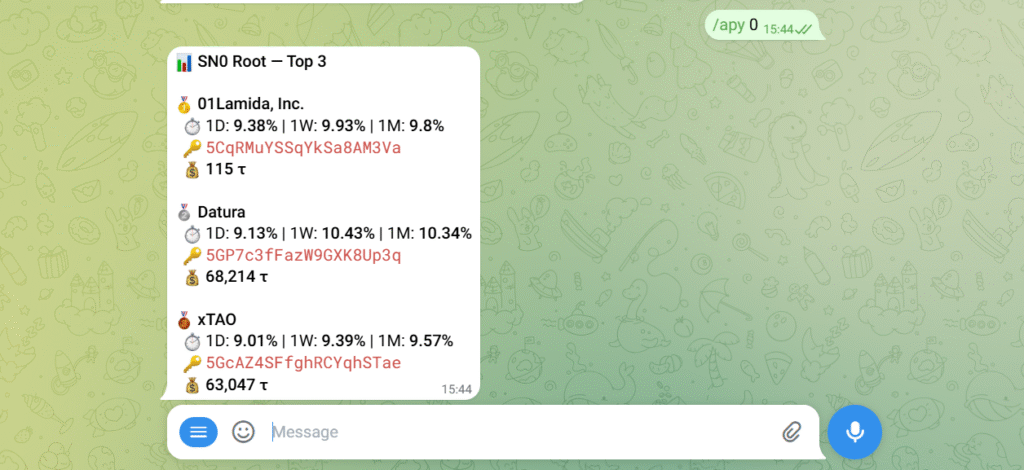
a. /apy [subnet number]: returns the best-performing validators on a specific subnet across one-hour, daily, weekly, and monthly windows. Useful for any staker actively evaluating where to place a new position on a known subnet.
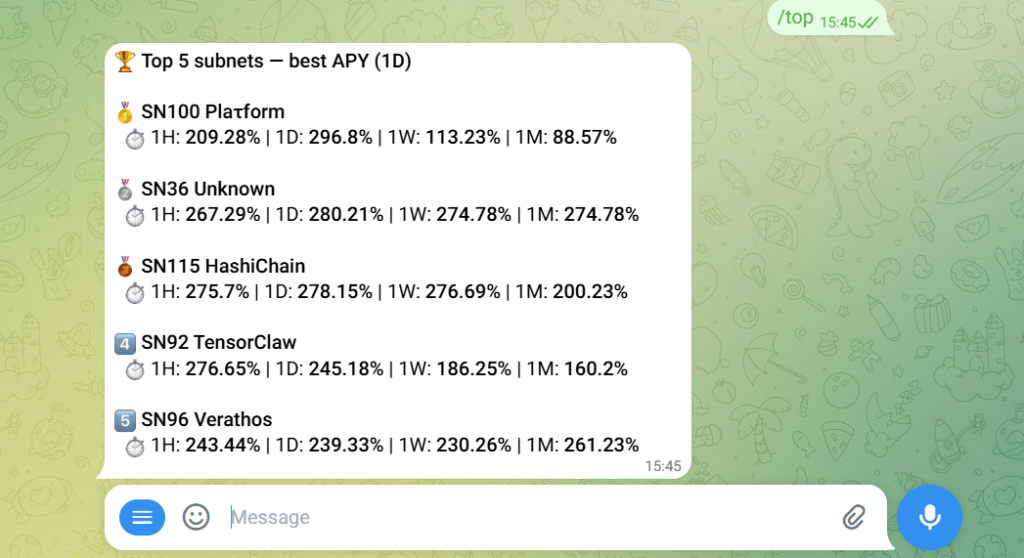
b. /top: returns the network-wide ranking of subnets by current APY. Desertion windows and early-bird windows surface clearly here, because both produce APYs that sit visibly above the network average.
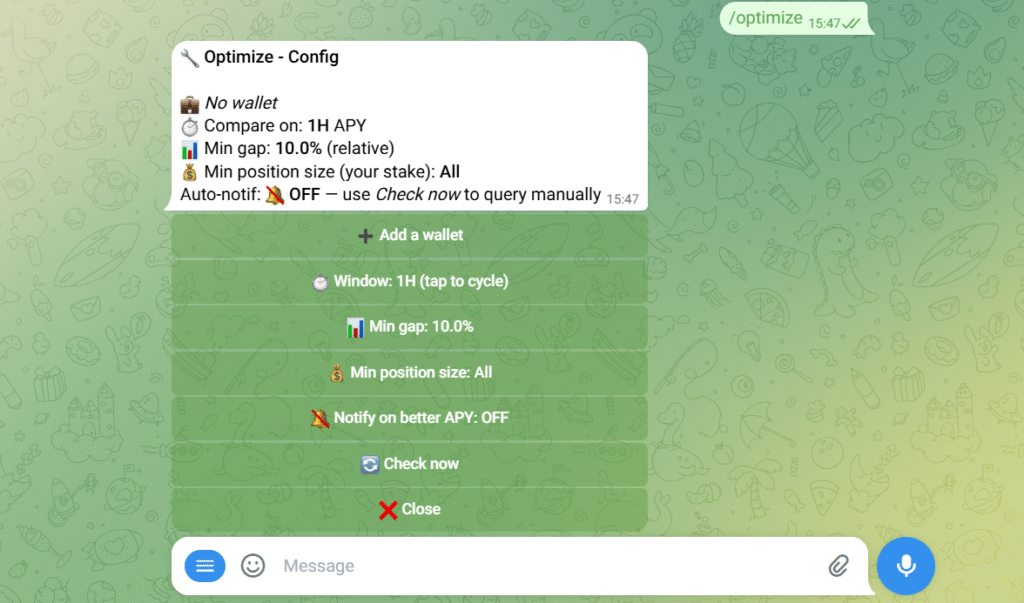
c. /optimize: the core monitoring command. The staker registers a public wallet address only, and the bot continuously compares existing validator positions against the best alternatives available on the network. Every two hours, the bot sends a clear comparison report covering which validators are underperforming, which alternatives are paying more, and exactly how much yield is being left on the table at current rates.
A user-defined trigger threshold (for example, alert me only if a validator is paying at least 10% more than mine) keeps the alerts relevant rather than noisy. When an opportunity crosses that threshold, the alert specifies which validator to leave and which one to join.
The Larger Tensia Stack
Tensia APY is not a standalone product. It pairs with Tensia.Bot, the on-chain observer the ecosystem has been using to track wallet movements, alpha price swings, large transfers, owner changes, and failed transactions across the network.
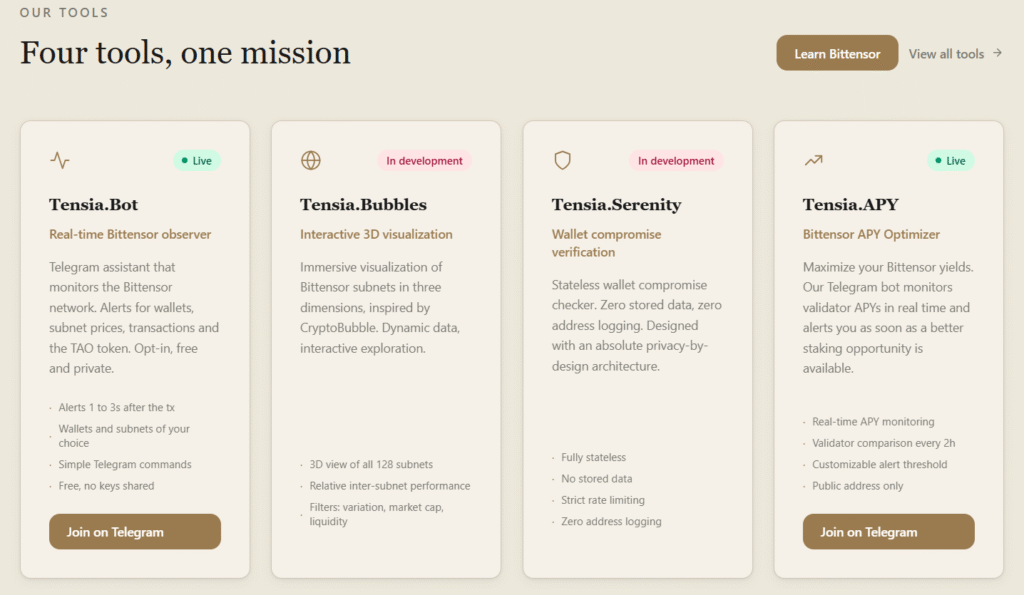
Tensia.Bot covers what is happening on Bittensor in real time, while Tensia APY covers where capital should actually be in response. Used together, the two tools cover both halves of the operational decision a serious staker has to make. The combination is what Tensia describes as operational clarity, and the underlying claim is that clarity itself is alpha when most participants are still operating from incomplete information.
Conclusion
Validator selection is the staking decision most underweighted across Bittensor, and the cost compounds across ordinary drawdowns, subnet desertions, and the early-bird windows that open when new subnets register.
Tensia APY automates the monitoring layer that has historically been impossible to maintain manually, surfaces the opportunities the moment they appear, and keeps the entire process read-only and verifiable.
For any staker still picking validators by reputation, alphabetical order, or interface defaults, the upgrade is overdue.
Enjoyed this article? Join our newsletter
Get the latest TAO & Bittensor news straight to your inbox.
We respect your privacy. Unsubscribe anytime.
Enjoyed this article?
Join our newsletter
Get the latest TAO & Bittensor news straight to your inbox — every morning before markets open.


No comments yet — be the first.