

The Bittensor ecosystem is growing quickly: New subnets are launching, subnet ‘$ALPHA’ tokens are appearing across the network, and the economic layer around decentralized AI is becoming more complex by the month.
But with growth comes friction.
During Bittensor Revenue Search 69, hosts Siam Kidd and Mark Creaser sat down with Tommi Vuorenmaa from MVTRX (Subnet 79) to unpack a question that is becoming increasingly important for the ecosystem: How do you actually trade $ALPHA efficiently as the network expands?
The conversation quickly moved beyond simple market speculation. Instead, it focused on infrastructure, liquidity, risk management, and the tools needed to make Bittensor’s markets work at scale.
At the center of that discussion was Subnet 79, MVTRX.
The Real Problem: $ALPHA Are Hard to Trade at Scale
Early in the conversation, Siam pointed out something many participants in the ecosystem already feel but rarely articulate.
Bittensor has created a fascinating economic system where each subnet effectively becomes its own micro-economy, but the infrastructure for trading those economies is still evolving. Tommi agreed.
From his perspective, the challenge is not simply volatility. Volatility is normal in emerging markets. The deeper issue is that liquidity can be uneven, especially when larger positions enter or exit the market.
As Mark noted during the discussion, when liquidity is thin, even a single large order can create significant slippage. That discourages serious capital from entering the ecosystem.
Tommi summarized the problem clearly. He noted that if investors cannot manage risk efficiently across multiple subnets, they will struggle to build diversified portfolios. And without diversified portfolios, the broader subnet economy cannot reach its full potential.
MVTRX Subnet 79 was designed with that challenge in mind.
From Taos to MVTRX: A Broader Vision
Subnet 79 was originally known as Taos, and the project has since rebranded to MVTRX (pronounced as Matrix), reflecting a broader ambition than simply creating another trading platform.
Tommi explained that the goal is to build an exchange infrastructure specifically tailored to the dynamics of Bittensor’s $ALPHA markets.
But the interesting part is where the system begins.
Instead of launching directly into a live trading environment, MVTRX starts with a simulation sandbox, and at this point, Mark immediately picked up on this point during the discussion. He asked why the team is starting out with a simulation instead of simply building the exchange first.
Tommi’s answer was that serious trading systems are rarely deployed without extensive testing. Institutional trading firms often run thousands of simulated market scenarios before releasing an algorithm into the wild.
MVTRX brings that same philosophy into Bittensor.
The Simulation Sandbox: Testing Trading Strategies Before They Go Live
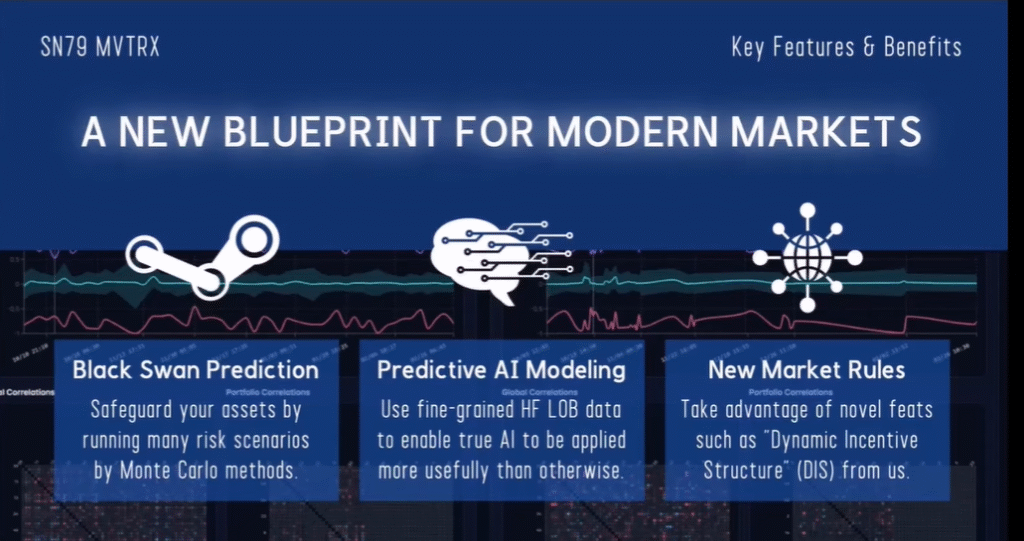
Inside the MVTRX sandbox, trading algorithms can be tested against simulated markets before they interact with real capital.
Tommi explained that the system currently runs around 80 simultaneous market simulations.
Each simulation includes detailed limit order books, complete with multiple bid and ask levels, allowing trading algorithms to experience market conditions that resemble real trading environments.
This? Siam found it particularly interesting! Traditional backtesting only uses historical data, which represents a single timeline of events, but simulated environments allow algorithms to explore many different market conditions.
Tommi confirmed this point. By generating multiple simulated market paths, developers can test how strategies behave under very different scenarios. Under this, some simulations may reflect calm markets, while others may generate sudden volatility or liquidity gaps.
This helps traders answer an important question before deploying capital: How does a strategy behave when conditions suddenly change?
Simulating Rare Market Events
Another topic that caught Mark’s attention during the conversation was the potential to study extreme market events.
Flash crashes and sudden market disruptions are notoriously difficult to predict because they occur so rarely in real datasets.
Tommi explained that simulation offers a potential solution. He explained that by generating many parallel market scenarios, the sandbox can produce situations that resemble rare market disruptions. These scenarios can then be used to train algorithms to detect patterns that might precede such events.
Over time, this could help trading systems recognize early warning signals and reduce exposure before volatility escalates.
For traders and investors, that kind of insight could be extremely valuable.
Dynamic Incentives for Healthier Markets
Beyond simulation, MVTRX is also experimenting with a different approach to exchange incentives. Most trading platforms rely on a fairly simple model: Like liquidity providers (known as market ‘makers’) receive rebates, and traders who take liquidity pay fees.
Tommi explained that MVTRX plans to introduce dynamic incentives that adapt to market conditions. Siam immediately jumped in to clarify how that would work.
Based on further clarifications, it’s seen that instead of fixed fee structures, the system adjusts rewards depending on what the market currently needs most.
For example:
a. If liquidity providers are scarce, incentives for makers increase, and
b. If price discovery becomes the priority, takers may receive better incentives.
Mark pointed out that this could help stabilize markets during periods of stress, Tommi aligned with him on this as the goal has been to encourage exactly the kind of trading behavior that keeps markets functioning smoothly.
In volatile environments, this flexibility could help reduce liquidity gaps and sudden price swings.
Building an Ecosystem for Algorithm Developers
MVTRX is not only about trading infrastructure, it is also designed to support the developers who build the algorithms that power these markets.
Tommi explained that several tools are being introduced to make participation easier. These include:
a. A miner service that allows participants to run subnet miners without infrastructure costs if they hold MVTRX $ALPHA,
b. A marketplace for trading algorithm templates, and
c. Free starter templates for developers entering the ecosystem.
Siam noted that lowering the barrier to entry could encourage a much larger community of developers to experiment with trading strategies. This would mean more participants, and more diverse approaches, which ultimately leads to stronger markets.
How MVTRX Plans to Generate Revenue
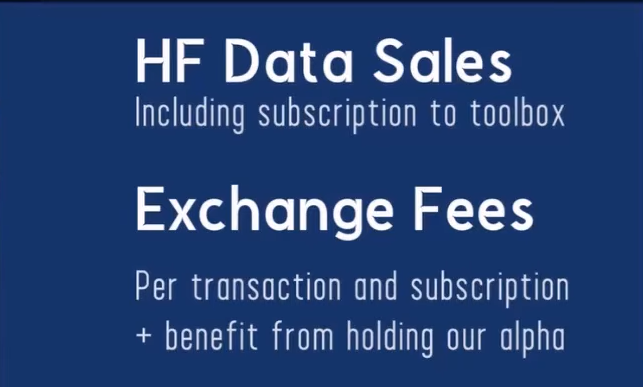
Of course, any subnet that wants to survive long-term needs a sustainable economic model. Tommi outlined two primary revenue streams for MVTRX:
a. The first pretty follows traditional exchanges’, the platform will collect transaction fees from trades executed on the network.
These fees may follow a tiered structure that rewards participants who hold MVTRX’s $ALPHA.
b. The second revenue stream comes from something more unusual. Since the simulation framework generates extremely detailed market data across many simulated environments, the resulting datasets may have value beyond the exchange itself.
Institutions, researchers, and algorithm developers may be interested in licensing these datasets to test trading models or study market behavior.
Mark highlighted that this could turn MVTRX into both an exchange and a research platform for market microstructure.
What Comes Next for Subnet 79
The project is still evolving, but several milestones are already planned.
Tommi explained that the next major step is launching a beta version of the live exchange for miners.
Initially, miners within Subnet 79 will be able to execute real $ALPHA trades while continuing to participate in the mining process.
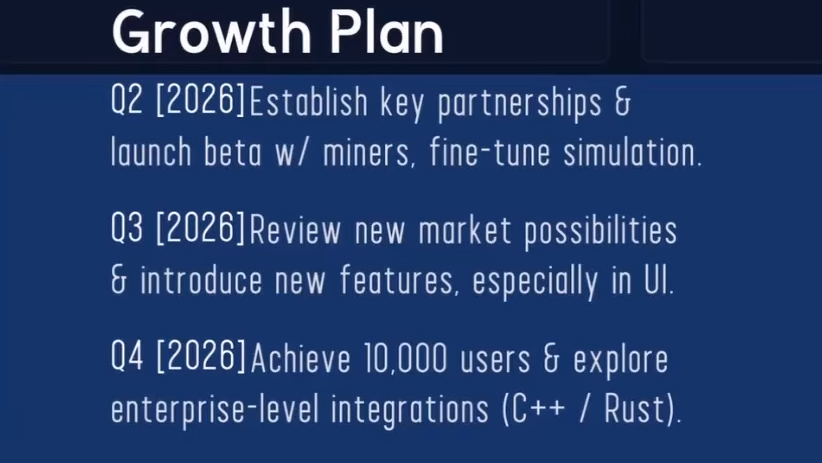
Beyond that, the roadmap includes several priorities:
a. Expanding the simulation environment,
b. Launching a full trading interface,
c. Partnering with other Bittensor subnets, and
d. Introducing more advanced trading tools.
Siam summed it up well during the conversation. He noted that the vision is not simply to build another trading venue, it is to create a system where simulation, algorithm development, and live trading reinforce one another.
A Step Toward a More Mature Bittensor Economy
As the discussion wrapped up, it became clear that Bittensor’s technology has advanced rapidly, but its financial infrastructure is still catching up.
Subnet 79 represents an effort to close that gap.
By combining simulated markets, algorithm research, adaptive trading incentives, and a dedicated exchange for alpha tokens, MVTRX is attempting to build the kind of infrastructure that a complex decentralized economy eventually needs.
This alone could make Bittensor’s subnet markets more liquid, more resilient, and more accessible to both developers and investors.
As Siam noted toward the end of the conversation, the real significance may be bigger than one subnet. It may signal the beginning of a more mature financial layer for decentralized AI.
WATCH THE FULL PODCAST BELOW:
Enjoyed this article? Join our newsletter
Get the latest TAO & Bittensor news straight to your inbox.
We respect your privacy. Unsubscribe anytime.
Enjoyed this article?
Join our newsletter
Get the latest TAO & Bittensor news straight to your inbox — every morning before markets open.


No comments yet — be the first.