

There is a version of the Bittensor origin story that plays out more often than anyone likes to admit. A researcher has an idea, registers a subnet to fund development, uses $ALPHA emissions to cover running costs, and hopes a real business emerges somewhere down the line.
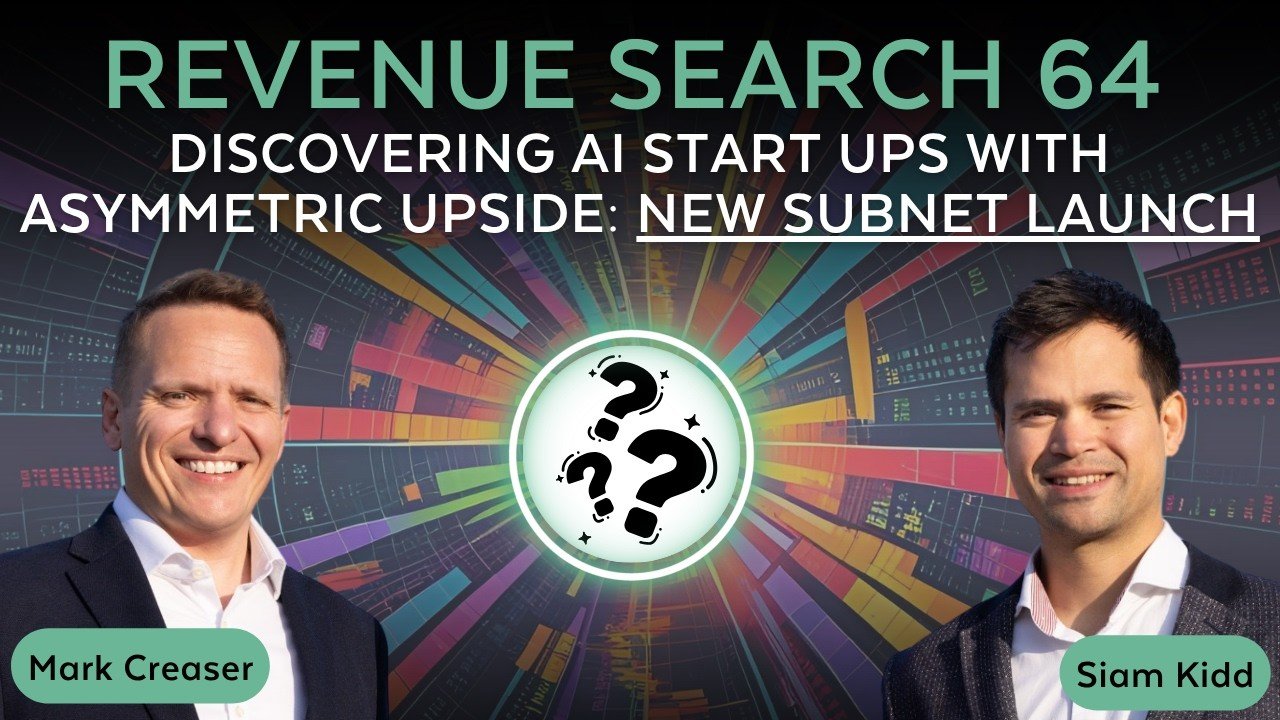
Episode 64 of the Revenue Search, hosted by Siam Kidd and Mark Creaser, introduced someone who fits that pattern in reverse. Josh Riddett came with a decade of operating history, live enterprise contracts, six-figure monthly revenue, and over 50 renewable energy sites already operational across the UK.
For Green Compute (Bittensor Subnet 110), it is the next chapter of one that is already working.
Who Josh Is and What He Built

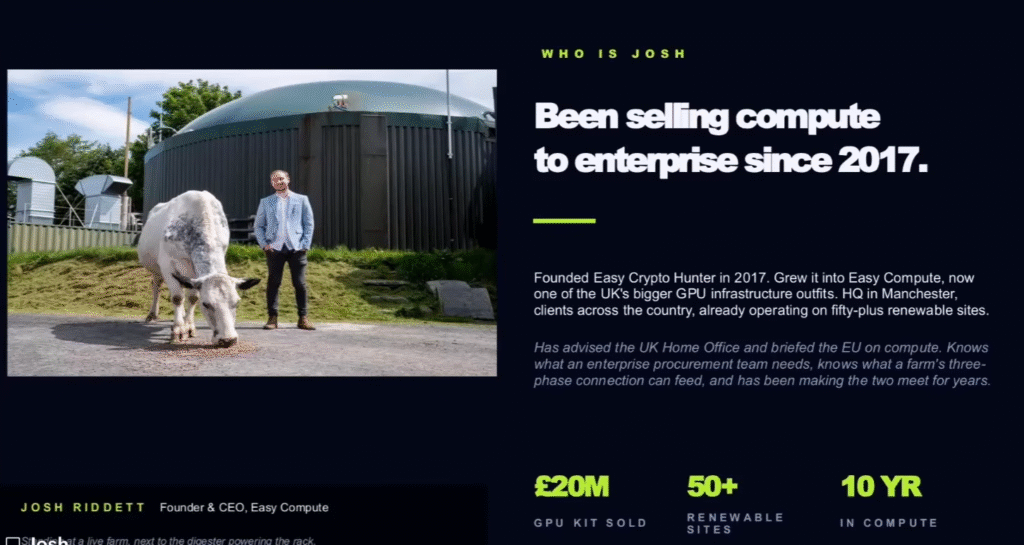
Josh founded Easy Crypto Hunter in 2017, growing it into one of the UK’s largest GPU hardware manufacturers through the Ethereum mining era and into the AI infrastructure wave of the past two years.
He has built and sold millions of pounds worth of compute equipment to high-net-worth investors, developed a client base of over 400 customers, and built deep relationships with the renewable energy farming community that now forms the backbone of Green Compute.
The transition from crypto mining hardware into AI inference was a natural evolution. The same 4090 and 5090 class GPUs that once powered Ethereum rigs now deliver inference workloads at a fraction of traditional enterprise data center costs, and Josh has spent years proving that model commercially.
As he said during the episode: “I am not coming at this with ‘trust me, I think this is a good idea.’ We are already doing it.” The subnet does not need to work for the business to survive. The business already works, and the subnet is how it scales.
The Problem Nobody Is Talking About: Constrained Power
The most striking part of Josh’s appearance on Revenue Search was a piece of energy infrastructure reality that most people in AI have never encountered. The UK energy grid has a structural problem called constrained power, and it is quietly destroying an enormous volume of clean energy every single day.
Renewable energy sites regularly generate more electricity than the local grid substation can distribute, and when that happens the surplus is simply wasted. Wind turbines spin into dump boxes that physically destroy overflow energy, solar farms shut down mid-afternoon because the local substation has hit its limit, hydropower sites go offline during heavy rainfall. Even, anaerobic digestion sites, which produce power continuously from agricultural waste, frequently generate hundreds of kilowatts that the grid cannot absorb and the farm cannot use.
At the same time, AI infrastructure is running into power access as its single biggest deployment bottleneck. Green Compute bridges these two problems by bringing data centers directly to where surplus power already exists.
The financial shift for site owners is immediate:
a. Selling excess power to the UK grid earns between 8 and 12 pence per kilowatt,
b. Running AI compute on the same power has returned over one pound per kilowatt for Josh’s existing clients, and
c. A standard 12-year payback period on a renewable energy installation can compress to four years with AI compute attached.
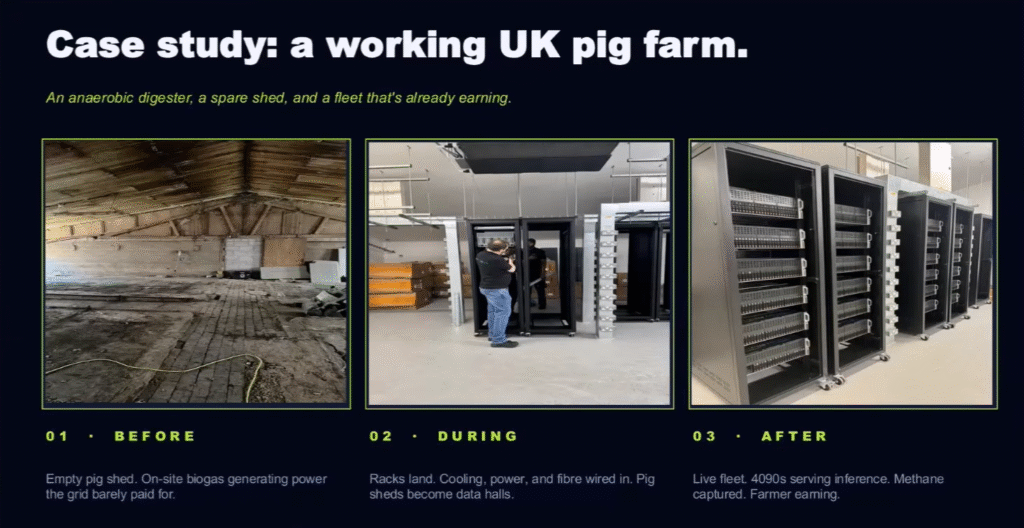
Josh described a Welsh farmer whose anaerobic digester produced a full megawatt while the local substation could only accept 500 kilowatts. After the farm’s own consumption, 400 kilowatts sat idle generating nothing. Green Compute converted a disused barn into a data hall and turned that dead capacity into one of the farm’s strongest income streams.
What Green Compute Offers That Others Do Not
Green Compute is not competing on price per GPU. The subnet is built for enterprise-grade inference workloads, and serving that market requires infrastructure discipline that does not currently exist elsewhere in the $TAO ecosystem. The differentiator here is symmetry.
Enterprise clients running serious inference workloads need hardware that is identical across the entire deployment: same GPU model, same CPU, matching RAM, consistent storage speeds, shared network architecture, and guaranteed uptime for the full contract duration. Mismatched hardware across a distributed cluster degrades load balancing and ruins workload performance regardless of the raw compute available. As Josh put it: “We get enterprise customers who want 500 GPUs, all of the same model, the same node configuration, the same everything. That symmetry simply does not exist in the $TAO ecosystem today.”
Beyond hardware, Green Compute offers something decentralized compute has largely abandoned: genuine human accessibility. Josh runs a sales team and technical team that clients can reach directly, negotiate with, and troubleshoot alongside. AWS and Azure cannot offer that.
He noted that his largest active contract runs at approximately $50,000 to $60,000 per month on a six-month term, with clients spanning enterprise AI companies, film studios, animation houses, universities, and private research institutions.
How the Subnet Works
Green Compute on Subnet 110 operates across three clearly defined roles:
a. Enterprise clients purchase compute through the platform on-demand or via multi-month dedicated contracts, payable in crypto or fiat,
b. Miners deploy approved GPU configurations on verified renewable energy sites and earn subnet alpha emissions for their participation, and
c. Validators manage workload distribution and quality assurance across the miner network.
Mining on Subnet 110 carries higher entry requirements than most Bittensor subnets, reflecting enterprise market realities rather than arbitrary restriction:
a. Minimum 10 gigabyte symmetrical internet connection,
b. Symmetrical hardware configurations focused on 4090 and 5090 GPU clusters with matching CPU, RAM, and storage across nodes,
c. Verifiable renewable energy sourcing confirmed through site inspection or video verification, and
d. Physical site management capability sufficient to guarantee sustained contract uptime.
Anyone can apply through the website, and anyone who meets the requirements can join.
The Tokenomics and Why They Are Different
Because Josh’s business is already profitable, Green Compute does not carry the $ALPHA sell pressure that burdens most subnet launches where token emissions fund operational costs. The flywheel runs on commercial demand instead.
Enterprise clients purchasing compute are encouraged to buy $SN110 to do so, creating buy-side pressure from companies with no existing $TAO exposure who need what the network provides. As revenue grows, hardware investment becomes more attractive for renewable energy site owners, expanding the compute pool, enabling larger contracts, and driving more external demand without the loop depending on continuous token issuance to stay alive.
What This Means for Bittensor
Siam made an observation near the end of the episode worth sitting with. He noted that the full AI stack runs from energy generation through storage, distribution, compute, data, training, and deployment. While Bittensor has built genuine capability across the middle and lower layers, the one layer that has remained entirely unaddressed is where the energy powering all of it actually comes from.
Green Compute is the first subnet to engage that layer with real infrastructure, real clients, and a revenue model already proven on the ground. As Josh put it: “If we end up with hundreds of megawatts of compute controlled on microsites across the UK, that is the very definition of decentralized architecture, which is the whole point of Bittensor in the first place.”
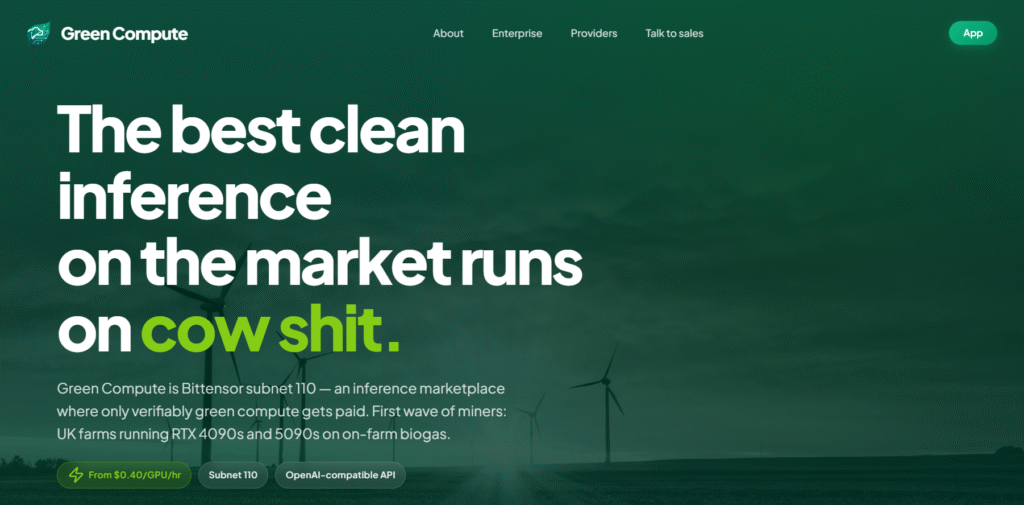
Green Compute is live on Subnet 110 at green-compute.com, with the sales team reachable directly and miner applications open through the site.
Enjoyed this article? Join our newsletter
Get the latest TAO & Bittensor news straight to your inbox.
We respect your privacy. Unsubscribe anytime.
Enjoyed this article?
Join our newsletter
Get the latest TAO & Bittensor news straight to your inbox — every morning before markets open.
No comments yet — be the first.