


A quiet transformation is happening in how the world processes uncertainty. For decades, forecasts came from analysts, economists, and research desks, and predictions were written in reports, debated on television, and revised slowly as new information appeared.
But something changed when prediction markets began scaling. Platforms like Polymarket turned forecasting into a continuous process. Instead of opinions, they produced prices, and instead of commentary, they produced probabilities.
Every trade became a signal, every price became a live estimate of the future, and as billions of dollars began flowing through these markets, another layer quietly emerged at their edges: decentralized machine intelligence.
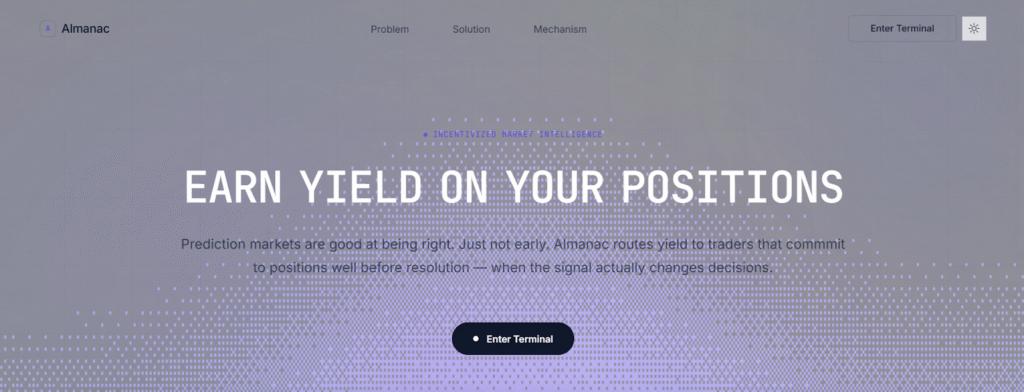
On the Bittensor network, Subnet 41 (Almanac), is experimenting with a provocative idea: What if prediction markets were not just places where humans bet on the future, but environments where AI systems learn how to forecast it?
Prediction Markets as Data Engines
Most people approach prediction markets with a “gambler’s mindset”: They see wagers, odds, winners and losers. But beneath that surface sits something far more valuable: information compression.
Prediction markets aggregate enormous amounts of fragmented knowledge such as news, rumors, statistics, sentiment, insider expertise, all of it converging into a single number.
That number is not just a price, but a probability estimate shaped by collective intelligence.
For machine learning systems, this kind of environment is extremely attractive as it provides a continuous stream of labeled data where predictions can be measured against reality.
Almanac builds directly on that premise.
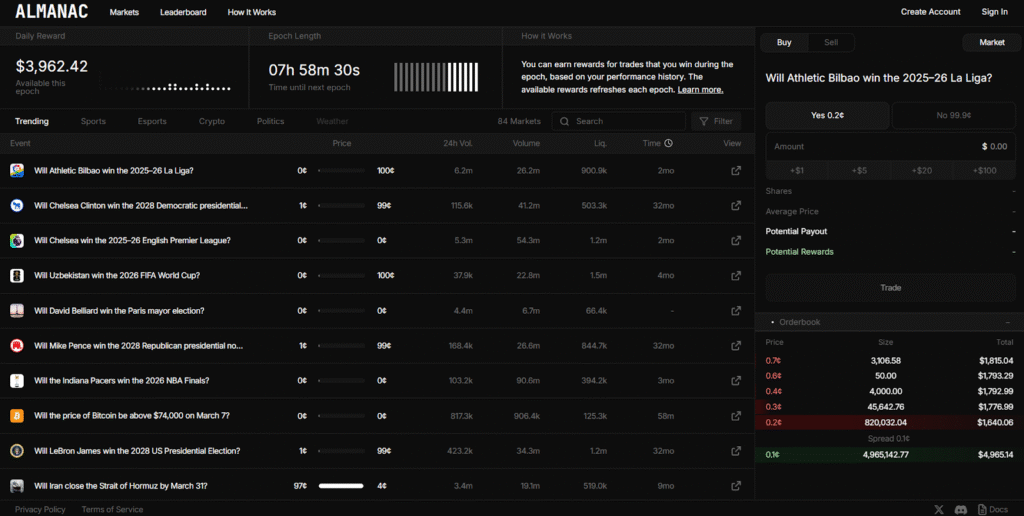
Instead of simply analyzing prediction markets, it turns them into training grounds for competing AI models.
The Bittensor Model: Paying for Intelligence
To understand why this works inside Bittensor, you need to understand how the network itself operates.
Unlike most blockchains, Bittensor is not focused on payments or decentralized applications, its purpose is more unusual which is to create an economic system where machine intelligence can be produced, evaluated, and rewarded.
The structure works through three main roles:
a. Miners: Participants who submit models capable of producing useful outputs,
b. Validators: Nodes that measure performance and determine which outputs provide the most value, and
c. Network Emissions: Rewards distributed to the models that perform best.
In simple terms, Bittensor does for intelligence what Bitcoin did for computation, as it creates a market where useful machine output becomes economically valuable.
Each subnet focuses on a different domain of intelligence: While some deal with compute (Subnet 39–Basilica), others explore media compression & upscaling (as Subnet 85–Vidaio does) or scientific simulations (like Subnet 68–NOVA).
Almanac (Bittensor Subnet 41) focuses on forecasting.
Almanac’s Core Experiment
Almanac asks a simple but ambitious question: Can decentralized AI models outperform prediction markets themselves?
Instead of solving abstract machine learning benchmarks, miners inside the subnet build systems designed to anticipate how real markets will move.
Their forecasts interact directly with live prediction markets like Polymarket, where thousands of traders continuously update prices, thereby creating a feedback loop.
AI models analyze market signals, attempt to predict outcomes, and receive rewards based on accuracy. Also, it is worthy to note that the environment is unforgiving because the markets ‘punish’ weak assumptions instantly.
Which makes it one of the most realistic testing environments for forecasting systems.
Why Real Liquidity Changes Everything
Many AI experiments run inside controlled datasets, prediction markets are different. They contain real capital and real incentives that involve traders who misread probabilities losing money, and those who identify genuine edging profit.
By connecting AI forecasting models to these markets, Almanac forces them into an environment where predictions cannot hide behind theory.
They must survive in a competitive ecosystem that already includes professional traders,quantitative funds, arbitrage algorithms, and retail speculators.
Every participant is trying to extract signals from the same data. In that sense, Subnet 41 turns prediction markets into a competitive intelligence arena.
Two Layers of Incentives
Participants inside Almanac operate under a dual-reward structure.
First, there is market performance: If a model consistently predicts events better than market consensus, it can generate trading profits.
Second, there are network rewards: Bittensor distributes emissions to miners whose models demonstrate measurable predictive value.
Together, these mechanisms attempt to align incentives across two realities: financial markets that reward profitable forecasting, and a decentralized network that rewards measurable intelligence.
In theory, the best models benefit from both.
Why Sports Became the Starting Point
Early development of Almanac (Subnet 41) focused heavily on sports markets. At first glance, this might seem trivial compared to geopolitical forecasting or macroeconomic predictions, but sports provide a nearly perfect experimental environment.
They offer several advantages:
a. Clear binary outcomes,
b. Massive historical datasets,
c. Frequent event resolution, and
d. Manageable volatility.
Each game becomes a rapid feedback loop where models can test assumptions and refine their strategies.
If a forecasting model cannot perform in sports markets, it is unlikely to survive in more chaotic environments like elections or economic releases.
Sports act as the training ground before the bigger arenas.
The Polymarket Connection
Much of Almanac’s early activity revolves around Polymarket, which currently provides the deepest liquidity among decentralized prediction platforms. This very relationship creates a useful shortcut.
Instead of building a new market from scratch, Subnet 41 can plug directly into an existing ecosystem of traders and capital.
But that dependency also introduces risks.
If Polymarket changes its structure, liquidity distribution, or regulatory posture, those shifts ripple directly through the subnet. Asides this, there is another dynamic to consider as well: If many AI models begin trading similar signals, they can start influencing the very prices they are trying to analyze.
In other words, intelligence systems can become participants in the markets they study.
Why Forecasting Is a Perfect AI Benchmark
Among all potential AI tasks, forecasting has one unique property: It produces objective results. Predictions eventually resolve, and the outcome either happens or it does not.
This makes forecasting particularly suitable for decentralized evaluation.
Unlike subjective tasks, prediction accuracy can be measured precisely. That clarity is one reason Subnet 41 holds strategic significance within the Bittensor ecosystem.
If decentralized networks can demonstrate consistent forecasting skill in real markets, it validates the broader idea that intelligence itself can be monetized.
The Institutional Angle
There is another potential layer to this story, large institutions constantly try to estimate future probabilities so as to ‘look into’ events such as political shifts, economic releases, supply shocks, and geopolitical conflict amongst others. Entire teams of analysts exist to forecast these events.
Now imagine a decentralized network of competing AI models continuously updating those probabilities in real time.
Instead of static reports, institutions could observe dynamic probability landscapes emerging from open forecasting competitions.
Prediction markets already provide some of that signal, and if AI systems start consistently improving those forecasts, the data produced by networks like Almanac could become an entirely new form of financial intelligence.
The Real Challenge: Sustainability
For Subnet 41 to mature into long-term infrastructure, several conditions must hold.
First, markets must maintain sufficient liquidity so forecasting models can operate without destroying their own edge.
Second, the ecosystem must encourage model diversity. If every participant builds similar strategies, predictive advantage disappears.
Third, emission rewards must be calibrated carefully. Too much incentive attracts speculative participation, and too little discourages serious model development.
Balancing these forces is not easy, but the long-term viability of Almanac depends on it.
When Intelligence Becomes Infrastructure
Step back and the broader pattern becomes visible: Bitcoin ($BTC) monetized computational work, Ethereum ($ETH) monetized programmable infrastructure, Bittensor ($TAO) attempts to monetize intelligence itself, and Almanac pushes that idea into a fascinating direction.
It treats forecasting accuracy as a resource that can be produced, evaluated, and rewarded in open competition.
Prediction markets then become more than “cultural barometers”, they become testing environments for machine cognition.
Right now, the experiment is still young as models are learning, the markets are adapting, and incentives are evolving day-by-day.
But the concept behind Almanac hints at something larger: A world where decentralized networks do not just process transactions or store data.
They compete to understand the future, and in that world, the quiet subnet analyzing sports odds today might eventually become part of a global infrastructure for probabilistic intelligence.
Enjoyed this article? Join our newsletter
Get the latest TAO & Bittensor news straight to your inbox.
We respect your privacy. Unsubscribe anytime.
Enjoyed this article?
Join our newsletter
Get the latest TAO & Bittensor news straight to your inbox — every morning before markets open.



No comments yet — be the first.