


A structural shift is unfolding in financial markets: What once required institutional infrastructure, quant teams, and specialized tools can now be executed by individual developers using rapidly advancing AI systems. As a result, the market for probabilistic financial data has expanded dramatically through a sharp increase in accessibility and participation. This change is creating a growing demand for reliable, real-time prediction data, and the infrastructure layer serving that demand is becoming increasingly important.
On Synth’s Q1 Alpha Call, James Ross, the founder of Synth (Bittensor Subnet 50), outlined how the platform is evolving to meet this moment. The discussion covered recent product developments, accelerating market demand, and the roadmap ahead, highlighting Synth’s transition from a forecasting tool into a core data layer for traders, institutions, and emerging AI-driven financial systems.
What Synth Is Building
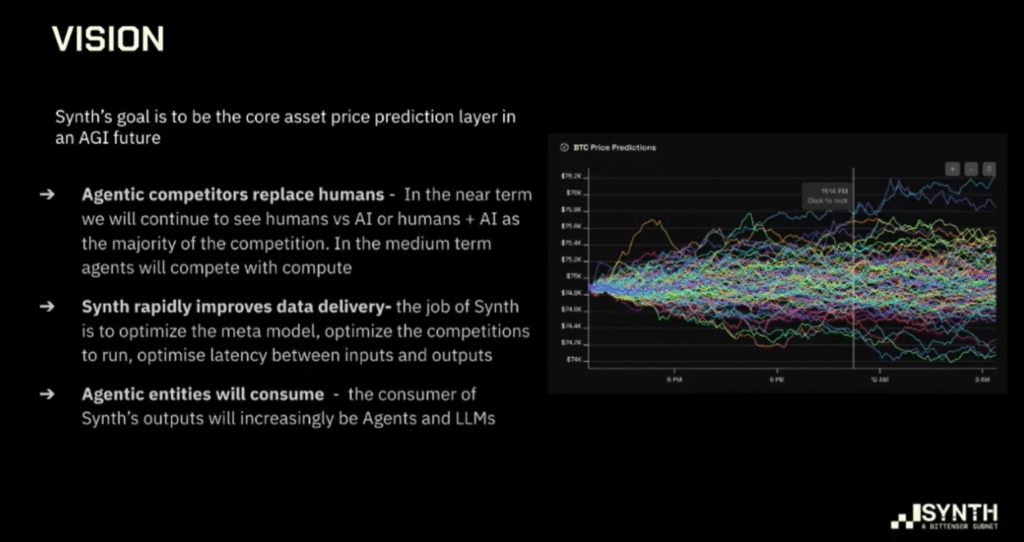
In practice, Synth (Subnet 50) operates as an engine sitting at the center of a data pipeline. It continuously synthesizes forecasts from a network of competing miners, runs that output through a meta model that filters and weights the best signals, and distributes clean probabilistic data to the funds, traders, and AI systems consuming it downstream.
The competition layer today is still largely human-assisted, with miners combining machine learning models alongside manual intervention and optimization. But as James noted on the call, the team is actively building toward a fully automated research loop, one where human involvement becomes progressively less necessary and the system grows sharper on its own.
Q1 by the Numbers
During the first quarter of 2026, the team moved from building to selling, from interesting to indispensable, and the metrics reflect that transition honestly.
A few things worth noting from James’s update:
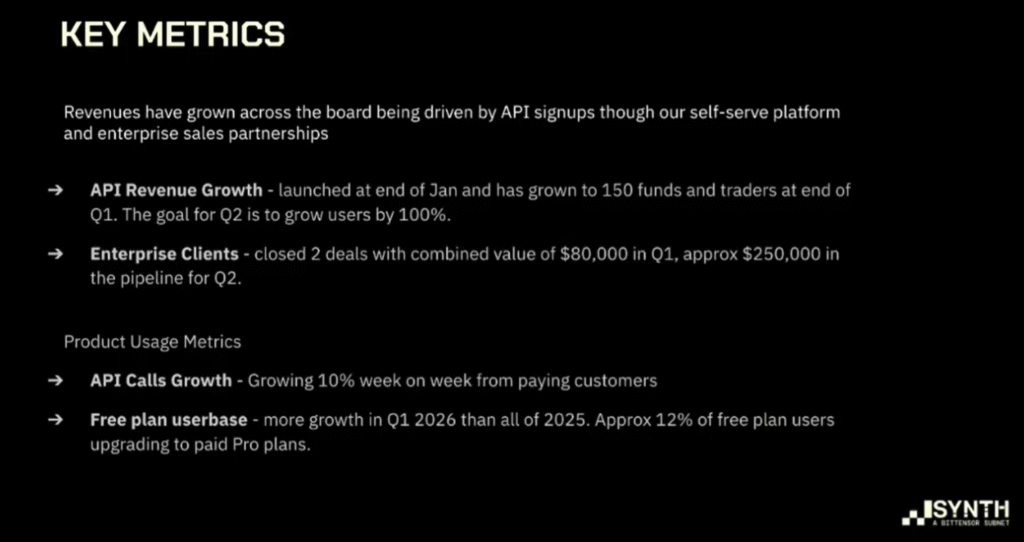
a. Synth closed Q1 at $70,000 in monthly recurring revenue, driven by direct API sales and two signed enterprise partnerships, with a healthy pipeline of hedge fund conversations building behind them.
b. The self-serve API, launched at the end of January, now serves approximately 150 funds and traders actively using the product in daily operations, with a goal to double that number through Q2.
c. A new $499 Pro-Unlimited plan was introduced to serve power users requesting millions of API calls per month, filling a gap that the existing tier structure was not capturing.
d. Free-to-paid conversion is running at approximately 12%, with dedicated effort planned to push that figure higher over the coming months.
e. The forecast refresh rate was reduced from 60 seconds down to 12-15 seconds, a meaningful improvement for traders integrating live data into fast-moving systems.
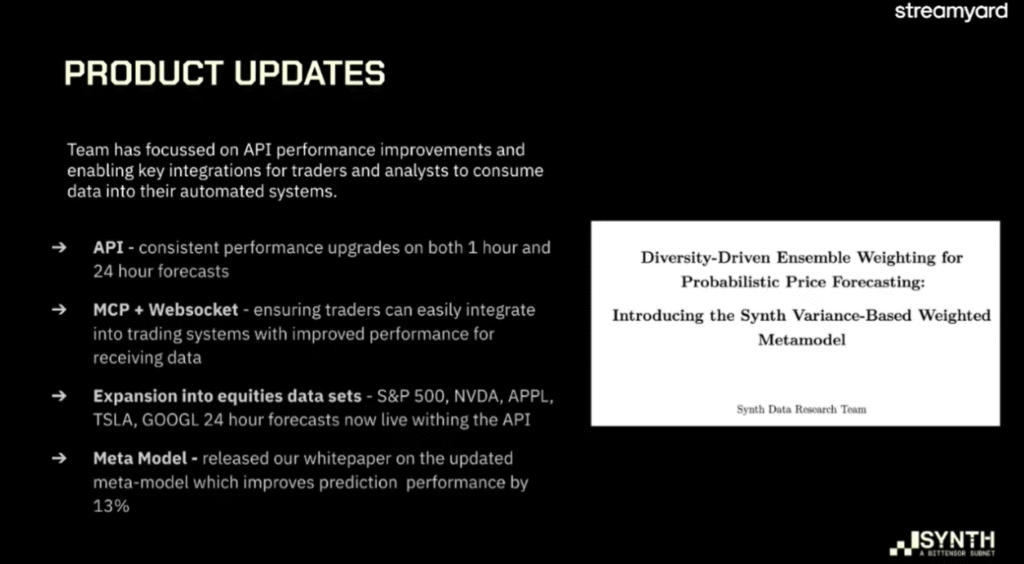
On the product side, asset coverage expanded considerably. Synth now models 12-13 assets spanning equities, commodities, and crypto, having added S&P 500, Nvidia, Apple, Tesla, Google, WTI Oil, Hype, and $XRP alongside the original $BTC core.
The meta model also received a significant architectural upgrade, with a new variance-based weighted design improving prediction performance by approximately 13%. The research team published a paper on this work, and James encouraged the community to read it closely for anyone tracking how the underlying forecasting quality is maturing.
Why the Market Has Changed Beneath Everyone’s Feet
One of the clearest takeaways from the call is how quickly Synth’s total addressable market has expanded. Just six to nine months ago, the number of people capable of deploying automated trading strategies sat around 100,000, largely limited to quants and institutions. Today, with AI tools lowering technical barriers, that number has grown to an estimated 10 million, marking a 100x shift driven by accessibility rather than marketing.
Platforms like Polymarket reflect this trend, with rising volumes and broader participation as more users deploy automated strategies. This directly increases demand for Synth’s probabilistic data, now used not only by institutions but also by a growing base of technically efficient individual traders.
What the Next Quarter Looks Like
The Q2 roadmap James laid out is focused, specific, and ambitious in the right ways. Rather than sprawling in every direction, the team has identified a handful of high-leverage priorities:
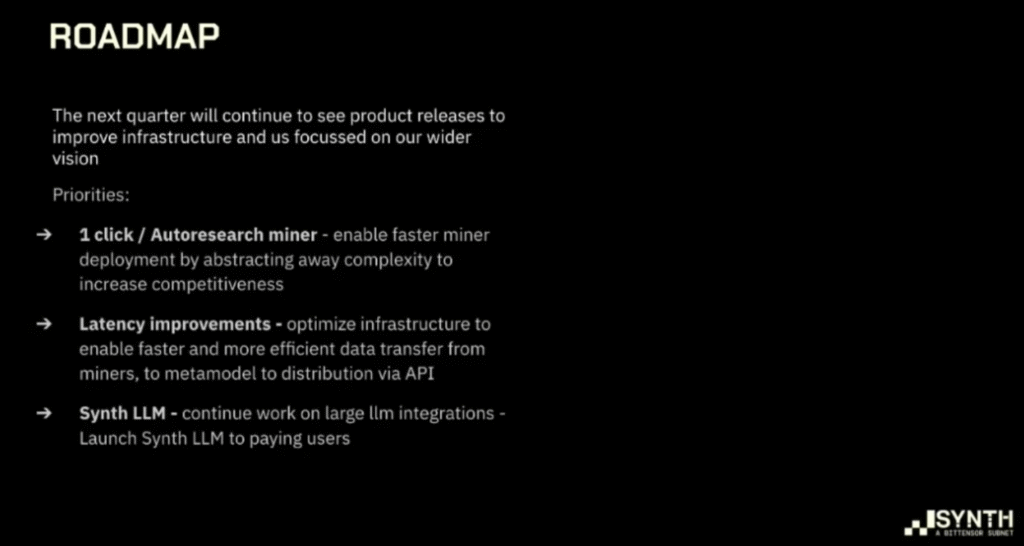
a. One-Click Miner Deployment, designed to abstract away the complexity of joining the subnet so that machine learning researchers and developers who are not blockchain-native can contribute without needing to learn an entirely new technical stack first.
b. Continued Latency Improvements to the API pipeline, with the goal of making data transfer from miners through the meta model to distribution faster and more seamless with every iteration.
c. Academic Partnerships, with conversations already underway to bring serious machine learning talent into the competitive mining environment and raise the quality ceiling of the forecasts being produced.
d. The Launch of the Synth LLM, a project the team has been developing and refining carefully over time, which will allow users to engage with the data through natural language, asking complex questions and receiving answers shaped by Synth’s own perspective on how that information should be interpreted and presented. Beyond serving power users directly, James described this as a proof of concept to bring before major LLM partners, demonstrating concretely how Synth’s data performs inside a conversational interface.
Conclusion
What Synth has accomplished in the last quarter is something genuinely harder than shipping a feature list. As James Ross laid out clearly on the Q1 Alpha Call, the team has converted a compelling research product into infrastructure that real institutions and traders are paying for, building on top of, and integrating into their daily operations. That transition, from interesting to essential, is the one that actually matters in any technology cycle, and it is the one most products never successfully make.
The revenue growth, the enterprise partnerships, the expanding asset coverage, and the sharpening meta model are all pointing in the same direction. As AI agents take on a deeper role in financial markets and the demand for real-time probabilistic data compounds alongside that shift, the layer sitting between raw predictions and the systems consuming them becomes quietly indispensable. Synth is building that layer with clarity and conviction, and Q1 made a strong case that the execution is rising to meet the ambition.
Enjoyed this article? Join our newsletter
Get the latest TAO & Bittensor news straight to your inbox.
We respect your privacy. Unsubscribe anytime.
Enjoyed this article?
Join our newsletter
Get the latest TAO & Bittensor news straight to your inbox — every morning before markets open.



No comments yet — be the first.