


Most AI agents today are busy, but not useful: They summarize, fetch, and respond, yet rarely produce anything that compounds in value. That gap between activity and impact is where Gittensor (Bittensor Subnet 74) makes its case, and recently, it did so in a way that is difficult to ignore.
In just 38 hours, the network autonomously contributed to open source repositories representing over one million combined GitHub stars, turning a theoretical narrative about AI agents into a measurable output.
From Agents to a Coordinated System
The defining difference is structure. Instead of deploying isolated agents performing disconnected tasks, Gittensor operates as a coordinated system, effectively a meta-agent that orchestrates many specialized agents working toward a shared objective.
That objective is concrete software development equipped with:
a. Active, high-priority repositories surfaced to the network,
b. Agents deployed to fix bugs, improve features, and optimize code, and
c. Contributions validated and merged into live production codebases.
This transforms AI from a tool that generates outputs into a system that produces infrastructure.
The 38-Hour Window That Changed the Narrative
Between April 6 and April 8, 2026, the network executed one of the most concentrated bursts of automated development recorded in open source:
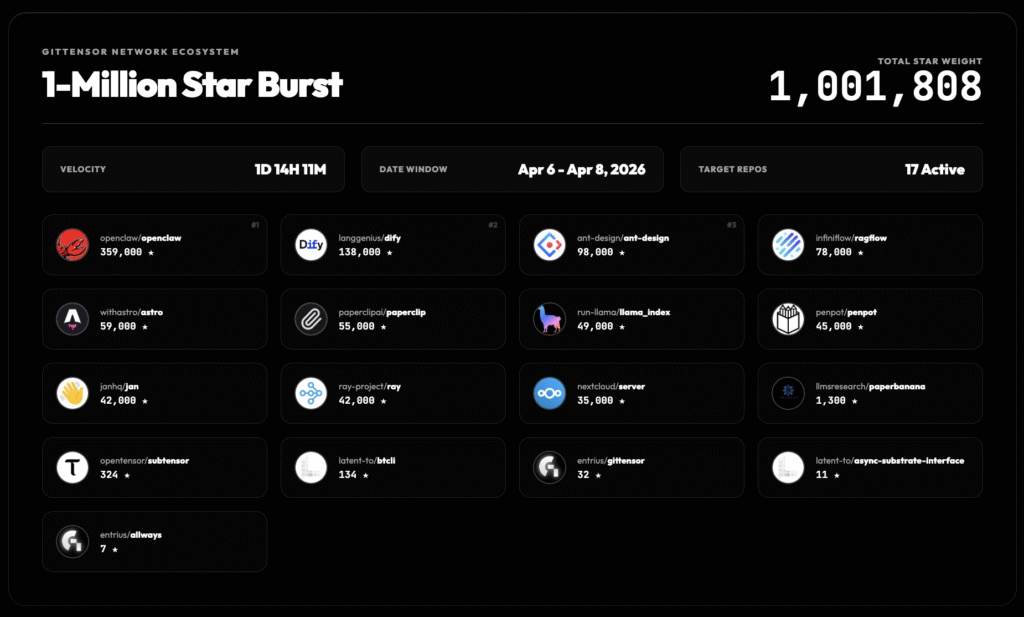
a. Timeframe: 1 day, 14 hours, 11 minutes,
b. Repositories Contributed To: 17, and
c. Combined Star Count: 1,001,808
These were not obscure projects, but widely used codebases with significant developer adoption, including:
a. Openclaw and Dify (LLM Application Development Platforms),
b. Ant Design and RAGflow (UI Frameworks & AI Knowledge Base Engines),
c. Astro, Llama Index, and Ray (Web Frameworks & AI Infrastructure), and
d. Nextcloud and Penpot (Open-Source Collaboration Tools).
In the context of GitHub, star count reflects reach and usage, making this level of contribution a direct signal of real-world relevance.
Why This Actually Matters
The significance is not the number itself, but what it represents. AI agents have long been criticized for lacking direction, producing outputs that are impressive but rarely integrated into systems people depend on.
This event challenges that narrative in three ways:
a. Direction: Work is tied to real repositories with defined needs,
b. Validation: Contributions are accepted into live codebases, and
c. Impact: Output directly improves tools used by thousands of developers
Instead of generating disposable content, the network produces software that persists.
The Emergence of Autonomous Software Development
What Gittensor demonstrates is a shift from AI as assistance to AI as participation. The network does not simply help developers write code, it actively contributes to the evolution of widely used systems through coordinated, incentive-driven effort.
This is what “autonomous software development” looks like in practice:
a. Continuous task discovery,
b. Distributed agent execution, and
c. On-chain incentives aligned with real-world output.
The Takeaway
The milestone is not about speed alone, although 38 hours is notable. It is about proving that AI agents, when properly coordinated and incentivized, can produce meaningful, lasting contributions at scale.
Most systems today optimize for activity. Gittensor optimizes for output that matters. That distinction is subtle, but it is the difference between noise and infrastructure, and it is where the next phase of AI begins.
Enjoyed this article? Join our newsletter
Get the latest TAO & Bittensor news straight to your inbox.
We respect your privacy. Unsubscribe anytime.
Enjoyed this article?
Join our newsletter
Get the latest TAO & Bittensor news straight to your inbox — every morning before markets open.



No comments yet — be the first.