

Crypto has a short attention span: Projects spike, narratives shift, and yesterday’s darling becomes tomorrow’s cautionary tale. Against that backdrop, the projects that matter long-term tend to be the ones doing foundational work, the kind that doesn’t ‘photograph’ well but proves impossible to replace.
Bittensor ($TAO) is that project, and presently, the window to appreciate it early is still open (but not for much longer!)
A Network With an Actual Job
Most Web3 projects exist to fund a promise, but Bittensor ($TAO) operates in a different dynamics. Bittensor exists to run a market and to specifically serve as a live, competitive marketplace where AI models are deployed, stress-tested, and rewarded based on performance. No hype cycle required. The work either holds up or it doesn’t.
Here’s what that looks like in practice:
a. Miners contribute AI compute and model outputs across specialized categories,
b. Validators score that work, determining who earns and who doesn’t
c. Subnets, 128 of them, organize this competition by domain: language, image, code, data, and more
d. $TAO, the native token, flows to whoever produces the best intelligence, not whoever marketed hardest
The supply is capped at 21 million (same ceiling as Bitcoin) and every token was distributed through participation.
All these with neither early investor dump waiting to happen nor foundation wallet sitting on 20% of supply.
That kind of structural cleanliness is exceptionally rare.
Why the Market Hasn’t Priced It In
Bittensor’s relative obscurity isn’t a mystery once you understand what it’s up against — not competition, but comprehension.
a. It Occupies An Awkward Middle Ground: AI developers and blockchain developers are both abundant, but people who genuinely understand both are not.
Bittensor lives in that gap, which makes it easy to dismiss at first glance and hard to explain at second.
b. The Terminology Misleads: Words like “miner” and “validator” carry strong associations in crypto, same that don’t apply here.
On Bittensor, these roles are about producing and judging intelligence, not securing a ledger. Anyone arriving with existing crypto knowledge has to unlearn before they can understand.
c. The Mission Is Too Big For A Tagline: “Decentralize intelligence” sounds abstract until you sit with it. The project isn’t just about trying to be a cheaper version of an existing tool, it’s also attempting something categorically different.
That ambition is also its communication problem.
The Signals Worth Paying Attention To
Despite the obscurity, the people who do understand Bittensor tend to commit to it seriously. A few data points worth noting:
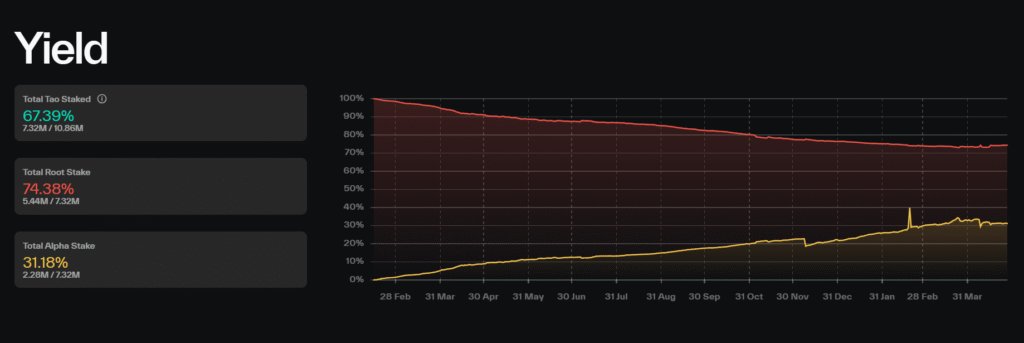
a. About 70% of circulating $TAO supply is currently staked, a level of lock-up that suggests genuine long-term conviction, not speculation,
b. Grayscale created a dedicated $TAO investment trust, extending institutional access to the asset,
c. Digital Currency Group (DCG) and BitGo have both made significant moves into the ecosystem, and
d. Community-developed solutions running on Bittensor subnets are now producing outputs that compete with commercially built alternatives without the corporate infrastructure behind them.
They’re indicators of a network with real utility and serious backers who’ve looked closely at the fundamentals.
The Broader Argument
The question of who controls AI infrastructure is no longer abstract as centralized labs are scaling fast, operating behind closed doors, and answering primarily to their investors. That model works until it doesn’t, and by that time, the consequences become broad.
An open, permissionless alternative that routes value to contributors rather than shareholders, in an environment of increasing AI consolidation, becomes both philosophically appealing and strategically important.
Bittensor’s design (dynamic subnet economics, fair token distribution, and an incentive model built around quality rather than capital) positions it as exactly that alternative.
Whether the 2026 price forecasts circulating in analyst circles ($500–$850 $TAO, conservatively) materialize is secondary to the more durable point: the infrastructure thesis is sound, and very little else in the market is building toward the same thing.
Why Quiet Might Be the Point
There’s a version of success that doesn’t require everyone to know your name. Critical infrastructure rarely trends. It just becomes necessary.
Bittensor ($TAO) doesn’t need to win a popularity contest, it needs to keep building the best open market for machine intelligence, and then let the world’s growing appetite for decentralized AI do the rest.
The community it has already gathered understands this, and they’re not waiting for a viral moment. What they’re waiting for is the moment where the rest of the market catches up to what’s already been built.
That gap (between what Bittensor is and what the market currently thinks it is) is precisely where the opportunity lives.
Enjoyed this article? Join our newsletter
Get the latest TAO & Bittensor news straight to your inbox.
We respect your privacy. Unsubscribe anytime.
Enjoyed this article?
Join our newsletter
Get the latest TAO & Bittensor news straight to your inbox — every morning before markets open.



No comments yet — be the first.