
Real decentralization has a specific feeling. You know it when the protocol stops belonging to the people who built it and starts belonging to the people who use it.
That moment for TensorUSD is now.
TensorUSD is built to be the stable monetary layer of the Bittensor ecosystem. A decentralized stablecoin backed by TAO, enforced by miners, governed by code. It is built without a bank, custodian or a counterparty whose trust you are quietly depending on.
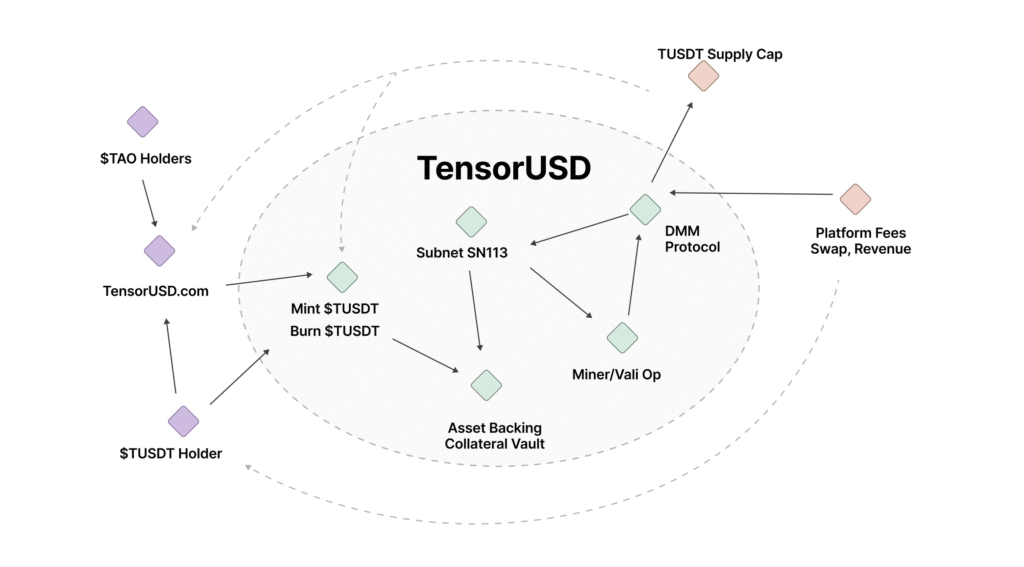
Moreover, the ecosystem it serves is real. As of May 28, 2026, TAO carried a market capitalization of roughly $2.83 billion across 128 active subnets, with expansion to 256 subnets planned later in the year, and Bittensor’s subnet tokens together were worth around $1.05 billion. A network of that scale, built on an asset as volatile as TAO, needs a stable monetary layer that no single party can compromise. That is the gap TensorUSD is built to fill.
But a protocol is only as decentralized as its governance.
And true decentralization does not stop at the smart contract. It runs all the way to the top to who decides, who proposes, who holds power, and how that power moves.
Hence, TensorUSD is a DAO.
TensorUSD has no owner. What it has instead is a community governance with a vote and a smart contract that actually follows through.
From here, every decision lives with the community and every execution lives in the code.
Every holder of the SN113 alpha token is now something more than an investor.
They are citizens.
If you hold SN113 alpha tokens, you are not just holding an asset. You are holding a say in how funds are spent, who gets compensated, what changes and what stays. That is how the contract is written.
This is the core narrative of what TensorUSD is, and it matters more than any technical specification.
A stablecoin owned by its community is a financial instrument and a statement about who gets to build the future of decentralized money.
The architecture of this republic is precise.
Revenue flows through a smart contract and not a person, entity, or multi-sig wallet can redirect what the protocol earns. The treasury contract’s ownership has been renounced, with the developer wallet replaced by a burn address, and every single distribution must be approved through a vote. Once revenue goes in, only the rules decide where it goes.
That revenue comes from three sources, all flowing into the treasury as TAO or TUSDT: a 10% APY interest fee on minted positions, charged hourly; an 11% liquidation fee when a position is liquidated; and a 0.3% transaction fee. No donations, no token sales propping up the treasury, no external dependency. The protocol earns from its own use, and the rules above decide where every cent of it goes.
50% of it goes into an emergency fund. It sits completely untouched unless a user suffers losses from an exploit. It is neither used for operational expenses nor for salaries. Not for anything except making users whole when something goes wrong. Consider what that means for a user who has minted TUSDT against their TAO. If the protocol is ever exploited and they suffer a loss, there is a dedicated reserve funded by the protocol’s own revenue, which exists specifically to cover that loss. That is not a promise in a whitepaper but a rule in the contract.
30% goes into an operations fund where contributors do not simply receive it. They earn it.
Here is what that looks like in practice.
A developer in the Bittensor ecosystem has spent three weeks building a liquidity integration for TensorUSD. The work is done and the code is live. They want to be compensated.
Proposals can be submitted between the 5th and the 25th of each month, a 20-day window. To file one, a holder needs at least 1,000 SN113 alpha tokens plus a transaction fee in TAO; anyone holding less can ask the council of maintainers to file on their behalf. The developer submits within that window. The work done, the impact it had, and the amount requested, say, 500 TUSDT. It goes into screening. The community reads it, discusses it, and the proposals that earn the highest engagement, the top 10, advance to election. The community is solely responsible for deciding collectively that this work was worth voting on.
It clears the threshold. On the 1st of the following month, voting opens.
Every SN113 alpha holder who has been staking their conviction has more weight in this vote than someone who just bought tokens yesterday. The quadratic curve means a single large holder cannot simply override the rest. The vote runs for 48 hours. It passes.
On the 15th of the month, the smart contract pays out. No invoice chased and no payment delayed. No one needed to approve it at the last minute.
Every step ran on a schedule known in advance: the submission window, the screening, the vote opening at the start of the month, and the payout on the 15th. That is governance that actually works.
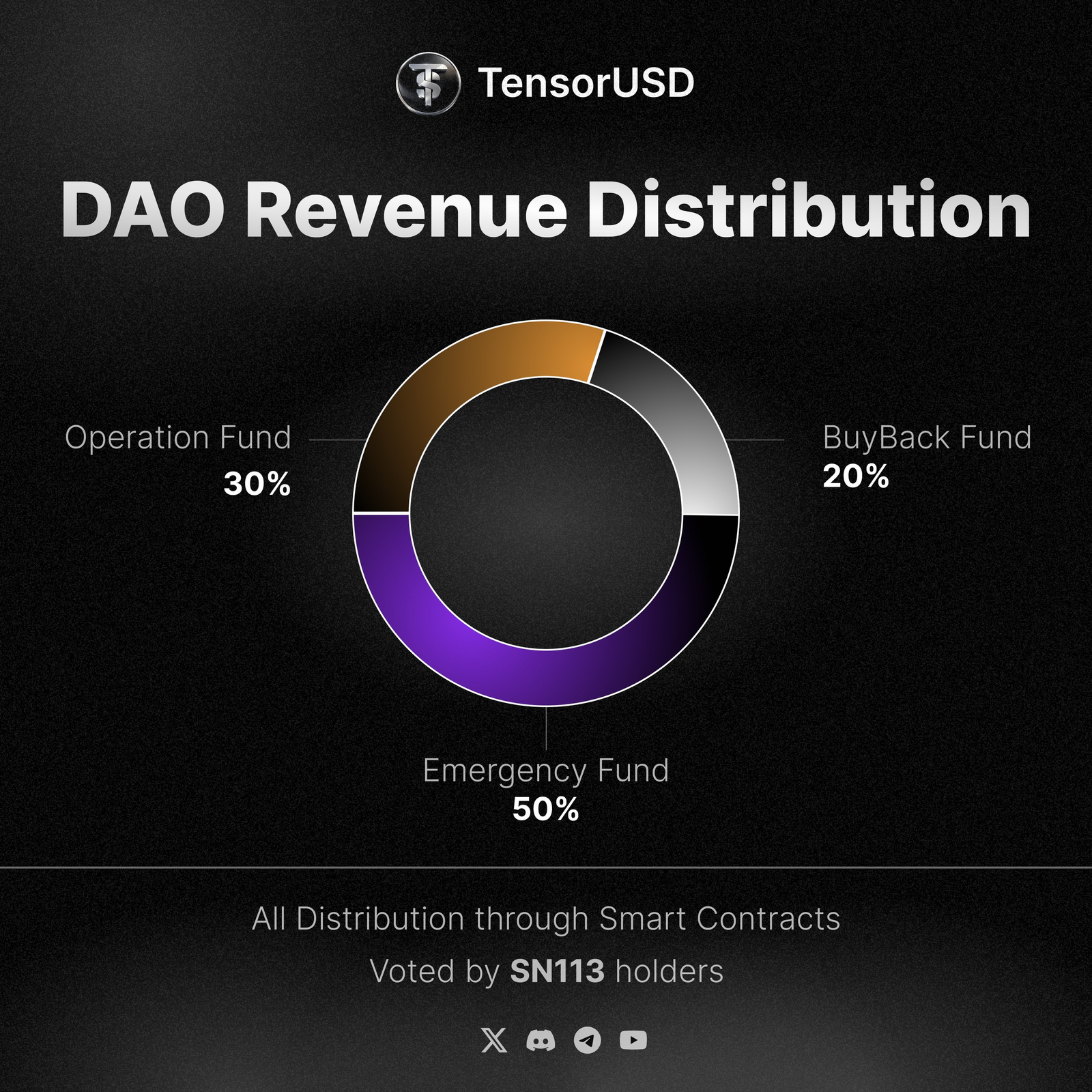
The remaining 20% flows into a Community Fund, split across four purposes. To keep the numbers honest, here is how that 20% breaks down against total protocol revenue: half of the fund (10% of total) goes toward insurance payments; 20% of the fund (4% of total) is distributed as dividends to TUSDT holders; another 20% of the fund (4% of total) is used to buy SN113 alpha from the open market and burn it, reducing supply and returning value to the ecosystem; and the final 10% of the fund (2% of total) rewards the people who show up and participate in elections, because governance only works when people engage with it.
The treasury does not have a treasurer. The protocol is its own accountant.
Governance runs on two principles that, together, make it genuinely fair.
The first is quadratic voting based on holdings of the SN113 alpha token. Voting power is defined by a simple formula:
Voting power = √(SN113 balance) × conviction multiplier
This means that while larger holders carry more weight, no single whale can simply overpower the collective. The relationship between holdings and influence is deliberately, mathematically normalised. A holder with 10,000 tokens does not have ten times the voting power of someone with 1,000, they have roughly 3.2 times, because √10,000 = 100 while √1,000 ≈ 31.6. Scale still buys influence, but at a sharply diminishing rate. The curve flattens. The collective stays balanced.
The second is conviction: time-staked weight. The longer you commit your stake, the more it counts. The conviction multiplier (M) is defined by how long the stake has been held:
M = 0.5 (staked < 3 months), 0.8 (3-6 months), 1.0 (> 6 months)
Imagine two holders. One holds 5,000 alpha tokens but votes immediately, giving a weight of √5,000 × 0.5 ≈ 35. Another holds only 3,000 but has staked past the six-month mark, giving √3,000 × 1.0 ≈ 55. The second holder’s vote outweighs the first. This is not a system that rewards the loudest voice in the room. It rewards the most committed. The holders who believe in TensorUSD long enough to stake their conviction alongside their tokens.
Voting power itself is captured by a Merkle-tree smart contract through snapshots taken at random before each election. The latest snapshot is the one that counts, so power reflects real, committed holdings rather than last-minute positioning.
Together, these two mechanisms produce something rare in decentralized governance: a system where power is earned, not just bought.
The proposal process is built for openness and rigour in equal measure. An election reaches a binding result only when it clears a quorum of 20% of the circulating SN113 supply, and a proposal needs more than 50% of votes to win. Funding proposals must be tied to work actually done; non-funding proposals must be tied to a pull request. Either way, implementation runs through the same path: the PR is submitted, merged by maintainers, and for funding proposals, the treasury contract handles distribution.
Leading this DAO is a maintainer: a single elected steward, supported by five councils, responsible for running the governance of TensorUSD. The maintainer must hold subnet ownership, ensuring genuine skin in the game. They are elected for a two-year term extendable to a maximum of 2 terms. The first election takes place on the 5th of June, 2028, with a voting period of 5 days and a requirement of more than 50% approval to win.
The maintainer role is not a position of unchecked power. It is a position of responsibility to the community that elected them. Every decision, every fund movement, every parameter change goes through the same governance process as everyone else. Moreover, the design goes further to prevent self-dealing: a newly elected maintainer’s subnet cannot use its own holdings for the first six months in position. During that transition, the previous governing subnet’s snapshot continues to determine voting power.
If a maintainer’s subnet is ever deregistered, an emergency election triggers on the 5th of the nearest month. The governance is built for continuity, the new maintainer resumes governance by the 15th, and in the absence of any governing subnet, the last snapshot of the previous governing subnet is used. The ecosystem keeps moving.
This transition matters beyond TensorUSD itself.
What is being built here is proof of something simple. A stablecoin can be completely and irrevocably owned by its community. The people who hold the token are the people who run the protocol, and governance is the foundation everything else is built on. Everything else like the collateral, the liquidations, the treasury, the peg itself sits on top of it.
Every vote cast by an SN113 alpha holder is an act of ownership and responsibility. Of belief that decentralized money should be governed by the people who use it, not the people who built it, not the people who funded it, not anyone sitting in a boardroom making decisions on behalf of a community they will never fully understand.
TensorUSD was always about stability.
A stable peg, healthy collateral, and an ecosystem that can do business without looking over its shoulder.
But the deepest form of stability is structural. It is a system where the rules are known, the power is distributed, and the community that holds it decides where it goes next. There is no single point that can be pressured, no decision maker that can be replaced by someone with different intentions, no moment where the protocol quietly stops being what it was built to be.
That is what a DAO makes possible.
That is what TensorUSD is now.
The question was never whether a community could own a protocol.
The question was whether a protocol would trust its community enough to let it.
TensorUSD just answered that.
The stable layer for the age of decentralized intelligence now belongs to the people who believe in it.
If you want to follow what comes next, TensorUSD is still being built in the open, moving toward mainnet as a community-owned protocol.
Stay updated and explore more at www.tensorusd.com
Enjoyed this article? Join our newsletter
Get the latest TAO & Bittensor news straight to your inbox.
We respect your privacy. Unsubscribe anytime.
Enjoyed this article?
Join our newsletter
Get the latest TAO & Bittensor news straight to your inbox — every morning before markets open.

No comments yet — be the first.