

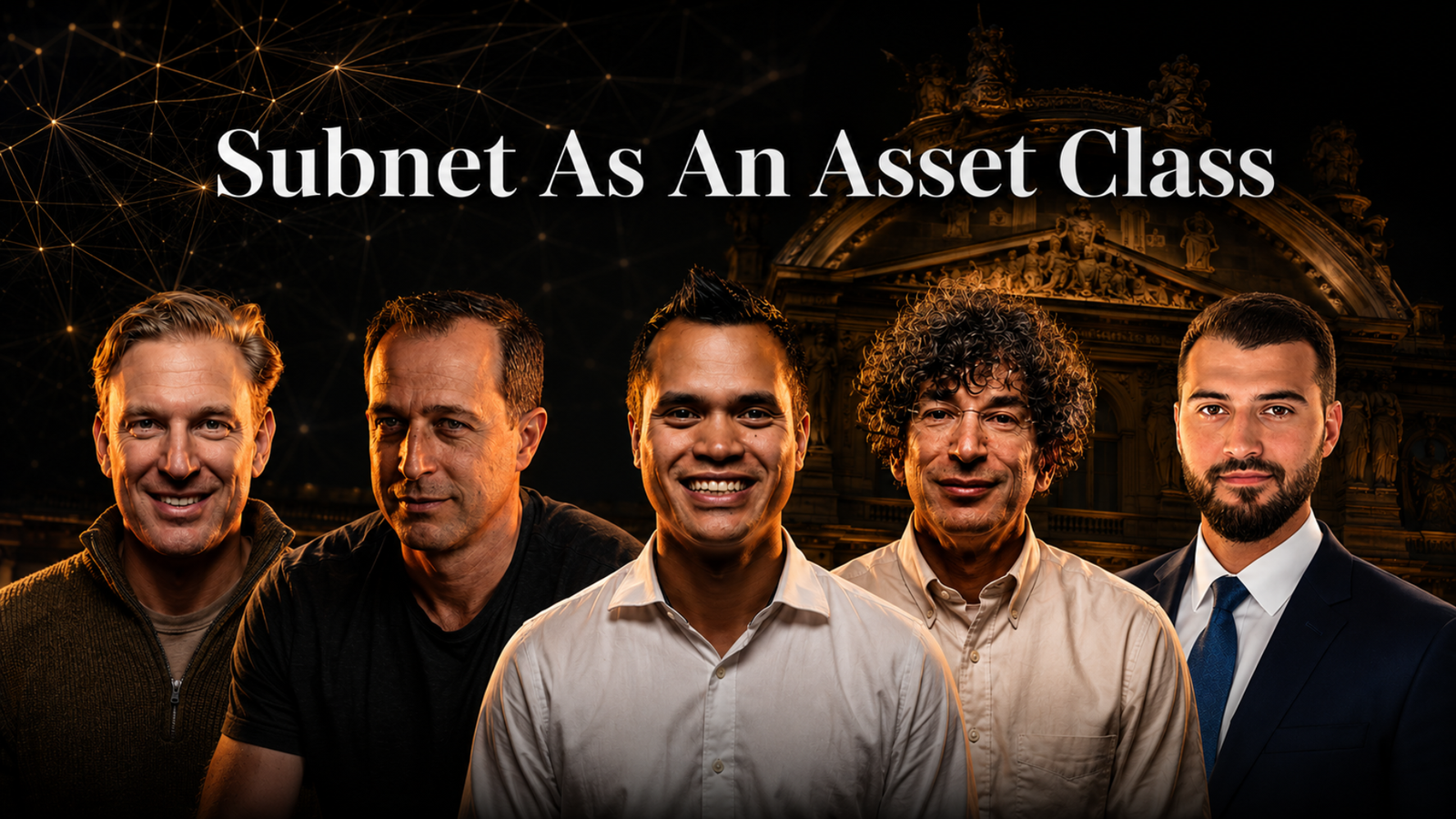
The “Subnets as an Asset Class” panel at Proof of Talk delivered something the broader Bittensor conversation has been missing for a year: a candid read from the people actually deploying capital into the ecosystem.
Mike Grantis of General Tensor moderated a panel that included James Altucher of Tao Synergies, Evan Malanga of Yuma Group, Frank Schuil of Safello Group, and Siam Kidd of DSV Fund.
Each represents a different institutional vehicle for Bittensor ($TAO) exposure, and the panel did something rare in Bittensor: it stopped selling the story and started auditing it.
How the Panelists Pitch Bittensor to Institutional Investors
Each panelist approaches the institutional sell differently depending on their audience. The patterns that emerged:
a. For AI-native audiences, the pitch starts with the philosophical question of whether OpenAI and Anthropic should control the future of AI, then walks into the structural argument for decentralized alternatives.
b. For crypto-native audiences, the pitch is value accrual. Polygon and Solana captured almost none of the value generated by the businesses built on top of them, while TAO accrues value directly because every subnet pool is denominated in it.
c. For European institutional audiences, regulation comes first. Most institutions in Europe will not touch the asset unless it sits inside a regulated wrapper, which is why ETPs and structured products matter more than direct token exposure.
d. For traditional investors broadly, the framing increasingly compares Bittensor to centralized AI valuations rather than other crypto protocols. The $950B centralized AI market gives a clean asymmetric bet narrative against a still-small decentralized alternative.
The conclusion across all four pitches converges in one lesson. Institutional capital does not have a Bittensor problem, it has a translation problem, and the translation that works is AI with regulation as the entry point rather than crypto with AI as a feature.
The Investment Vehicles on the Panel
Each panelist runs a different vehicle for institutional or retail exposure to TAO, and the diversity itself is part of the story:
a. Tao Synergies (NASDAQ: TAOX), run by James Altucher, is positioned as the largest publicly listed $TAO holding company.
The strategy extends beyond simple treasury accumulation into ecosystem education through TaoDaily, the TaoPod, and BlueTao, a ChatGPT-like front-end using Chutes (SN64) for inference and BitMind (SN34) for social media search.
b. Yuma, the DCG-owned subsidiary, runs a validator, a subnet accelerator, and an asset management business.
Its index products include the Yuma Composite Index covering all 128 subnets, a top-10 product, and a third combined product launching that bridges $TAO and subnet exposure.
c. Safello Group (Nasdaq First North: STAO) launched the staked $TAO ETP that is now listed on SIX, Nasdaq, and EuroNext Paris.
The staked version matters because the yield offsets product costs and gives institutional investors a familiar wrapper.
d. DSV Fund is the first regulated hedge fund 100% in subnet ‘$ALPHA’ tokens. The firm also operates Astrid Arena (SN127) through a London-listed PLC, runs a subnet VC operation, and has executed over 30 OTC deals since launching its OTC strategy after the last Proof of Talk.
The collective signal is that institutional access to Bittensor is no longer hypothetical. The wrappers exist across multiple jurisdictions and structures.
What Investors Actually Get Hung Up On
The panel was direct about where investor due diligence stalls, and most of the friction points trace back to one structural question:
a. Subnet tokens are not equity. Wall Street investors repeatedly ask whether holders have any claim on future cash flows, whether a subnet getting acquired benefits token holders, and whether the protections that exist for shareholders exist for token holders.
b. Value accrual mechanics need to be explained per subnet. Some subnets buy back their $ALPHA with revenue, which creates a structural case for token appreciation as revenue grows. Others use utility mechanisms like requiring stake to mine. Each subnet has to defend its own value capture model.
c. The lack of equity-style ownership rights is the recurring sticking point. A subnet operator only emits 18% of supply to themselves, meaning even non-selling operators do not technically retain majority ownership of the asset they created.
d. Goalposts have moved repeatedly. Tao Flow V2, Conviction, shorting, and the new emissions block all shifted the ground rules over a 12-month window. Allocators trying to commit $10M to $50M into the ecosystem cannot make forward-looking decisions when the protocol mechanics keep changing.
e. Subnet bifurcation creates uneven downside profiles. Research subnets without near-term revenue face structural sell pressure that revenue subnets can offset through buybacks, and most investors struggle to value the first category without an obvious exit path.
The cleanest metric the panel landed on was time-to-first-buyback. Revenue alone is a vanity metric, since a business needs profit before it can return value to alpha holders.
The Capital Access Problem No One Wants to Say Out Loud
The closing observation was also the most contrarian one, delivered as ‘not so nice’ feedback aimed squarely at where the ecosystem is falling short:
a. Good subnet teams are struggling to access capital inside the Bittensor ecosystem, even teams that could raise meaningful centralized rounds elsewhere.
b. Multiple subnet teams have said directly that they could raise $10M tomorrow on a centralized round but cannot get capital from the Bittensor side, which creates real risk of talent migration.
c. The ecosystem needs better capital rails at both the protocol level and the broader infrastructure level, or a competing protocol with VC-backed rails could compress Bittensor’s lead the way Solana once compressed Ethereum’s.
d. Capital is oxygen, and the lack of it is starting to suffocate teams that should be thriving inside the network.
The framing was sharp because it pushed against the standard Bittensor narrative that decentralization and incentive alignment alone are enough. The panel’s read is that they are necessary but not sufficient.
The Marketing Gap the Community Still Has Not Closed
When asked where the community itself falls short, the panel converged on a few specific gaps:
a. TAO has no central head of marketing, which is both its strength and its biggest distribution problem. Solana hired a marketing function early. TAO relies on everyone in the ecosystem to act as a distribution channel.
b. The technical front end is strong, the consumer front end is weak. The community has built strong B2B infrastructure but has not produced enough consumer-touchable products that demonstrate what Bittensor actually does at a glance.
c. Canonical resources outside of Discord are missing. New investors and curious newcomers need clean, simple, easy-to-find documentation that explains the ecosystem without requiring weeks of immersion.
d. The community keeps comparing Bittensor to other crypto protocols when the more useful comparison is increasingly against Web2 giants and open-source AI players like DeepSeek and Qwen.
The marketing gap is structural and self-imposed, since the same decentralization that makes Bittensor durable also makes coordinated messaging impossible.
The Honest Read
The “Subnets as an Asset Class” panel landed on the sharpest reading of Bittensor’s institutional posture available right now. The investment vehicles exist, the regulatory wrappers are working, and the AI narrative is finally landing with allocators who would have ignored a pure crypto pitch a year ago.
What is still missing is value-capture clarity, capital access rails that keep builder talent inside the ecosystem, and a marketing layer that explains subnets without three months of Discord immersion. The next leg up depends on whether the community closes those three gaps before a competing protocol shows up with cleaner rails and a simpler story.
Enjoyed this article? Join our newsletter
Get the latest TAO & Bittensor news straight to your inbox.
We respect your privacy. Unsubscribe anytime.
Enjoyed this article?
Join our newsletter
Get the latest TAO & Bittensor news straight to your inbox — every morning before markets open.

No comments yet — be the first.