


For all the talk about Bittensor producing decentralized intelligence at scale, the network has already delivered consumer-facing interfaces like Chutes Chat that let everyday users feel the output.
BlueTAO, currently in alpha and built by James Altucher, is a direct attempt to build on that foundation and raise the bar even higher. The product is a ChatGPT-style interface running entirely on Bittensor subnets, with no OpenAI, no Anthropic, and no centralized model provider in the stack.
Every text and image generation routes through subnets like Chutes (SN64), which means each query is a live demonstration of what the network can deliver to a non-technical user.
What BlueTAO Is and Why the Architecture Matters
The product itself is a familiar interface stacked on an unfamiliar backend, which is exactly what makes it interesting.
The key elements:
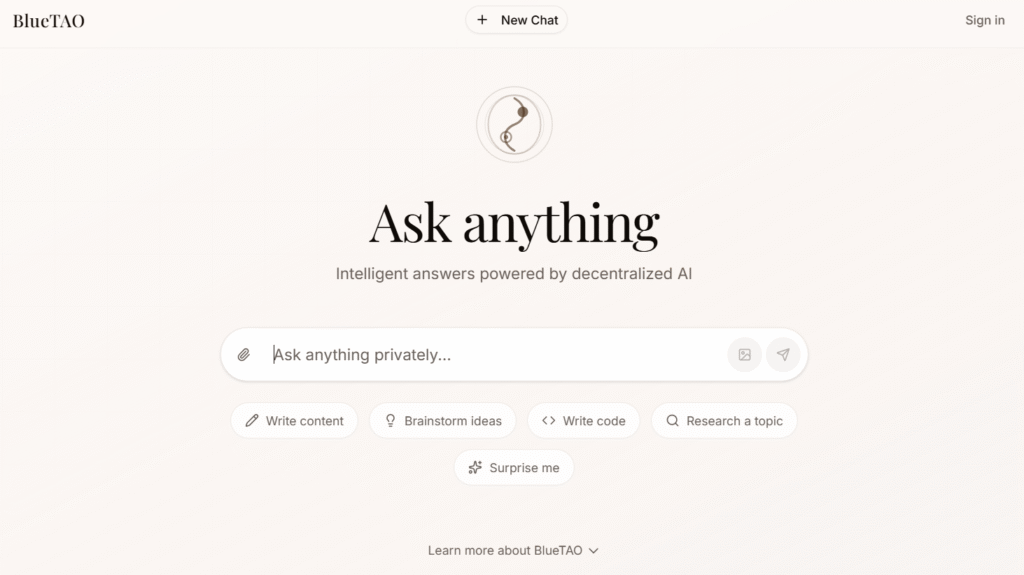
a. A ChatGPT-style conversational interface that users can interact with without knowing anything about Bittensor, subnets, or staking.
b. Text inference powered by Bittensor subnets, with Chutes (SN64) handling the core routing across the network’s decentralized model providers.
c. Image generation through the same decentralized inference layer, removing the dependency on centralized image APIs.
d. $TAO as the underlying value layer, positioning the product as a direct consumer expression of what holding $TAO buys access to.
The architectural point is bigger than the product itself. For most users, “decentralized AI” has been an abstract pitch with no daily-usage equivalent.
BlueTAO collapses that distance by routing every prompt through the network rather than around it, which means the product’s quality is the network’s quality, with no centralized fallback to mask weaknesses.
Why This Matters for the Bittensor Thesis
The launch lands at exactly the moment when the network is being pushed to prove it can support real consumer-facing products, not just enterprise data pipelines.
A few reasons this attempt is worth tracking:
a. It Exposes the Network’s Quality Honestly: A user-facing interface built entirely on Bittensor subnets either works or it does not. There is no centralized model to quietly handle the hard cases.
b. It Validates Inference Subnets Specifically: Chutes and other inference-layer subnets need consumer demand to demonstrate their value beyond emission share, and BlueTao gives them a live demand source.
c. It Reframes $TAO Holding as Access Rather Than Speculation: The pitch shifts from “buy $TAO because the network is valuable” to “buy $TAO because it powers the product you are already using.”
d. It is Being Built by Someone With an Investor’s Lens: James Altucher’s positions as co-owner of TAO Daily and Digital Assets Advisor to TAO Synergies mean he is approaching the product from where institutional capital is starting to look at Bittensor seriously.
Enjoyed this article? Join our newsletter
Get the latest TAO & Bittensor news straight to your inbox.
We respect your privacy. Unsubscribe anytime.
Enjoyed this article?
Join our newsletter
Get the latest TAO & Bittensor news straight to your inbox — every morning before markets open.



No comments yet — be the first.