

Academic research tools get validated in friendly environments, scientists use them cooperatively. They do this paper after paper, building on each other’s assumptions rather than attacking them. Nobody pays anyone to break FreeBayes, so nobody bothers to find out whether it breaks.
Bittensor changes that dynamic entirely. Put money on the line, open the benchmark to anyone willing to run a miner, and the cracks show up in days rather than decades.
That is exactly what happened when Minos (Bittensor Subnet 107) went live on mainnet two weeks ago, and what they found in the process is more significant than a typical launch report.
The Finding That Justifies the Whole Thesis
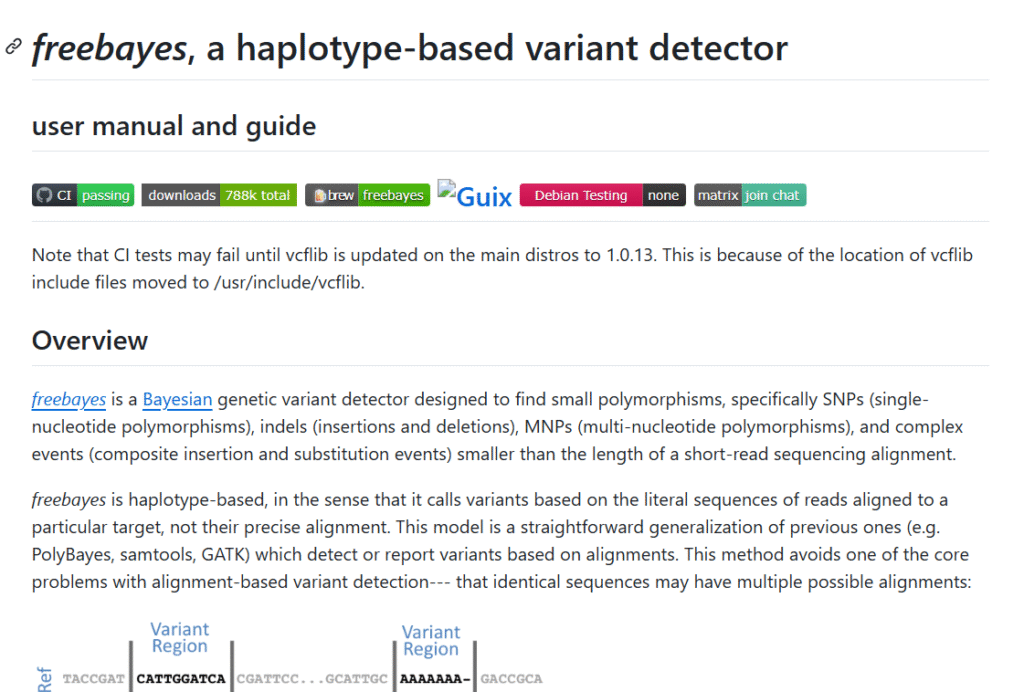
FreeBayes is a widely used variant-calling tool that appears in thousands of genomics research papers. It has never been seriously challenged because academic environments are cooperative, not adversarial. Minos’s miners challenged it within the first two weeks.
The exploit was that instead of carefully identifying real mutations, miners configured FreeBayes to call mutations at nearly every genomic position.
Because the benchmark was not penalizing false alarms hard enough, this scored well while producing results that would be clinically worthless. A metal detector that beeps constantly finds every coin, but also every bottle cap, nail, and soda can. The find rate looks perfect, but the tool is useless.
The team responded fast:
a. Overcall guardrails were added to the scoring system.
b. False-positive penalties were significantly strengthened.
c. Regression tests were built specifically around this failure mode.
d. FreeBayes was deprecated for new miner submissions on May 9, 2026.
A vulnerability sitting inside one of clinical genomics’ most trusted tools for years, found in two weeks.
That is what adversarial incentives do.
What the Network Actually Produced
The raw numbers from the first 16 days tell their own story:
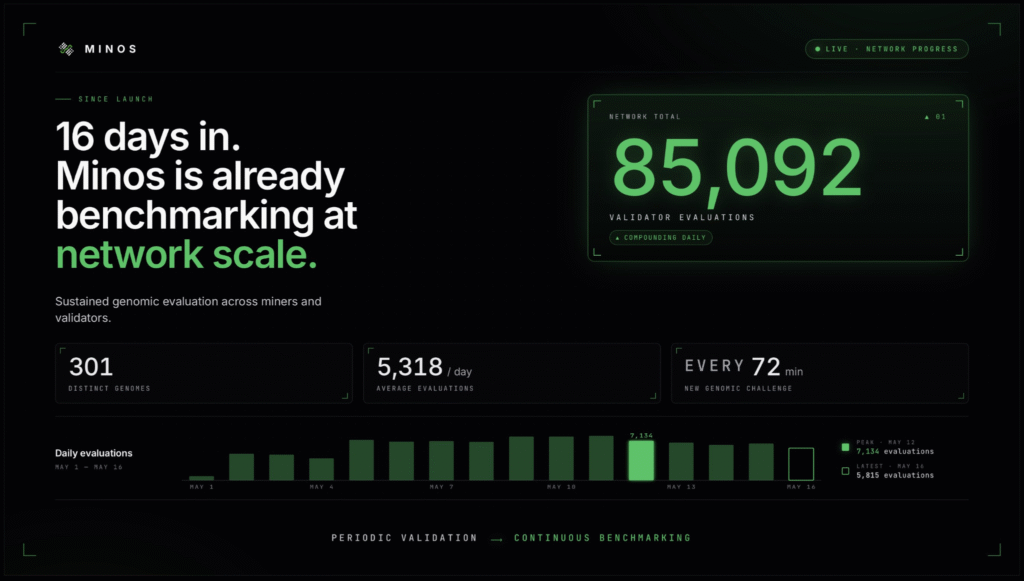
Minos: Two Weeks Operational Score Sheet
a. 85,092 validator evaluation records completed.
b. 301 distinct synthetic genomes processed.
c. 5,318 evaluations per day on average, peaking at 7,134 on May 12.
d. A new genome shared with miners every 72 minutes, scored within one epoch.
Clinical benchmarking workflows are still largely periodic and manual, often running on annual validation cycles. Minos is building at a pace that makes that look prehistoric, and doing it under continuous adversarial pressure rather than in a controlled research setting.
What the Launch Taught Them About Running a Subnet
The genomics findings were the headline. The operational lessons are just as transferable, especially for teams in early stages.
The biggest one came from validator coordination: When you are making simultaneous changes across scoring logic, payload formats, and deployment infrastructure, knowing validators are online is not enough. You need to know exactly what code they are running.
Implementing validator spec. versioning, recommended by Brian McCrindle who worked closely with the team during launch, solved this cleanly.
It gave the team the ability to:
a. Coordinate validator upgrades without guesswork.
b. Identify stale validator behavior before it contaminates scoring.
c. Debug score differences by isolating the exact layer causing them.
d. Roll out future protocol changes with less operational risk.
By the end of week two, improvements had shipped across every layer: API reliability, overcall protection, burn policy, deregistration behavior, and pruning logic.
The Through-Line
Minos is becoming a stress test for every assumption the clinical genomics toolchain has been making in environments where nobody has a reason to break anything. Now there is a reason, and the cracks are showing up fast.
The subnet is stronger than it was at launch, the scoring is harder to game, and the team has proven it can diagnose and ship under real pressure. Two weeks in, the thesis is already proven.
Enjoyed this article? Join our newsletter
Get the latest TAO & Bittensor news straight to your inbox.
We respect your privacy. Unsubscribe anytime.
Enjoyed this article?
Join our newsletter
Get the latest TAO & Bittensor news straight to your inbox — every morning before markets open.


[…] Minos (SN107) and Claims (SN111) use Bittensor competition around scientific inference but handle ground truth very differently. […]