


Full article credit: Bitstarter team
Prediction markets have a perverse feature: the better you are at reading them, the faster they shut you out.
Sharp bettors — the ones who spend thousands of hours building statistical models, stress-testing probability frameworks, hunting for edges measured in fractions of a percent — routinely find their accounts limited to $2 a bet, or banned outright, the moment a book’s algorithms flag them. Their expertise, which in almost any other field earns reward, here draws punishment. Win consistently and you lose access. Excellence is the disqualifying condition.
This is a structural project. Books are not in the business of pricing markets accurately — they are in the business of volume and margin. A sharp bettor who consistently finds mispriced odds is a direct threat to that model. The smarter you are, the more aggressively the doors close.
Three people have been thinking about this problem — from different angles, for longer than most — and in January 2026 they launched the fix.
The minds behind the magic
Harry Crane, Philip Maymin, and Iosif Gershteyn share an unusual combination: serious academic credentials, deep roots in prediction and probability, and a philosophical orientation that goes well beyond the technical. All three arrived at this problem independently, through different paths, and found that their thinking converged on the same diagnosis.
Crane is a Professor of Statistics at Rutgers University — Chancellor’s Excellence Scholar, co-director of the Graduate Program in Statistics, affiliated faculty in Philosophy — whose research sits at a genuinely unusual intersection: not just probability theory, but the philosophy of probability.
What does it actually mean to assign a number to an uncertain event? That question has driven his career, and it turns out to be exactly the right question for anyone building in prediction markets.
Growing up, he was fascinated by a man in his neighbourhood called Reds, and whose secret Crane spent years trying to understand.
“This guy used to walk around without what seemed like a job, but seemed to have plenty of money. His name was Reds. I learned that he was a bookie. And I wanted to have whatever it was that he had.”
That obsession sent him through actuarial science, through poker, through a PhD in probability, and eventually back to prediction markets — pulled in around the 2016 US election, when he overheard two people treating a polling probability as if it were a fact about the world rather than a statement about belief.
“People were talking about the probability going from 20% to 30% as if it was a real number. I was intrigued, because that’s exactly what I was struggling with. What do these numbers mean for a single election?”
Philip Maymin — the Stephen and Camille Schramm Chair in Analytics at Fairfield University’s Dolan School of Business, founding editor of Algorithmic Finance, co-founder of the Journal of Sports Analytics — came from quantitative finance. His background was in hedge funds before the MIT Sloan Sports Analytics Conference pulled him toward applying those same tools to prediction. He now runs one of the most respected analytics programmes in the US, built on the conviction that statistics feels boring only because it is taught badly — and that prediction is the context that makes it suddenly, urgently interesting.
Iosif Gershteyn is the most unexpected of the three. He is a biotech CEO — founder of ImmuVia Inc., serial founder across technology, medical devices, and oncology therapeutics, with publications spanning computational immunology, antibody engineering, and neuroscience. He has also, in parallel, spent years teaching existentialist philosophy at Harvard’s Abigail Adams Institute.
He came to prediction markets through philosophy. A course called Ideas of the Market in his first week of college convinced him that finance was the only field where you could prove your thinking was correct — not with argument, but with outcome. He describes himself as a pragmatist in the precise philosophical sense: truth is not abstract, it is whatever works, measured by result, immune to spin.
“I consider finance applied philosophy — where I can prove that I’m right not by words, but by just making money. That’s a pragmatic approach to truth. You can’t lie your way out of being wrong.”
All three built Analytics.Bet together — a platform that teaches the statistical and analytical tools of professional prediction. For years, they watched the same pattern play out. Their best students developed genuine edges. The books found them. The clock started ticking.
That experience — watching skilled analysts get systematically locked out of the markets they understood best — is what Djinn is built to solve.
Gershteyn frames it like this:
“The better you are, the more you should be rewarded in a just system. Djinn is creating a more just system in a very perverse place.”
The solution they built
Djinn is built on a simple observation. A sharp analyst — a Genius, in Djinn’s vocabulary — has two things the books hate: accuracy and a track record. A recreational bettor — an Idiot, in the same non-pejorative sense — has something the books actively welcome: an account in good standing, full platform access, and a profile that reads as unthreatening. What neither has alone is what the other possesses.
Djinn connects them through a trustless protocol called the Blind Handshake. The Genius submits an encrypted signal — a prediction, with odds and stake. The Idiot locks collateral and accepts the mission. The signal decrypts only once the money is committed, so the execution is genuinely blind. Settlement flows from escrow automatically once the outcome resolves. No trust required between the parties. No way for either side to defect.
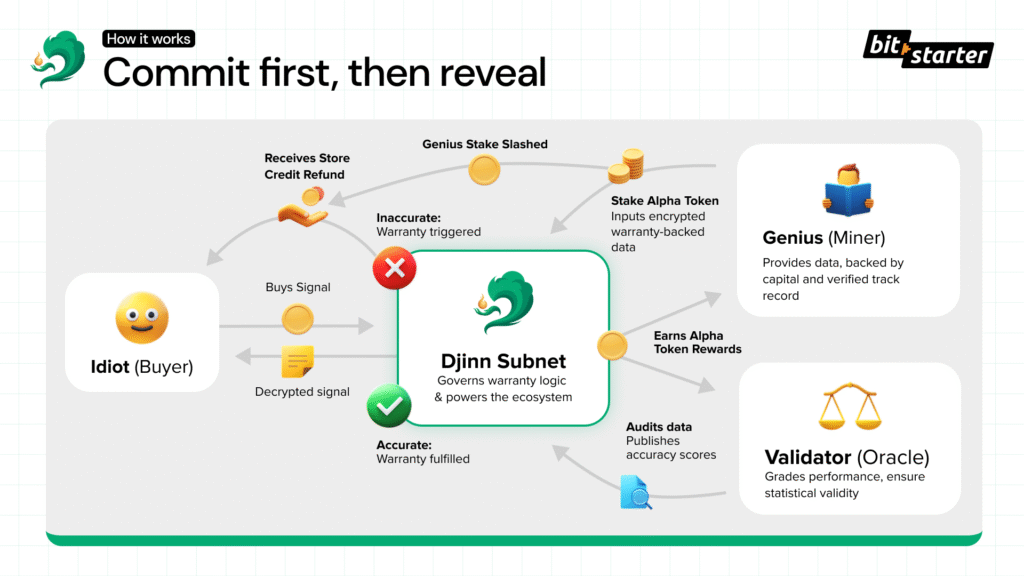
The Genius gets scale — their signal reaches multiple execution accounts simultaneously, multiplying the volume through which they can deploy their edge without ever touching a flagged account. The Idiot gets alpha — earning commission from an account they were going to use anyway, with no analytical work required on their end. The market, over time, gets a degree of efficiency it has never had: sharp money finally finding its way through rather than being blocked at the gate.
Philip Maymin puts it this way:
“Djinn exists because in each of us we are half mindful and half mindless — and AI has given us the opportunity to outsource the mindless component. Djinn provides the opportunity to separate mindfulness and mindlessness across different people. If I can have the advice of Harry or Iosif on my shoulder, wouldn’t that make me a better, more effective human being?”
The mindful work — building models, identifying edges, reading markets — stays with the Genius. The mindless work — execution, account management, logistics — moves to the Idiot. What looks like a simple marketplace is actually a clean separation of two roles that, when conflated, have always frustrated the people doing both.
Why Bittensor?
The ideas behind Djinn existed for years before the project launched. What was missing was infrastructure that could bootstrap a two-sided marketplace without venture capital, without a cold-start problem on both sides, and without the fundraising pressure that pulls young companies off course before they’re ready.
Bittensor solved all three. TAO emissions incentivise both miners and validators from day one — you can build both sides of the network simultaneously without solving a chicken-and-egg problem with VC money. Coordination happens at the protocol level. And a well-designed incentive mechanism grows organically as participants arrive, creating momentum rather than dependency on a runway.
Gershteyn describes finding Bittensor as the first time in crypto he felt genuinely early — the specific sensation of recognising something before the market had priced it in.
“For the first time in crypto I felt like I got it — and I felt like I was early. And then in parallel, you’re thinking: how can I be part of this?”
Maymin adds something harder to quantify: community. Traditional startups mean building in a silo, hoping users show up. Bittensor means building in public, with people who already have skin in the game — raising problems, offering solutions, investing in the outcome before the product is finished.
“I can’t imagine working in any other way now. Going back to working in a silo and hoping people recognise what you built? As opposed to working with people who are raising problems, offering ideas, building with you.”
Djinn launched onto Bittensor from Davos in January 2026. Five months on, the team is shipping and ready to launch on mainnet. The signal is finding its way through.
Learn more about Djinn (SN103):
Enjoyed this article? Join our newsletter
Get the latest TAO & Bittensor news straight to your inbox.
We respect your privacy. Unsubscribe anytime.
Enjoyed this article?
Join our newsletter
Get the latest TAO & Bittensor news straight to your inbox — every morning before markets open.



No comments yet — be the first.