

Bittensor conversations often collapse into the same themes: emissions, token flows, validator politics, and subnet rankings. But underneath that layer, teams are quietly building very different kinds of infrastructure, some targeting enterprise AI deployment, others robotics, e-commerce intelligence, or autonomous agents.
Novelty Search Episode 73’s media chat offered a rare look into four of those projects directly from their founders: Cacheon (SN14), Cathedral (SN39), Bitrecs (SN122), and Swarm (SN124).
What made the discussion interesting was not just the technology itself, but how differently each team interprets what a subnet should actually be. Some are pure optimization layers. Some are live production systems. Others are effectively open AI laboratories competing through incentives.
Cacheon (SN14): Turning AI Inference Into a Competition
Cacheon is focused on one of the least glamorous but most important parts of AI infrastructure: inference speed.
Instead of training models, miners compete to build faster inference servers through custom Docker-based implementations. Validators benchmark submissions on identical hardware and prompts, measuring:
a. Time-to-first-token, and
b. Tokens-per-second throughput.
The subnet operates on a winner-takes-all structure where the fastest implementation captures rewards. The broader goal is to eventually deploy the best-performing configurations directly into enterprise AI backends and production inference stacks.
Cathedral (SN39): Benchmarking Autonomous AI Agents
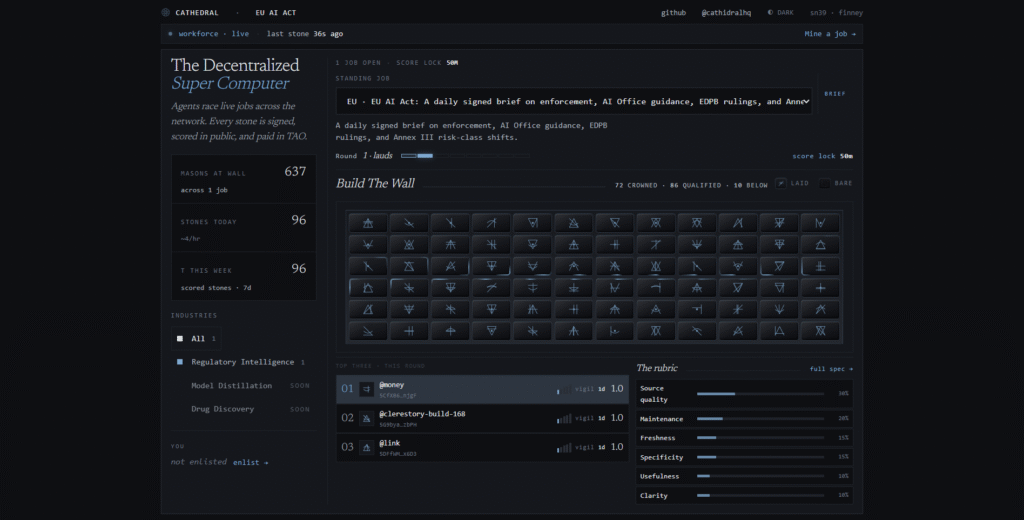
Cathedral is building infrastructure for evaluating autonomous AI agents rather than standalone models.
Miners submit fully configured Hermes agents, including tools, memory systems, prompts, and models. Validators then execute real tasks against those agents directly inside their environments and evaluate how they perform.
Early tasks include:
a. Regulatory document summarization,
b. Bug reproduction, and
c. Software workflow execution.
Because validators can inspect execution traces, prompts, and tool usage, the subnet is also generating high-quality behavioral data useful for future fine-tuning and agent benchmarking.
Bitrecs (SN114): Decentralized Product Recommendations
Bitrecs is applying Bittensor’s incentive layer to e-commerce recommendation systems. Rather than submitting models, miners compete by creating prompts optimized for product recommendations inside Shopify stores.
The subnet evaluates outputs against synthetic benchmarks and live store data using metrics tied directly to commercial performance.
The optimization targets include:
a. Click-through rates,
b. Engagement,
c. Basket size, and
d. Average order value.
The interesting part is how closely the subnet’s evaluation loop maps to measurable business outcomes. Even small improvements in recommendation quality can translate directly into increased merchant revenue.
Swarm (SN124): Autonomous Drones for Avalanche Rescue
Swarm is building autonomous drone intelligence trained through competitive reinforcement-learning environments. Miners submit full navigation systems, models, and control logic, which validators test inside simulated environments.
The subnet’s first major use case is avalanche rescue in Andorra. The idea is straightforward but high stakes:
a. Launch drones immediately after an avalanche,
b. Scan terrain autonomously,
c. Locate trapped victims, and
d. Relay coordinates to rescue teams before they arrive.
The system also evaluates environmental safety risks such as potential secondary avalanches. Swarm’s broader ambition is closing the gap between simulated robotics training and real-world autonomous deployment.
The Bigger Pattern
What made the conversation interesting was how clearly it showed that Bittensor is no longer converging around one single type of subnet design.
Cacheon is optimizing AI inference infrastructure, Swarm is building autonomous robotics intelligence, Bitrecs is competing on commercial recommendation systems, and Cathedral is evaluating autonomous AI agents as programmable workers.
They all use incentive competition, but the actual surfaces being optimized are completely different.
That diversity may ultimately become one of Bittensor’s strongest characteristics: not a single AI application, but a network where entirely different industries compete to discover better intelligence through open incentive systems.
Enjoyed this article? Join our newsletter
Get the latest TAO & Bittensor news straight to your inbox.
We respect your privacy. Unsubscribe anytime.
Enjoyed this article?
Join our newsletter
Get the latest TAO & Bittensor news straight to your inbox — every morning before markets open.



[…] Learn about Cathedral’s earlier direction here. […]