


Novelty Search Episode 073 was not just about subnet demos. During the call, Jacob ‘Const’ Steeves unpacked some of the network-level upgrades scheduled for next week, alongside a few longer-term ideas that could significantly reshape how Bittensor’s economics work.
The discussion covered Conviction, TAO Flow adjustments, subnet emission controls, chain buy mechanics, and even the possibility of removing Root dividends entirely.
Conviction Will Not Automatically Affect Every Subnet
One of the biggest clarifications from Const was that Conviction will not suddenly activate across all subnets by default.
A subnet only enters Conviction once roughly 10% of its outstanding stake supply becomes locked for the required period. Until then, nothing changes operationally for that subnet.
That distinction matters because many subnet owners feared Conviction would immediately introduce governance pressure or hostile ownership dynamics across the network.
It was noted that:
a. Conviction only activates where there is already active competition around ownership, and
b. Communities themselves effectively trigger the mechanism through stake locking.
Subnet Owners Can Defend Against Hostile Conviction Attacks
A major concern around Conviction has been whether wealthy actors could simply accumulate enough stake to challenge subnet ownership. Const explained that the design intentionally gives subnet owners defensive advantages.
If an attacker begins locking stake, the subnet owner can immediately lock an equivalent amount and receive maximum Conviction weight instantly, while challengers still need time for their Conviction to mature.
The broader implication of this is that Conviction is designed more as a contested ownership framework than a sudden takeover mechanism.
TAO Flow Is Being Adjusted to Remove Subsidy Noise
Another major upgrade next week is a modification to TAO Flow. The core change is that chain subsidy injections will now be subtracted from net TAO Flow calculations.
In practical terms, this removes artificial buy pressure created purely by liquidity injections from the chain itself.
Const’s argument was that TAO Flow should measure genuine market demand flowing into a subnet, not demand inflated by protocol-side subsidy mechanics. The result is expected to make emissions steeper and more concentrated toward subnets attracting real external interest.
Subnet Owners Will Be Able to Disable Emissions
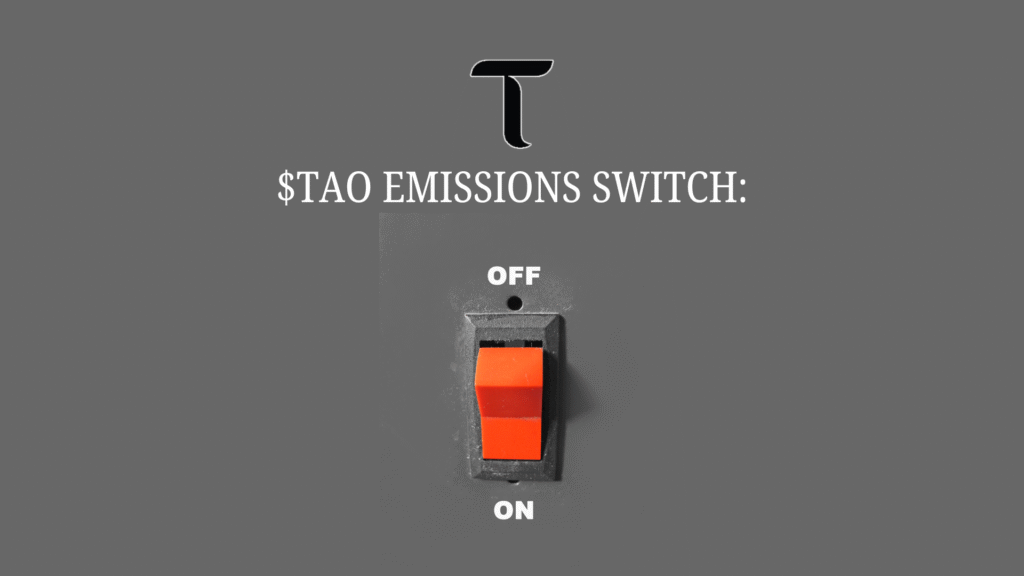
One of the quieter but more important changes is that subnet owners will gain the ability to turn emissions off entirely for their own subnet.
The feature is aimed primarily at inactive or low-participation subnets that may prefer not to continuously receive liquidity injections.
Rather than emissions being permanently forced by the protocol, subnet owners gain more direct control over how their subnet participates economically inside the network.
Chain Buys Will No Longer Be Immediately Burned
Historically, chain buys purchased subnet ‘$ALPHA’ tokens and then burned it immediately, but that mechanism is changing.
Under the new structure:
a. The chain accumulates purchased alpha instead of burning it, and
b. If a subnet is deregistered, that accumulated alpha is recycled back into the system.
The purpose is largely economic fairness. It prevents scenarios where manipulated subnet activity extracts disproportionate value from chain-funded liquidity injections before deregistration.
Root Dividends May Eventually Be Replaced by Pure Burn Mechanics
The most controversial idea discussed was still only conceptual, but likely the most important long term.
Const floated the possibility of eventually removing Root dividends entirely and replacing them with a pure burn mechanism.
The reasoning is twofold:
a. Push more capital into subnet participation rather than passive Root staking, and
b. Make Bittensor’s economic design easier to understand externally.
Under this framing, subnet activity itself becomes the mechanism through which the network captures value and reduces supply pressure.
It was also suggested this could eventually push Bittensor toward structurally deflationary token dynamics if subnet demand continues growing.
The Through-Line
What stood out from the discussion was that most of these upgrades are not isolated features. They are attempts to gradually tighten the economic alignment between subnet quality, capital allocation, emissions, and network ownership.
Conviction introduces long-term ownership signaling, TAO Flow changes refine emission routing, emission controls give subnet owners more flexibility, and chain buy restructuring improves capital accounting.
Together, they point toward a version of Bittensor that is becoming increasingly focused on economic efficiency and competitive subnet performance rather than passive participation alone.
Watch the full NS episode below:
Enjoyed this article? Join our newsletter
Get the latest TAO & Bittensor news straight to your inbox.
We respect your privacy. Unsubscribe anytime.
Enjoyed this article?
Join our newsletter
Get the latest TAO & Bittensor news straight to your inbox — every morning before markets open.


No comments yet — be the first.