

Every network that claims to be decentralized eventually has to answer the same question: who actually keeps it honest? In Bittensor‘s case, the answer is validators. They are the participants who evaluate miner output, score the quality of work being produced across every subnet, and submit those scores to the blockchain so the network knows where to send its rewards.
In case you missed it:
They are not the most visible part of the ecosystem, but they are the most structurally critical. Remove them, and the incentive layer that makes Bittensor function dissolves entirely. Keep them honest and competitive, and the whole network sharpens around them.
This piece breaks down everything you need to understand about validators on Bittensor: what they do, how they earn, why the role carries more strategic value than most people realize, and what it concretely takes to become one.
What a Validator Is
The simplest way to understand a validator is to think of them as a judge inside a competitive market. While every subnet on Bittensor is built around miners producing a specific digital intelligence commodity (an AI inference, a financial forecast or even, raw compute), validators are the participants responsible for evaluating the quality of what miners produce, assigning scores, and submitting those scores as weights to the blockchain.
Here’s where things get more interesting:
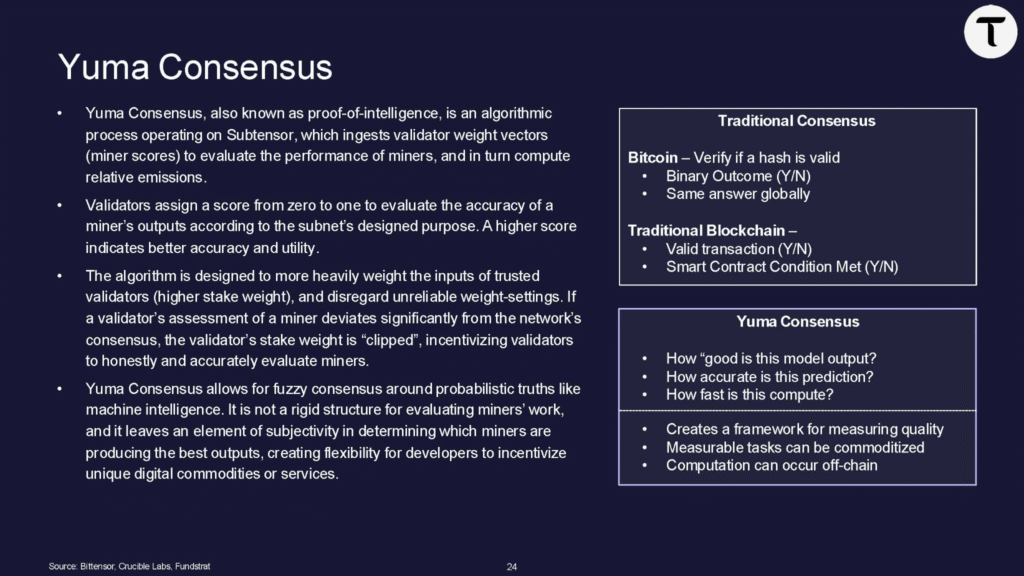
a. Yuma Consensus, Bittensor’s core ‘agreement mechanism,’ then takes the combined weights submitted by all validators on a subnet and uses them to determine how emissions get distributed.
b. The validators who score accurately and whose weights align with broader consensus earn more. Those who drift from consensus, or worse, simply copy other validators‘ weights without doing the underlying evaluation work, see their influence and earnings diminish over time.
One important distinction worth holding onto: validators do not write the rules of evaluation. That responsibility belongs to the subnet owner, who designs the incentive mechanism that governs how miner output should be scored.
Validators run the code the subnet owner provides and apply it with honesty and consistency. Their entire financial incentive is built around doing that job well.
The Work Validators Actually Do
Validation is an active, continuous responsibility, not a set-and-forget operation. On any given subnet, a validator is doing the following on an ongoing basis:
a. Sending regular requests to miners and collecting their responses to build a real-time picture of each miner’s performance,
b. Scoring those responses against the subnet’s incentive mechanism and maintaining a moving average of each miner’s output quality over time,
c. Submitting those scores as weights to the Bittensor blockchain at regular intervals to feed into Yuma Consensus,
d. Acting as the only legitimate gateway through which external users and applications can query the subnet, since miners are only incentivized to respond to recognized validator hotkeys with sufficient stake behind them.
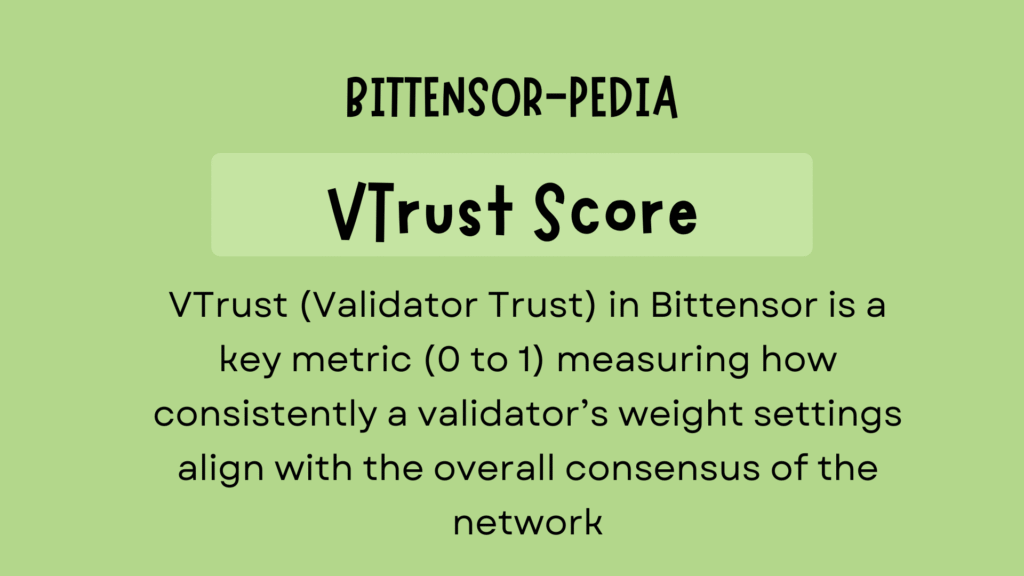
e. Managing stake positions, VTrust scores, and consensus alignment continuously to maximize emissions and maintain a competitive permit position.
Beyond the protocol work, validators also carry a reputational responsibility to the broader community. Attracting delegated stake from other $TAO holders, which is one of the most meaningful ways to compound validator earnings, depends entirely on building trust through transparent operations, consistent performance, and genuine participation in the ecosystem.
Why This Role Is Worth Your Attention
Looking at validation purely as a yield-generating activity is accurate but incomplete. The validator role carries a set of structural advantages that compound over time and sit well beyond what the emissions alone would suggest.
a. Gateway Access to Subnet Intelligence: Validators are the only participants through which users and applications can query a subnet’s outputs. This means every validator effectively controls a doorway into the network’s intelligence production, and that access can be monetized through API infrastructure built on top of the subnet entirely independent of protocol emissions.
b. Returns Stack across Subnets: Validator earnings are additive. Operating across multiple subnets simultaneously means income compounds from each one, and validators with a presence on the Root subnet further amplify their overall returns across the entire network.
c. Delegation Income Compounds with Reputation: As a validator builds a track record, other $TAO holders delegate their stake behind them. That delegated stake increases the validator’s influence in Yuma Consensus and generates a steady stream of delegation fee income on top of direct emissions, creating two parallel income channels that grow together.
d. Subnet ‘$ALPHA’ Token Visibility: Dynamic TAO gives validators early and detailed visibility into which subnets are gaining momentum before the broader market catches on. That information edge creates meaningful opportunities to accumulate undervalued alpha tokens at the early stages of a subnet’s growth cycle.
e. Early Positioning in a Still-Early Network: Bittensor grew from 65 to 128 active subnets in 2025 alone. The validators who establish strong, well-maintained positions now are building infrastructure and reputation that becomes progressively harder to displace as the network scales and competition for permit slots intensifies.
How Validators Earn
Validator compensation comes from two distinct sources, and understanding both is essential for modeling whether the role makes financial sense for your situation.
a. Direct emissions make up the first and most immediate income stream. After the subnet owner’s 18% cut is deducted from total subnet emissions, approximately 41% flows to validators and 41% to miners.
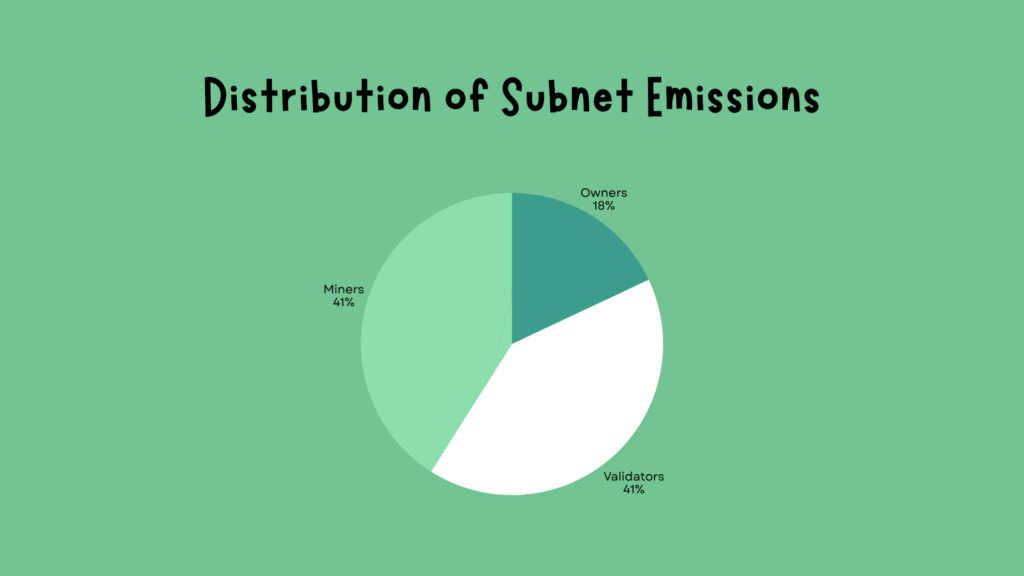
A validator’s individual share of that 41% is determined by two factors working together: the relative stake they hold on the subnet, and their VTrust score, which measures how consistently their submitted weights align with the consensus of other validators.
High stake combined with high VTrust maximizes emissions, while poor consensus alignment reduces a validator’s share regardless of how much capital sits behind them.
b. Delegation fees make up the second income stream. Any validator can open themselves to delegated stake from other $TAO holders, and in return, they collect a percentage of the dividends earned through that delegated stake.
This percentage, known as the delegate take, can be set anywhere between 0% and 18% and adjusted over time. For validators who invest in building community trust and visibility, delegation creates a compounding income channel that grows as their reputation does.
For validators operating on lower-emission subnets, additional income paths exist through monetizing API access to subnet outputs, accumulating undervalued $ALPHA tokens for future appreciation, or concentrating primary income on higher-performing subnets while maintaining permit positions across a broader footprint.
What You Need to Get Started
The barrier to becoming a validator on Bittensor is real, both in capital and technical complexity. Here is exactly what the process involves:
a. Wallet Creation: Set up a coldkey for secure long-term fund storage and a hotkey for daily operational use, both generated through the Bittensor CLI.
b. Stake Acquisition: The technical minimum stake for a validator permit is 1,000 $TAO, but the competitive functional floor sits between 5,000 and 20,000 $TAO depending on the subnet.
Miners naturally prioritize queries from validators whose weights carry more influence over consensus, meaning undercapitalized validators receive lower-quality responses and set less accurate weights as a result.
c. Hotkey Registration: Register your hotkey on your chosen subnet to receive a UID slot and formally enter the subnet’s participant set.
d. Validator Permit: The network automatically grants permits to the top 64 nodes by stake on each subnet. If a competing hotkey accumulates more stake than yours, you lose your permit and revert to miner status until your stake position recovers.
e. Node Infrastructure: Running a validator requires a reliable server with sufficient uptime, processing capacity, and hardware specifications to meet each subnet’s requirements.
This is not optional, downtime directly affects VTrust and earnings.
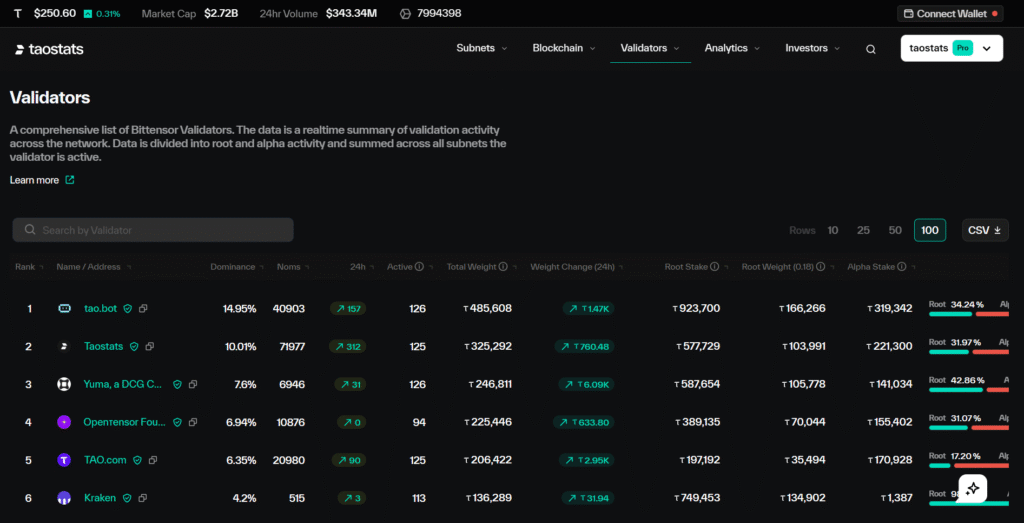
f. Ongoing Monitoring: Tracking your VTrust score, stake position, and consensus alignment through platforms like Taostats is a continuous operational requirement, not a periodic check-in.
Things to Know Before You Commit
A few strategic realities worth internalizing before putting capital and infrastructure behind validation:
a. Subnet Selection is a Consequential Decision: Each subnet has different hardware requirements, minimum stake thresholds, competitive dynamics, and emission potential.
The right subnet for your resources is rarely the most obvious one.
b. Multi-Subnet Operation is Where the Real Returns Are: Earnings are additive across subnets, and validators who maintain strong positions across as many subnets as possible, including the Root subnet, consistently outperform those concentrated in a single one.
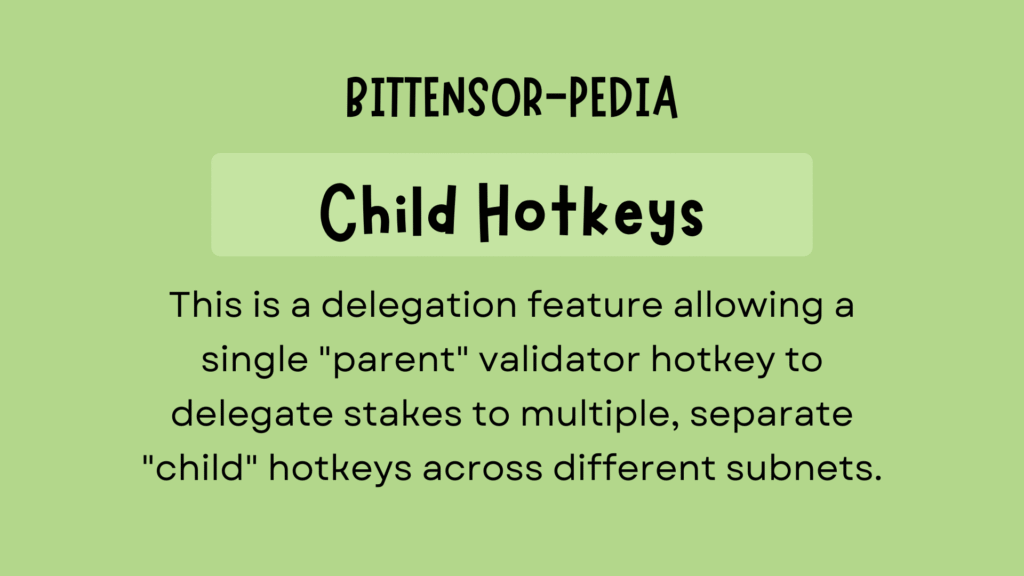
c. Child Hotkeys are Worth Implementing From the Start: Distributing stake to child hotkeys lets you manage validation across multiple subnets without exposing your parent coldkey to the operational risks that come with daily subnet activity.
d. Weight copying is a Punishable and Detectable Shortcut: Some validators copy the weights of others instead of doing genuine evaluation work. Bittensor has introduced encrypted weights to address this, and validators caught in misaligned consensus patterns see their VTrust and earnings reflect it accordingly.
Conclusion
Validators are not peripheral participants collecting passive rewards while the rest of the network does the real work. They are the layer through which Bittensor decides what quality looks like, which miners deserve to be compensated, and who gets access to the intelligence the network produces. Every emission, every subnet output, and every data point that reaches an end user passes through a validator’s scoring at some point in the pipeline. The role demands capital, technical infrastructure, and consistent operational discipline, but what it returns is more than yield. It is a structurally embedded position inside a decentralized AI network that is still early enough that establishing a strong foothold now carries advantages that compound quietly and significantly over time.
Enjoyed this article? Join our newsletter
Get the latest TAO & Bittensor news straight to your inbox.
We respect your privacy. Unsubscribe anytime.
Enjoyed this article?
Join our newsletter
Get the latest TAO & Bittensor news straight to your inbox — every morning before markets open.



No comments yet — be the first.