


Most people encounter the word ‘halving’ in the context of Bitcoin, where it has become one of the most anticipated events in crypto, historically preceding significant price appreciation and marking a new phase in the asset’s economic cycle.
Bittensor has its own halving mechanics, and they meaningfully are more complex than Bitcoin’s single-token model. Because Bittensor operates with two distinct token layers ($TAO at the network level and $ALPHA tokens at the subnet level) it also operates with two distinct halving mechanisms, each with different triggers, different scopes, and different consequences for the people participating in the network.
Understanding the difference directly affects how miners plan their operations, how validators think about their returns, and how token holders position themselves ahead of supply-side shifts.
The $TAO Halving: A Network-Wide Event
The $TAO halving is Bittensor’s equivalent of Bitcoin’s supply reduction mechanism. It occurs automatically when the total amount of $TAO in circulation reaches a predetermined issuance threshold, with subsequent halvings following the same supply-based logic at regular intervals.
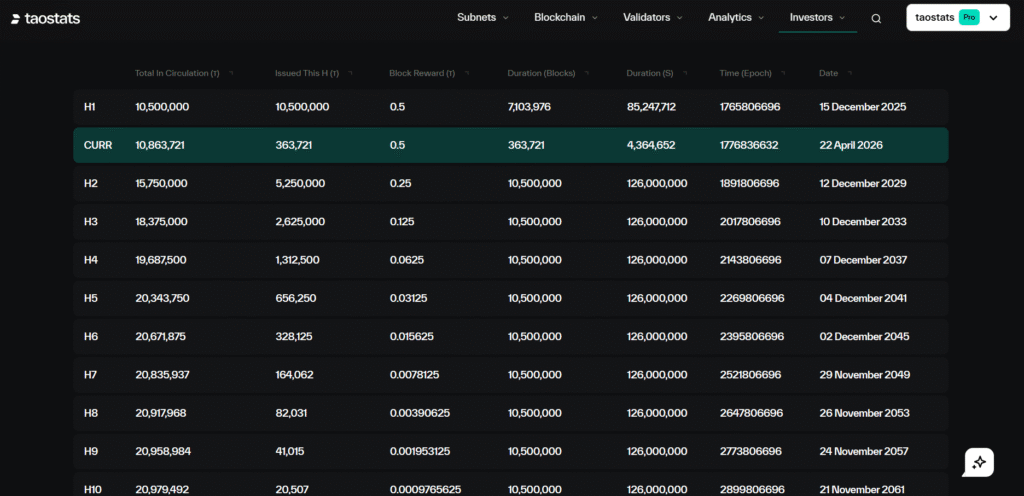
When the threshold is crossed, the network’s daily block reward is cut by 50%, reducing daily $TAO emissions from approximately 7,200 $TAO to $3,600 $TAO after the first halving.
The effect on the broader token economy flows through two channels:
a. $TAO block rewards are halved, meaning less $TAO enters circulation with every block produced from that point forward.
b. $ALPHA pool injections are halved, because the amount of $ALPHA tokens injected into each subnet’s liquidity pool is directly proportional to $TAO injections and must maintain the current price ratio.
NB: One additional factor worth noting is that $TAO recycling can delay halving events. When $TAO is returned to the emission pool through subnet registration fees, it is effectively removed from the circulating supply calculation, pushing the issuance threshold further out and extending the time before the next halving is triggered.
The $ALPHA Halving: A Subnet-Level Event
The $ALPHA halving operates on an entirely different clock and at a different level of the network. Rather than being triggered by network-wide $TAO supply, it is triggered when a specific subnet’s total $ALPHA token issuance reaches its own predetermined threshold.
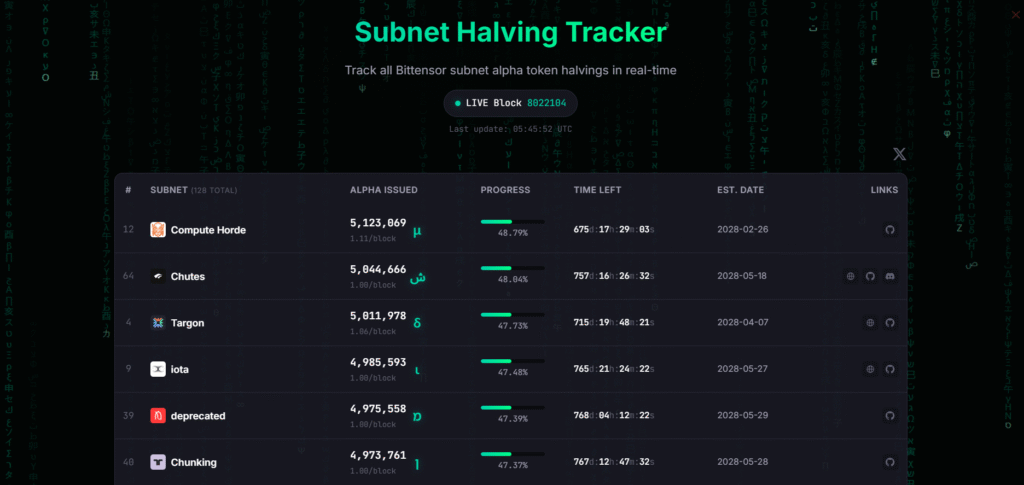
Because each subnet’s $ALPHA supply grows at its own rate depending on activity, stake, and emissions, every subnet will experience its $ALPHA halving at a different time, independently of what is happening at the network level.
When an $ALPHA halving occurs, the impact is more comprehensive than a $TAO halving. It simultaneously reduces:
a. $ALPHA pool injections into that subnet’s liquidity pool by 50%, and
b. $ALPHA participant rewards distributed to miners, validators, and subnet owners by 50%
Unlike the $TAO halving, which leaves participant rewards untouched, the $ALPHA halving hits both sides of the equation at once. Miners and validators operating in a subnet that reaches its $ALPHA halving threshold will see their per-block rewards cut in half, making it one of the most consequential economic events at the subnet level.
TAO Halving vs. $ALPHA Halving: A Direct Comparison
| Feature | $TAO Halving | $ALPHA Halving |
| Scope | Network-wide | Specific subnet only |
| Trigger | Total $TAO issuance threshold | Total $ALPHA issuance threshold |
| Impact on liquidity | Halves $TAO and $ALPHA pool injections | Halves $ALPHA pool injections |
| Impact on participant rewards | Rewards remain unchanged | Rewards cut by 50% |
| Timing | Same for all subnets | Independent per subnet |
| Frequency | Follows network-wide supply schedule | Follows each subnet’s supply schedule |
What This Means for Miners, Validators, and HODLers
The halving mechanics play out differently depending on how you participate in the network, and the distinctions matter more than most people initially appreciate.
1. For Miners
The most important thing a miner can know is that a $TAO halving does not directly reduce $ALPHA reward emissions, but can indirectly affect their value. Their rewards remain constant through a network-wide halving event, meaning day-to-day mining income is unaffected. What does change is the liquidity environment around the subnet token, which can introduce price volatility that affects the real-world value of those unchanged rewards.
An $ALPHA halving is a different story entirely. When a subnet’s own issuance threshold is reached, mining rewards are cut by 50% with no grace period.
Miners should:
a. Track each subnet’s $ALPHA issuance milestone independently, since every subnet reaches its halving on its own timeline.
b. Factor upcoming $ALPHA halvings into return projections before committing hardware or capital to a subnet.
c. Diversify across multiple subnets where possible to avoid having the bulk of mining income concentrated in a subnet approaching its halving threshold.
Validators face the same reward dynamic as miners and should apply the same logic as a $TAO halving leaves $ALPHA validator rewards unchanged. An $ALPHA halving cuts them in half, which for validators with significant stake in a high-emission subnet represents a material reduction in income.
Key considerations for validators include:
a. Monitoring the $ALPHA issuance curve of every subnet they operate on, not just the highest-earning ones,
b. Reassessing stake allocation in subnets that are close to their $ALPHA halving threshold to determine whether current positions still make economic sense post-reduction, and
c. Watching for subnet owners who proactively implement manual reward reductions ahead of a halving, as this signals a team that understands its own tokenomics and is managing its economy responsibly.
3. For HODLers
For token holders, the $TAO halving is the most immediately relevant event. Fewer $TAO entering circulation each day creates the kind of supply-side pressure that, when paired with sustained or growing demand, historically creates favorable conditions for price appreciation.
The secondary effect is subtler but worth understanding:
a. $TAO halvings reduce $ALPHA pool injections without cutting participant rewards, which creates a liquidity imbalance inside subnet economies,
b. This imbalance can drive increased volatility in subnet $ALPHA tokens, particularly in subnets where the gap between reward issuance and pool liquidity becomes pronounced, and
c. Subnet owners who respond by manually cutting $ALPHA rewards to rebalance their local economy are signaling sound economic stewardship, making those subnets worth paying closer attention to as long-term holdings.
For HODLers with exposure to specific subnet ‘$ALPHA’ tokens, tracking each subnet’s issuance milestone is as important as tracking the network-wide $TAO supply, since an $ALPHA halving can significantly alter the return profile of a subnet position regardless of what $TAO is doing at the network level.
Conclusion
Bittensor’s dual halving structure is one of the more nuanced aspects of its economic design, and it rewards the participants who take the time to understand it properly.
$TAO halvings are network-wide supply events that reduce emissions and liquidity injections without touching participant rewards. $ALPHA halvings are subnet-specific events that reduce both liquidity and rewards simultaneously, arriving on a timeline that each subnet determines through its own activity.
Knowing the difference, and knowing where your subnet sits on its issuance curve, is the kind of information that separates participants who are caught off guard by economic shifts from those who saw them coming and positioned accordingly.
Enjoyed this article? Join our newsletter
Get the latest TAO & Bittensor news straight to your inbox.
We respect your privacy. Unsubscribe anytime.
Enjoyed this article?
Join our newsletter
Get the latest TAO & Bittensor news straight to your inbox — every morning before markets open.

[…] with supply. TAO has a maximum supply of 21 million, and the December 2025 halving reduced daily emissions from roughly 7,200 TAO to 3,600. Scarcity alone does not send an asset […]