

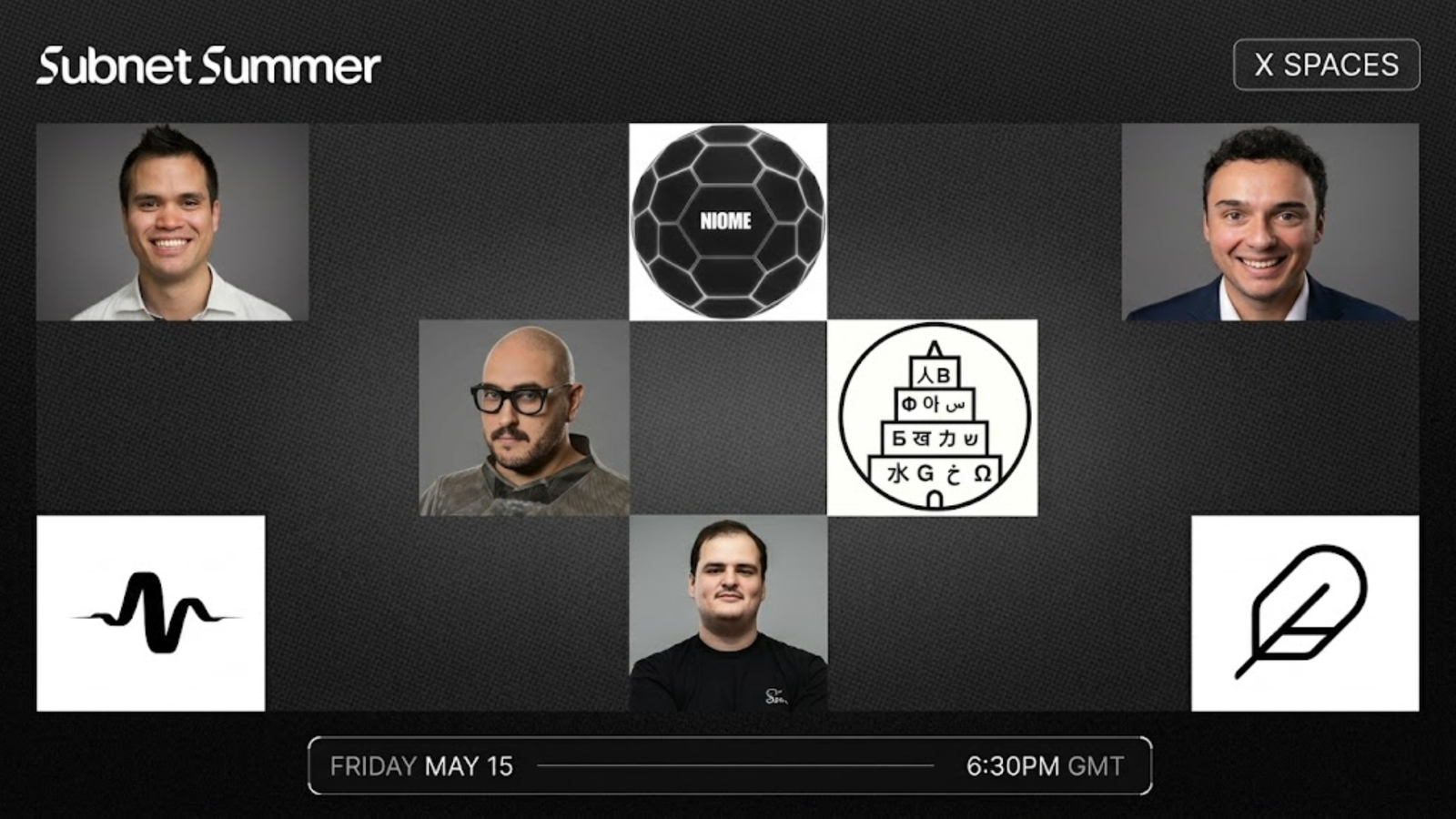
Bittensor’s latest “Subnet Summer” Spaces was supposed to be a discussion about institutional adoption and real-world use cases.
What it became instead was one of the clearest windows yet into how builders, investors, and subnet operators think about the future of the network.
Over nearly an hour and half, speakers from DSV, Score (SN44), LeadPoet (SN71), Niome (SN55), BabelBit (SN59), and Vocence (SN78) & Pertub (SN26) laid out what is working, what institutions still dislike about Bittensor, and what separates subnets becoming real businesses from those still stuck at the research stage.
1. The Institutional Read on Bittensor Right Now is “Promising Chaotic Circus”
Siam reported back from the recent DCG/Yuma event in detail. Of roughly 300 attendees, only about a third were Bittensor people, and his time was spent talking to the non-Bittensor side.
The recurring complaints were that too many changes happening too fast, several driven by two or three people, with rushed implementations creating new attack vectors faster than the previous ones get patched.
The exact phrase one institutional contact used was “promising chaotic circus.” Siam’s read is that big money is aware of Bittensor ($TAO) and wants to allocate, but is waiting for at least a six-month window of no changes before committing serious capital.
2. There is No Real Moat Against Successful Subnets Getting Acquired and Shelved
A second recurring institutional question Siam heard: what stops Anthropic, Elon, or OpenAI from buying up a promising subnet team and shelving it? There is no clean answer.
One subnet owner was recently fielding $10 million walk-away offers, and several quiet subnet exits are already happening. Most subnet owners have a price, and at the right number they would take it. For institutions trying to model long-term value on the network, this is a real risk that has not yet been priced in.
3. Revenue is Not the Bar Anymore, Buybacks Are!
Siam has been pushing the revenue narrative for over a year, but the goalposts have moved. Many subnets are now generating $5,000 to $50,000 a month, but few are converting that revenue into on-chain buybacks.
Operationally, buying back your own stock is a poor use of capital when the cash could be used to grow the business, but Bittensor’s deregistration mechanics force the issue. With deregistration cadence rumored to be tightening, buyback frequency is becoming a survival metric, not just a signaling one.
4. Deregistration Creates Perverse Speculation Incentives
The deregistration discussion was pushed back on as deregistration is fundamentally viewed as a liquidity event, and in crypto, large liquidity events are rare and valuable.
Bittensor is currently providing that liquidity event specifically to failed projects, which creates an asymmetric bet for speculators. Buying subnet ‘$ALPHA’ token at 1 $SN0 a couple of months from deregistration becomes a near-free option, which pulls capital toward bad projects rather than good ones.
5. The Network is Bottlenecked at Roughly 50 New Subnets per Year
The conversation also pointed out the structural limit no one is talking about. With one or two new subnets being registered per week, Bittensor is currently capped at roughly 50 to 60 new “companies” per year.
The argument is that this cap limits the upside of the network, because a handful of breakthrough subnets are worth thousands of failures, and the protocol’s current configuration is filtering on the wrong end. He wants the network to pour fuel on the fire and let open competition do the filtering.
6. New-Category Subnets Beat Commodity Subnets on Long-Term Value Capture.
Commodity-layer subnets like compute and storage compete on price and face well-funded incumbents who can subsidize themselves.
Category-creating subnets like Score’s vision models or LeadPoet’s high-intent leads are building new markets rather than fighting in existing ones, and they have stronger long-term moats because they can own a category outright rather than fight for share inside one.
7. Score’s PwC Deal is a Co-Selling Agreement, Not a Partnership
Max Sebti walked through Score’s PwC France deal in unusual detail. The structure is a co-selling agreement, not a typical partnership, which is meaningfully different. PwC brings clients to Score, the two teams build proposals together, and they pitch jointly.
PwC France alone does roughly $2 billion per year in client strategy work, which gives Score immediate access to an enterprise pipeline it could not have built alone.
Bittensor was named in the title of the joint press release, which is a level of visibility most subnet teams have never had with a Big Four firm.
8. PwC Waived Phase-Two Revenue Because Good Vision AI Teams are That Rare
The most striking detail from the Score deal: PwC agreed to take revenue only from the phase-one scoping work and not from the phase-two commodity sale of vision AI. This is pricing power on steroids: When enterprise clients struggle to source GPUs, RAM, and engineering talent on their own, a credible subnet team has enough leverage to set its own terms. That same dynamic should apply to other commodity-grade subnets willing to engage seriously with enterprise buyers.
9. Niome Pivoted From Raw Genomic Data to Synthetic after Discovering Pharma Wouldn’t Use the Raw Version.
Niome started on the assumption that aggregating vaults of real genomic data would make pharma a natural buyer.
It turned out that pharma cannot easily use raw aggregated data because of red tape and data safety constraints, and the rise of AI made the problem worse rather than better.
Niome now sells synthetic genomic data calibrated to specific disease conditions and demographics, which sidesteps the regulatory issues and gives pharma something it can actually train on. Niome also became the first subnet to sign a partnership with a government, in this case Scotland.
10. BabelBit is Replacing the BLEU Benchmark with Phrase Completion Latency
The BLEU benchmark is the industry standard for translation quality, but it rewards literal accuracy, which is the wrong objective for live interpretation. An interpreter, faced with someone saying “yeah, I really think I agree with everything you just said,” might translate that as a single word: “agreed.” That is not a BLEU-valid translation, but it is what a human interpreter actually does in the room.
BabelBit’s new benchmark measures phrase completion latency, the time it takes for the meaning to land in the other language, and the company’s base models are already running four to five times faster than commercial alternatives like Google Translate’s interpreter mode.
The Through-Line
The conversation surfaced a tension that runs through nearly every part of the Bittensor ecosystem right now. Institutional money is aware and interested but is waiting for protocol stability. Subnet teams are racing to build revenue and buybacks fast enough to clear the deregistration window. And the most interesting subnet teams are pivoting away from generic AI service positioning into category ownership, structured enterprise deals, and benchmark redefinition.
Enjoyed this article? Join our newsletter
Get the latest TAO & Bittensor news straight to your inbox.
We respect your privacy. Unsubscribe anytime.
Enjoyed this article?
Join our newsletter
Get the latest TAO & Bittensor news straight to your inbox — every morning before markets open.


No comments yet — be the first.