

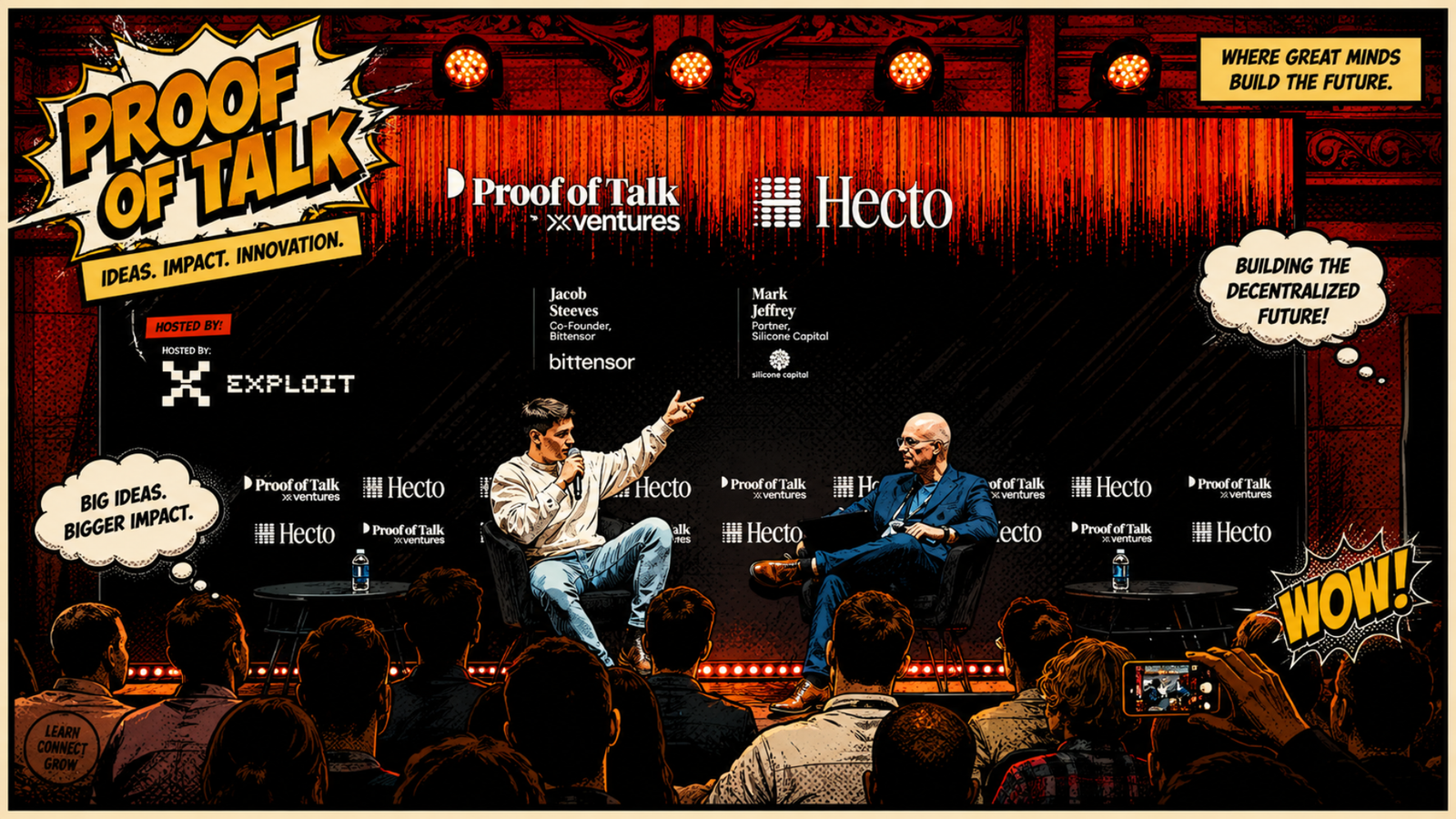
Bittensor’s co-founder, Jacob ‘Const’ Steeves, joined Stillcore Capital’s Mark Jeffrey on stage at Proof of Talk for a conversation that ran across the entire subnet thesis.
This singular discussion covered: what is actually working a year into dynamic $TAO, why building a subnet beats raising VC, who actually mines on Bittensor and why, and how the network competes with the trillion-dollar centralized AI giants.
The exchange surfaced several of the cleanest articulations of what Bittensor has become that the ecosystem has produced this year, including a closing line worth holding onto: the moat is the mechanism.
The Conversation, Question by Question
The key exchanges from the stage conversation:
Q: WHAT IS WORKING IN THE SUBNET ECOSYSTEM, AND WHAT IS NOT?
A: A year ago, most subnets were not working as building a functioning, exploit-free digital commodities market was genuinely hard.
The good ones are now exploding: Targon (SN4) and Lium (SN51) are shipping compute that flies off the shelves. Chutes (SN64) is running at full capacity, while NOVA (SN68) is producing better molecules than the team expected.
The mechanism is bubbling up real talent, with top operators showing a rare combination of speaking, thinking, and technical ability. What is failing is governance. Building a permissionless S&P 500 is hard, and the system still has holes the network is wide-eyed toward.
Q: WHAT IS JACOB’S FRAMING LINE FOR SUBNET ALIGNMENT?
A: A subnet is like a laser cannon. If it is not aimed perfectly, you are not shooting at the Death Star. You are shooting off into space producing noise without value.
Q: WHY BUILD A SUBNET INSTEAD OF RAISING FROM VCs?
A: AI is becoming a fiat game. Teams can raise $200 million and become millionaires, but that is winning life, not winning the actual competition. VC-backed startups use the same compute primitives, build the same kind of company, and raise from the same funds as OpenAI. Nothing about that path is structurally unique.
Bittensor’s superpower is structural. Once a subnet mechanism is working, the operator has something OpenAI does not: a machine that produces value faster, with the best engineers in the world working on it, whose names the operator does not need to know.
Q: What is Mark’s rule of thumb on subnet-style economics?
A: Building subnet-style costs roughly one-tenth what it would cost to build the same product any other way.
Q: WHY MINE ON BITTENSOR INSTEAD OF GETTING A JOB?
A: Mining attracts a specific personality. People who want a free lifestyle, who love the purity of competition, and who do not want a boss above them.
The closest thing to a boss is the subnet owner, and the miner’s job is to make the owner’s life harder by exploiting the incentive structure. Miners do not need PhDs. They often end up doing what PhDs do anyway, because they have the mentality the system rewards.
Subnets are also now real AI benchmarks. Mining a subnet successfully is more impressive than what a frontier model can do.
Q: WHAT DOES MARK MEAN BY BITTENSOR AND STRANDED TALENT?
A: Bittensor does for stranded talent what Bitcoin did for stranded energy.
Q: WHAT IS SUBNET STACKING AND WHY DOES IT MATTER?
A: Subnet stacking is when subnets use other subnets. Cost savings compound, and power increases geometrically.
Mark is currently mining Minos (SN107) using a prefabricated miner hosted on Targon (SN4), paying Targon in $TAO. The loop self-funds.
Every layer is becoming agent-accessible: with a single API key, agents can mine Bittensor, create subnets, extract data, store data, compute, and get inference inside one ecosystem.
Q: HOW DOES BITTENSOR WIN AGAINST OpenAI and Anthropic?
A: Centralized companies are already becoming small and agentic. Co-Automation, a recent Anthropic spin-out, runs entirely on agents with a small compute footprint. The trajectory is toward protocol-based compute clusters with incentive mechanisms for agents to soak up resources.
Bureaucracy is the constraint that breaks first. Intelligence has unlocked what a company can be, and human-mediated bureaucracies cannot move at the speed of compute. The ethical layer also matters. Centralized AI is structurally manipulable, and unholy alliances between corporations, financial centers, and governments will eventually enforce a specific worldview through models that will be hard to break.
Q: WHAT PROTECTS BITTENSOR’S LAUNCH MODEL?
A: No premine, no insider distribution, no friends getting handed early ownership. Bittensor was launched into a live market the same way Bitcoin was.
Q: WHAT ABOUT THE IMITATORS COPYING PROOF OF USEFUL WORK?
A: The fair-launch moat is real but not enough. The team should not rely on it. More competition expands the ecosystem. When Pearl launched recently with matrix multiplication mining, their miners immediately came to Bittensor for cheap inference and compute.
Within a week, Bittensor subnets had a wave of new revenue from Pearl’s miners as customers. Other protocols are customers, not enemies.
Q: WHAT IS THE ACTUAL MOAT?
A: The moat is the mechanism. Whether Bittensor can build economic systems that produce digital commodities more efficiently than alternatives is the only durable advantage.
Years of unpublished research on exploit-resistant systems is what backs that claim. No one else is mining intelligence at this level of abstraction. Bittensor can do pretraining, post-training, inference, compute, and LLM-as-judge systems inside one mechanism, and that abstraction layer is the actual product.
The Founder’s Read
The conversation captured something the ecosystem has been circling but rarely articulating cleanly. Bittensor is no longer best understood as a crypto-AI experiment competing for attention. It is a permissionless research engine producing real commodities at real efficiency advantages, attracting operators who would otherwise be doing fiat-game startups, attracting miners who would otherwise be stranded by traditional employment, and increasingly serving as the base layer that competing protocols quietly route their work through.
Const’s “moat is the mechanism” framing is the cleanest single-line summary of why none of the cloning attempts ultimately matter. The 12 to 24 months ahead will test whether the rest of the world catches up to what the operators inside Bittensor have already figured out.
➛ Watch the Full Conversation HERE
Enjoyed this article? Join our newsletter
Get the latest TAO & Bittensor news straight to your inbox.
We respect your privacy. Unsubscribe anytime.
Enjoyed this article?
Join our newsletter
Get the latest TAO & Bittensor news straight to your inbox — every morning before markets open.
Be the first to comment