

If you spent the last few weeks reading TAO Twitter, you’d be forgiven for thinking the wheels were coming off. The timeline is full of exhausted holders and increasingly loud accusations that Bittensor has drifted from “decentralized AI” into something closer to a casino with extra steps.
So we put together a short poll to find out where people stand on incentives, fixes, and conviction in TAO.
The results that came back are more interesting than the noise suggested.
The community is mad. The community is also still here.
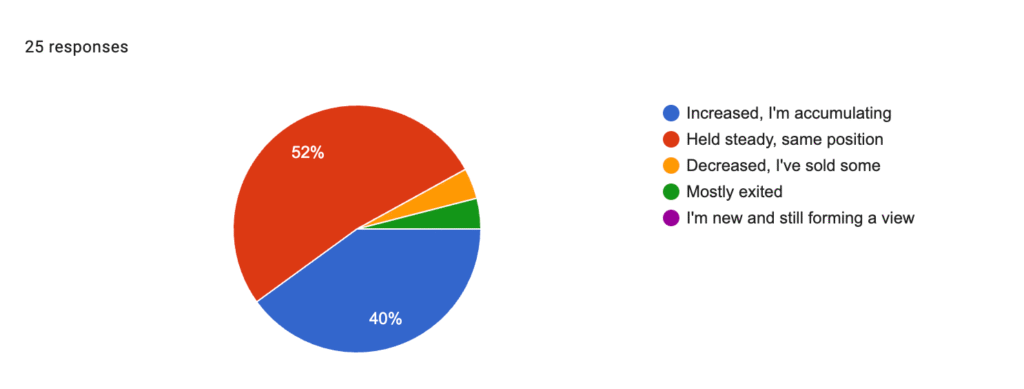
Start with the number that matters most. Out of 25 respondents, who are mostly TAO holders and community contributors, only 2 said their conviction in TAO had decreased over the last six months. The other 23 either held steady (52%) or were actively accumulating (40%).
Read that again. Despite the high influx of complaints on X and TG/Discord, 92% of respondents are still in the same position or buying more.
This finding says a whole lot about where the ecosystem stands. The community is frustrated with how the system works, but it has not lost faith in what the system is trying to be. People are not selling. They are complaining because they are still here.
So what are people mad about?
When asked the single biggest reason low-quality subnets keep getting rewarded, respondents split into three roughly equal camps.
- 48% blamed KOLs promoting bad projects for personal gain.
- 36% blamed the incentive mechanics themselves (dTAO, root APY, etc.)
- 36% blamed the lack of vetting or accountability for new teams launching subnets.
- Only 20% chose “it’s just early-stage chaos, the market will sort it out.”
- Just 8% rejected the premise entirely and said low-quality subnets aren’t being over-rewarded.
That top answer is worth sitting with. The single most-blamed force in the ecosystem right now is not the code, not the mechanics, and not the OTF. It is people, specifically, the influencers whose endorsements move flows. As one respondent put it bluntly: “Too many shillers and influencers ramping up posts for personal bags, then mysteriously disappear. It makes the chain feel like another pumpfun gimmick.”
On the fix, the community is split four ways
If the diagnosis has a clear leader, the prescription does not. Asked what they’d change about Bittensor tomorrow if they had the full power, respondents fractured almost evenly across the structural options:
- 36% want it easier to deregister or shut down failing subnets.
- 36% want the root staking APY reduced or removed.
- 36% want emissions capped or redistributed away from low-performing subnets.
- 24% want a vetting or approval process for new subnets.
- Only 8% said “nothing; let the free market decide.”
One respondent went deeper than the multiple choice allowed, proposing a full restructure: a “Subnet 0” that holds TAO with no APY to keep it in the ecosystem and off exchanges, paired with a market-weighted composite staking option to retire root prop entirely, and equal emissions across a permanently capped number of subnets.
The defenders are still in the room
It would be easy to write this poll up as a unified cry of distress. It isn’t. Some folks pushed back hard on the people complaining.
“Take off your rose-colored glasses,” one respondent wrote. “Bittensor has always been and always will be an oligarchic system, not a decentralized one. I’ve already seen everything in it.” A weary kind of acceptance, neither bullish nor bearish.
Another respondent defended root stakers with no diplomacy at all: “Stop criticizing and blaming TAO root stakers when your subnet bags are underwater. Root stakers are not your enemy and have no obligation to save your bags… Root stakers are the key to stabilizing the native TAO price in a bear market.”
And a third asked the community to extend grace to the foundation: “Do NOT overthink decentralisation. Const still has a lot of pull, which brings a lot of FUD; decentralisation takes time. OTF is aware and working on it. Give it time, we’ll get there.”
What this all adds up to
Three things, as the data suggests.
One: The frustration is there, and it is mostly directed at people behaving badly inside a system that doesn’t punish them for it, not at the protocol itself.
Two: The community does not agree on the fix, but it does agree that something needs fixing. Only 2 of 25 respondents endorsed pure laissez-faire. The era of “let the market decide” as the default answer appears to be ending.
Three: Despite all of the above, people are still here. Still holding. Still (in 40% of cases) buying more. The bear-case narrative is loud, but the sentiment is bullish.
That gap, between the loudness of complaint and the stillness of conviction, is where Bittensor lives right now. It is a community that cares enough to be furious and cares enough to stay.
Poll conducted May 20–21, 2026. 25 responses. Tao Daily will continue tracking community sentiment — if you’d like to be included in the next pulse check, follow @taodaily for the next form.
Enjoyed this article? Join our newsletter
Get the latest TAO & Bittensor news straight to your inbox.
We respect your privacy. Unsubscribe anytime.
Enjoyed this article?
Join our newsletter
Get the latest TAO & Bittensor news straight to your inbox — every morning before markets open.



No comments yet — be the first.