


Many subnets in Bittensor thrive on shiny marketing to stay relevant, while others do actual great stuff. Vidaio belongs firmly in the latter camp.
As a decentralised AI video processing platform powering VidaioOS (the AI agent layer for video), it’s tackling one of the biggest real-world infrastructure headaches: video storage, compression, upscaling, localization, and delivery at massive scale.
Over the past few weeks, Vidaio has racked up a string of impressive milestones that prove it’s building product-market fit with enterprise-grade utility.
Here’s a breakdown of what they’ve achieved.
Breaking Into the Big Leagues: MEXC Listing and Global Exposure
Early May brought a major visibility boost when Vidaio officially listed on MEXC. Trading for $SN85 kicked off on May 6, 2026, a move that takes the subnet out of Bittensor’s echo chamber.
The listing opened the subnet to a much wider audience of traders, builders, and potential enterprise partners. For a project focused on practical utility in the video space, getting on a major CEX like MEXC was a clear proof of growing momentum.
Industry Recognition: Featured by MEXC Learn

Just a few days ago, MEXC itself published a detailed blog post titled “Vidaio: Building The AI Agent Layer For Video On Bittensor.”
The piece positions VidaioOS as an autonomous system that connects to video storage, analyzes entire libraries, and intelligently decides how to compress, upscale, localize, tag, and optimize content.
It emphasizes the power of Vidaio’s decentralized competitive engine: miners compete to deliver better video outputs while validators enforce quality. The blog calls out the real infrastructure challenge Vidaio is solving (exploding global demand for video storage, compression, and delivery) and flags the combination of AI agents and Bittensor as “a notable direction to watch.”
When the exchange that just listed you writes a thoughtful deep dive like this, it’s validation that the project is being taken seriously at the institutional level.
Technical Dominance: SOTA Compression Breakthrough
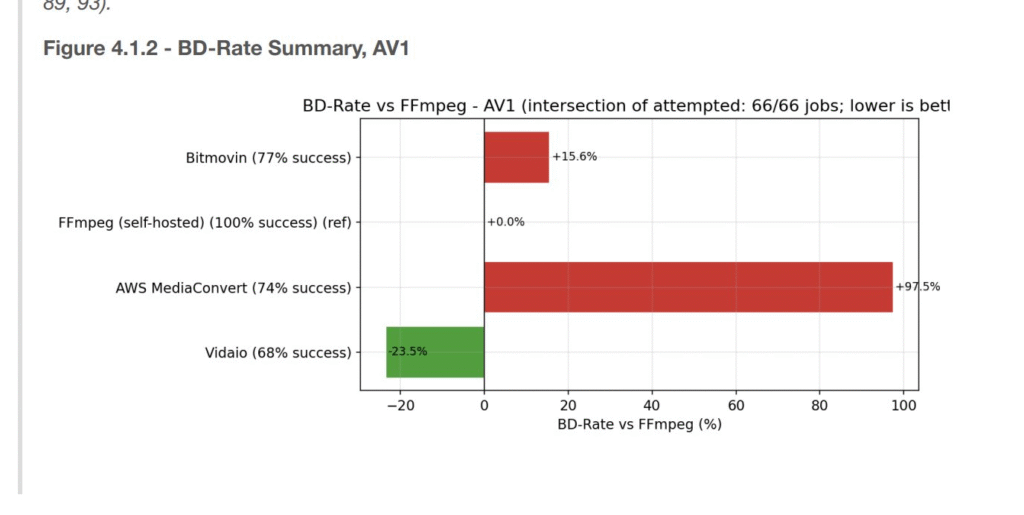
Just yesterday, Vidaio dropped the biggest technical flex yet: a sneak peek from their upcoming full benchmark report showing state-of-the-art compression performance.
Using perceptual quality metrics, Vidaio hit -23.5% versus FFmpeg, as shown in the image above.
For context, FFmpeg is the free, industry-standard tool that almost every video editor, streamer, and website uses to compress video files. It’s been around forever and is considered the baseline for turning big raw videos into smaller, watchable ones without making them look too blurry or blocky.
When Vidaio says they hit -23.5% versus FFmpeg, it means their system produces the exact same visual quality as FFmpeg, but uses 23.5% fewer bits of data (i.e., a much smaller file size or lower bandwidth).
That’s a huge deal in real life: it saves serious money on storage, cloud hosting, and internet delivery costs while the video still looks just as good to the human eye. It’s like getting the same quality movie download but in a file that’s almost a quarter smaller.
In other words, Vidaio is beating the “gold standard” by a noticeable margin. Huge.
Product Momentum: Vidaio Agent Beta Goes Live
On May 19, Vidaio opened the Vidaio Agent beta testing program. This is a huge step toward their vision of self-optimizing video libraries.
The agents will analyze content, recommend actions, and autonomously handle compression, upscaling, localization, and more.
Early users are invited to “test it, break it, and help us improve it.” This moves VidaioOS from powerful tools to an intelligent, autonomous layer.
Also remember that Vidaio entered a strategic joint venture with Pip Studios, a UK-based giant that works directly with major platforms, including Netflix, Amazon, Sony, Universal, and Paramount. Pip Studios is integrating VidaioOS directly into its secure enterprise workflows and global content pipelines.
The partnership positions Vidaio’s AI video infrastructure inside real-world studio operations, unlocking high-volume video workloads and accelerating enterprise-scale adoption.
Proven Traction: Millions More Frames Processed
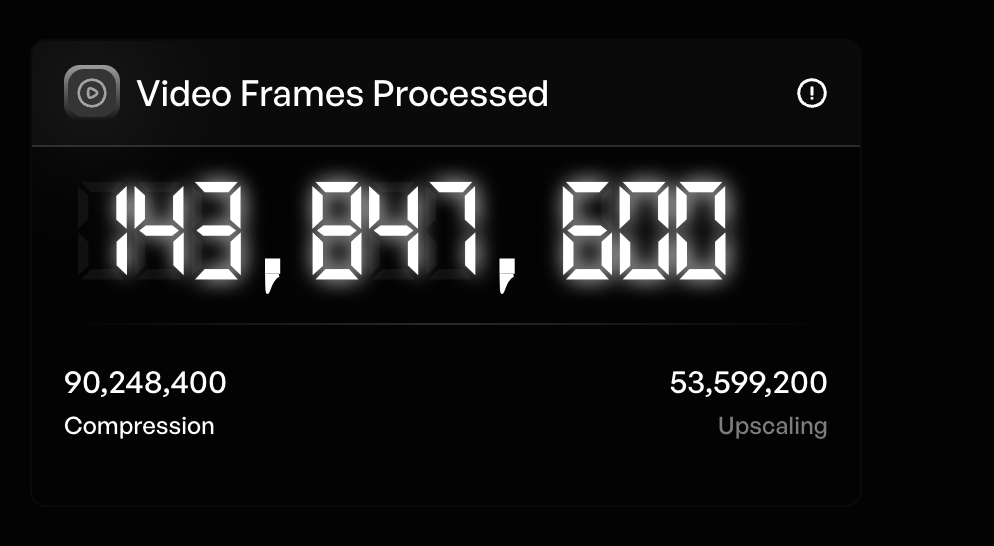
Vidaio has now processed a total of 143,847,600 video frames across its network. This breaks down to 90,248,400 frames handled through AI-powered compression and 53,599,200 frames enhanced with AI upscaling.
These impressive numbers highlight Vidaio’s rapidly growing adoption and prove that it’s already delivering measurable value and production-scale usage well beyond the development stage.
Vidaio Is Quietly Crushing Video AI
While many subnets chase hype, Vidaio has stayed laser-focused on building, and the past few weeks prove it’s paying off.
In a short time, Subnet 85 has secured a major listing on MEXC, earned glowing in-depth coverage from the exchange itself, delivered SOTA compression results that crush FFmpeg, launched the Vidaio Agent beta, formed a strategic joint venture with Pip Studios, and scaled real-world usage past 143 million video frames processed.
This is clear proof that Vidaio is solving expensive, real-world video infrastructure problems with measurable efficiency gains and truly autonomous AI agents.
If you’re in the Bittensor ecosystem or you simply value genuine projects driving traction, Vidaio deserves your attention.
Enjoyed this article? Join our newsletter
Get the latest TAO & Bittensor news straight to your inbox.
We respect your privacy. Unsubscribe anytime.
Enjoyed this article?
Join our newsletter
Get the latest TAO & Bittensor news straight to your inbox — every morning before markets open.



No comments yet — be the first.