


Root staking has quietly become one of the most important yield stories in Bittensor.
For many TAO holders, staking on Root (SN0) is the simplest way to earn yield without actively rotating across individual subnet alpha tokens. It is the safer, cleaner side of the ecosystem: stake TAO, earn TAO, and avoid the volatility that comes with chasing subnet-specific upside.
We asked the Bittensor community how much they’re allocated to root, and the replies may surprise you:
But something important has changed.
As of early May 2026, Root APY has moved close to 10%, up from roughly 4% earlier in the year. That is not a random spike but the result of a shift in how new subnets launch, how emissions flow, and how much value is being routed back to Root stakers.
The Simple Explanation
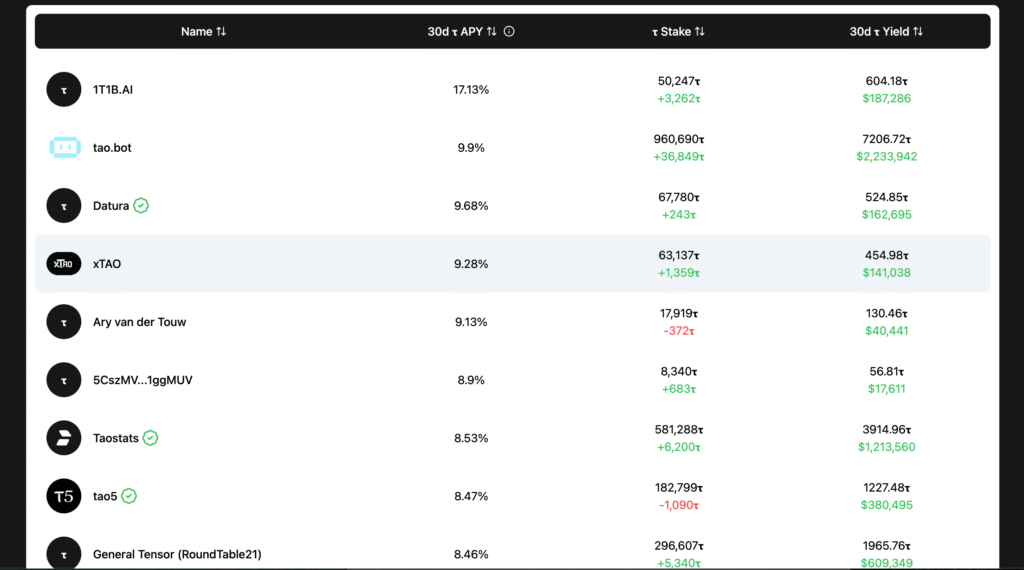
Root APY is rising because new subnets are now launching with more liquidity and a higher share of validator rewards flowing back to Root.
When a new subnet registers, it now receives a larger initial TAO pool. At the same time, new subnets naturally begin with a high root prop, meaning a larger portion of validator emissions flows to Root stakers instead of alpha holders.
The result is a self-reinforcing loop: More new subnets launch → More emissions flow through the system → A larger share of that value gets routed back to Root → Root stakers earn more TAO.
That is why Root APY has moved sharply higher.
What Root Prop Means
To understand why Root APY is rising, you need to understand root prop.
In Bittensor, subnet emissions are distributed across different participants in the system. A portion of those emissions (41%) goes to validators as emission. Root prop refers to the share of those validator emissions that is directed to Root stakers, rather than being captured by holders of a subnet’s alpha token.
So, if a subnet has a high root prop, it means Root stakers receive a larger share of the TAO value generated through validator emissions.
This is especially common with new subnets.
Why? Because new subnets usually do not yet have deep alpha-holder participation, mature market structure, or a broad base of capital allocated into their alpha token. Early in a subnet’s life, much of the value flow remains tied to Root because Root is still the dominant source of staking weight and validator alignment.
In simple terms, young subnets tend to send more value back to Root because their alpha economies are still developing.
That is why fresh subnet registrations can have an outsized effect on Root APY.
Why New Subnet Liquidity Matters
The other major change is liquidity.
Previously, new subnets launched with less initial TAO liquidity. New subnet teams had to start from scratch in terms of the depth of their subnets’ liquidity pool. That made their alpha tokens very volatile and highly responsive to price action.
Now, new subnets are starting with larger liquidity pools. This helps keep alpha prices more stable in the early stages and allows the system to absorb alpha holders selling more effectively.
And because new subnets typically have high root prop (as explained above), there’s a positive effect on root APY.
Subnet 26 provides a clear example. After registering under the improved liquidity setup, the TAO sent to Root stakers reportedly jumped by around 1,300% overnight.
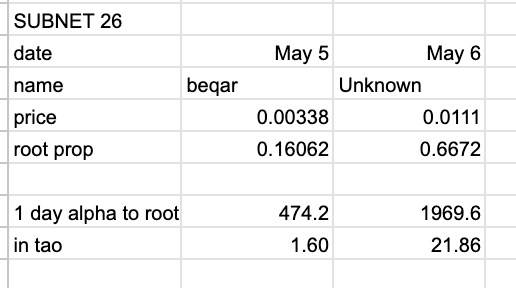
That is the impact of better launch conditions combined with high root prop.
The May 9 Change Made It Stronger
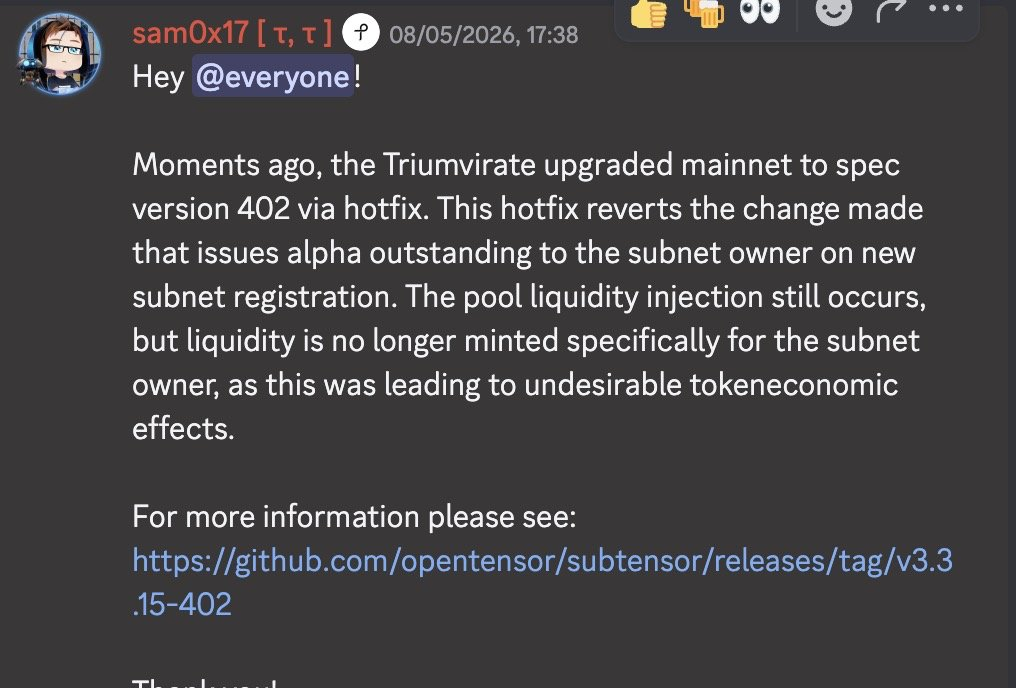
A protocol change rolled out on Friday, May 9, 2026, appears to have amplified this trend.
Before the change, new subnets typically launched with root props around 50% to 70%. Going forward, fresh registrations are expected to carry root props closer to 75% to 90%.
That means new subnet launches should send even more validator emission back to Root stakers.
If more subnets continue coming live under these conditions, Root APY has a clear path to remain elevated, and possibly climb higher.
Why This Is Bullish for TAO
The bullish case is not just about higher yield. It is about what higher Root APY does to user behavior.
First, it gives TAO holders a safer entry point. Not everyone wants to analyze subnet tokens, rotate across alpha positions, or take on high volatility. Root staking offers a simpler option: earn yield directly in TAO while staying exposed to the base asset of the network.
Second, it can reduce selling pressure. If Root APY becomes attractive enough, more holders may choose to stake instead of keeping TAO idle on exchanges or selling into cash. In fact, it can eventually encourage the slow shift of TAO into riskier dTAO plays.
Third, it strengthens the network’s feedback loop. Every new subnet brings innovation, utility, and fresh emissions. The mechanics now funnel more of that value back to Root stakers, creating a positive feedback loop: more subnets → higher Root APY → stronger incentive to hold and stake TAO → healthier network security and liquidity.
Enjoyed this article? Join our newsletter
Get the latest TAO & Bittensor news straight to your inbox.
We respect your privacy. Unsubscribe anytime.
Enjoyed this article?
Join our newsletter
Get the latest TAO & Bittensor news straight to your inbox — every morning before markets open.



No comments yet — be the first.