

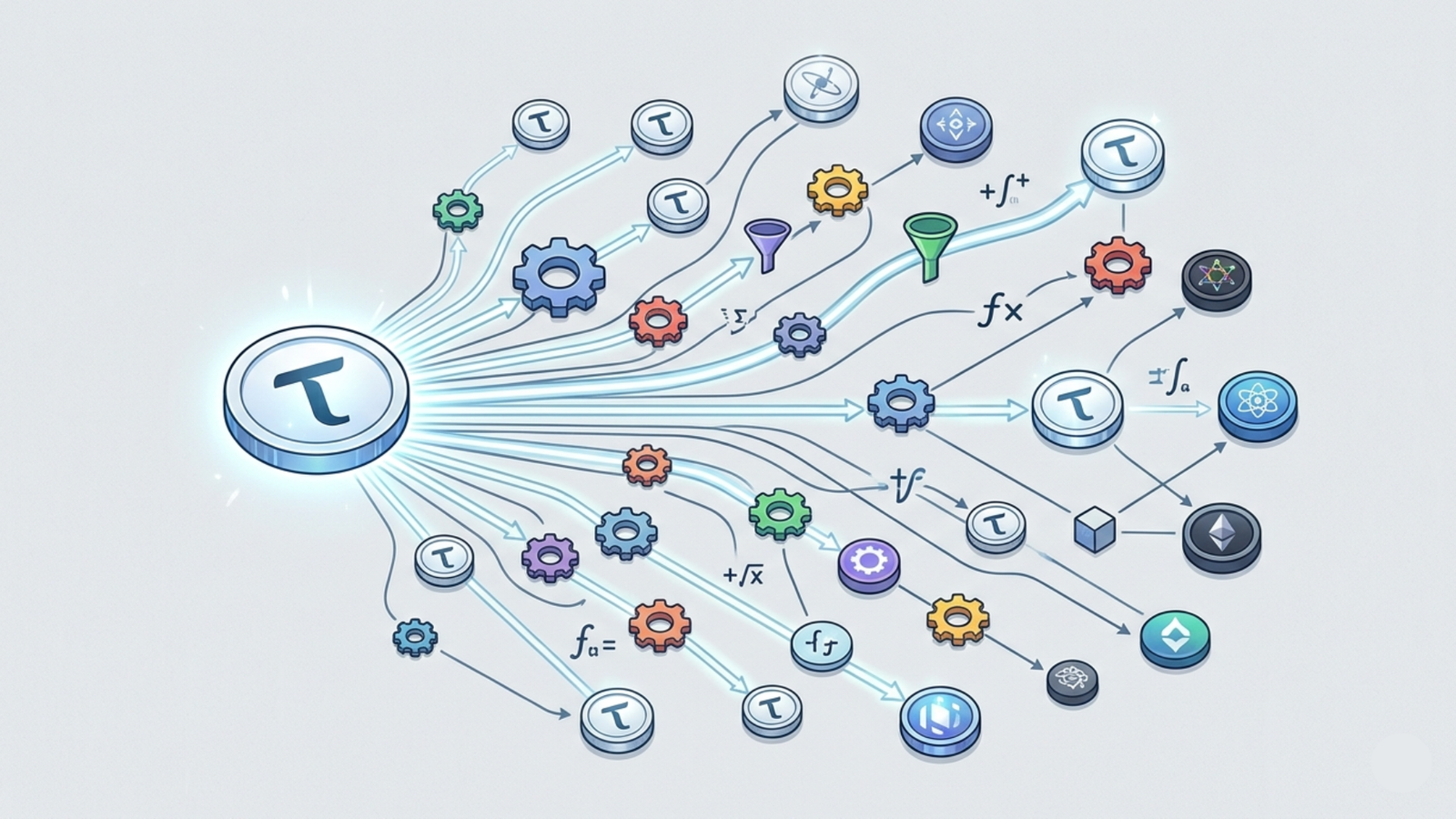
If you’ve ever stared at the words alpha_in, alpha_out, and Taoflow on Bittensor Twitter and felt your eyes glaze over. You’re not alone. Many people in the ecosystem are operating on vibes and half-understood ideas.
This guide puts the pieces together in plain English. By the end, you’ll understand exactly how alpha tokens get minted, what moves their price, why Taoflow rewards what it rewards, and why the same “1 alpha per block” can mean very different things for a small subnet vs. a mature one.
1. The Foundation: Subnets, Alpha, and AMM Pools
Bittensor today has 128 subnets. Each one has its own token called alpha, and each one has its own liquidity pool that works like a mini Uniswap.
Each pool has two sides:
- TAO reserve: the “money” side
- Alpha reserve: the “token” side
The price of 1 alpha (in TAO) is simply:
price = TAO in pool ÷ alpha in poolThat’s it, the ratio of the two reserves is the price.
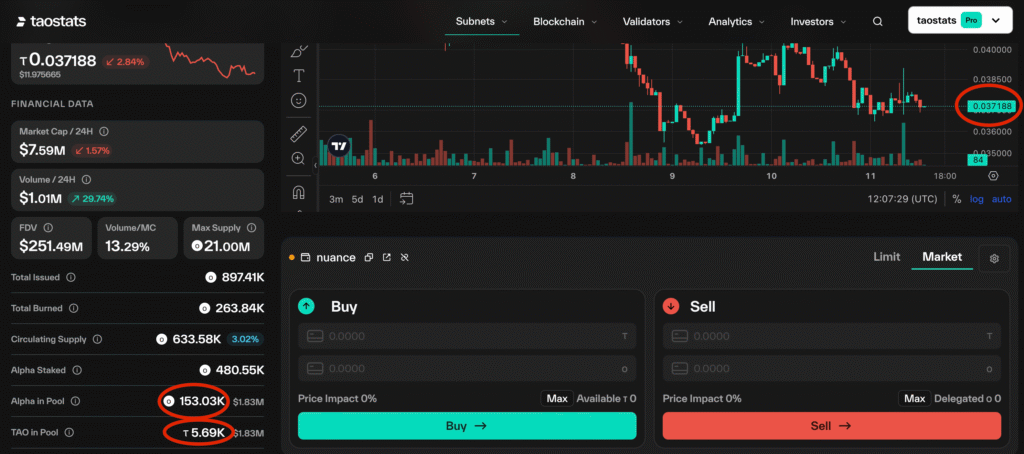
You buy alpha by staking TAO into a subnet’s pool. You sell alpha by unstaking. Both actions move the pool ratio, which moves the price.
Blocks are produced about every 12 seconds (~7,200 blocks/day). Every block, the protocol injects new tokens into pools according to rules we’re about to unpack.
2. The Two Stages of Emissions
Every block, Bittensor does two things in sequence:
| Stage | What happens | When |
|---|---|---|
| Injection | New TAO and new alpha are added to each subnet’s pool and reward bucket | Every block (~12s) |
| Distribution | Accumulated alpha rewards get paid out to participants | End of every tempo (~360 blocks ≈ 72 minutes) |
Injection is the part most people care about. It’s what drives pool growth and emission share.
Distribution is the payout: at tempo end, the alpha that was set aside gets split as roughly 18% to the subnet owner, 41% to miners, and 41% to validators (and their stakers).
This article focuses on injection, which is the part where Taoflow lives.
3. Taoflow: The Rule That Decides Who Gets New TAO
Before November 2025, emissions were divided based on alpha price. Whichever subnet had the highest token price captured the most TAO. That model created two problems:
- It punished small subnets. Tiny pools with low liquidity got hammered by every minor sell, while big pools could absorb massive selling without losing emissions.
- It enabled TAO emission gaming. A team could artificially pump their token price, harvest emissions during the inflated phase, extracting value without delivering anything.
In November 2025, the network transitioned to Taoflow: a flow-based emission model where each subnet’s share is determined by net TAO inflow (TAO staked in minus TAO unstaked out). By December 2025, 100% of emissions were flow-based.
A few specifics matter:
- Net flow is scale-invariant. A small subnet bringing in genuine new capital can outscore a big subnet that’s bleeding stakers. Pool size doesn’t give you a head start anymore.
- The flow signal is heavily smoothed. Bittensor uses an exponential moving average with a 30-day half-life (full EMA window ~86.8 days). It takes about a month of sustained flow change for the signal to move halfway. Pump-and-dump games don’t work.
- Negative net flow → zero emissions. If a subnet is bleeding TAO over time, it gets nothing. No alpha_in, no rewards, no pool growth.
- Registrations and the root claim don’t count as inflow. Only real staking activity moves the needle.
The total daily TAO emission to all subnets combined is currently about 3,600 TAO/day (0.5 TAO per block × 7,200 blocks, post-December 2025 halving). Taoflow decides how that pie gets sliced.
Read more about TaoFlow below:
4. What Happens Every Block
For each subnet, every block, the protocol does three things:
(a) New TAO injection
- Amount = subnet’s Taoflow share × total TAO emission this block
- Added to the TAO reserve of the pool
(b) Alpha_in: the balancing alpha
- New alpha minted and added to the alpha reserve of the pool
- Calculated to keep the price perfectly stable from the emission itself
- Variable, capped at 1 alpha per block
(c) Alpha_out: the rewards alpha
- Set aside for miners, validators, stakers, and the team
- Fixed at 1 alpha per block
- This is the dilutive part. It goes to people who often sell it for TAO, creating constant sell pressure
The alpha_in formula
alpha_in = (new TAO this block) ÷ (current alpha price in TAO)Then capped at 1.
So total new alpha minted per block per subnet = alpha_in (variable) + alpha_out (fixed 1), and that maxes out at 2. Most subnets mint less than that because their Taoflow share is small.
Why this design works
The alpha_in formula is engineered so that emissions alone never move the price. If you inject a tiny bit of TAO into the pool and add exactly the right amount of alpha to keep the ratio constant, price stays put. The pool just gets bigger.
Alpha_out, on the other hand, doesn’t go into the pool; it goes to people. Most of those people sell at least some of it, which does move price (downward). That’s the system’s built-in dilution. But note that some subnets like Targon, Bitcast, Lium, Yanez, and Gradients have built-in mechanisms that decrease the impact of Alpha_out via miner/subnet owner emission burns and buybacks from subnet revenue.
5. Current Normal Situation for SN15 ORO (May 9, 2026)
Before we look at what “extreme success” looks like, here’s what actually happens day-to-day on SN15 ORO right now (May 9, 2026:
| Metric | Value |
|---|---|
| Alpha price | ≈ 0.042 TAO |
| Total alpha supply | 858,100 |
| Market cap | ≈ 36,200 TAO |
| TAO liquidity in pool | 5,500 TAO (extremely low, because ORO is a young subnet) |
| Alpha in pool | ≈ 130,600 |
| % of alpha staked | 84.8% |
| Taoflow / emission share | ~0.37% |
| Daily dilution from alpha_out | ≈ 0.84%/day → ~25%/month |
This is the “normal” for a young, low-liquidity subnet like ORO. Emissions are adding a little TAO and a fractional alpha_in (usually well under 1 per block) every day. The fixed alpha_out still creates noticeable sell pressure.
This puts the whole system into perspective: most subnets (including ORO) are not dominating Taoflow; they’re in this low-flow, higher-relative-dilution phase.
6. The Alpha_in Cap: How a Wildly Successful Subnet Triggers Chain Buys
Now imagine ORO suddenly becomes a monster and captures 40% of all global Taoflow → 0.2 TAO per block.
The math walks like this:
- Protocol wants to inject 0.2 TAO into the pool.
- Required alpha_in to keep price flat = 0.2 ÷ 0.042 ≈ 4.76 alpha.
- But the cap is 1 → so it only mints 1 alpha_in.
So what happens to the remaining 0.158 TAO?
The protocol uses it as a direct buy order in the pool:
- The price-neutral portion gets injected normally: 0.042 TAO + 1 alpha added to the pool, no price change from this part.
- The remaining 0.158 TAO is added to the pool’s TAO reserve and used to buy and remove alpha from the pool at market price.
- Net result: TAO in pool goes up, alpha in pool goes down, alpha price ticks up every block.
This is the system’s way of saying “this subnet is crushing it”, when emissions can’t keep up with deserved capital inflow, the protocol responds with price appreciation instead of unlimited printing. The chain buy is a real, on-chain mechanism, and not a side effect.
7. How Alpha Price Actually Moves
Pin this on your wall:
Emissions themselves don’t move price. Real user actions do.
The alpha_in part of emissions is specifically calibrated to leave price untouched. What moves price is real activity in the pool:
| Action | Pool effect | Price effect | Taoflow effect |
|---|---|---|---|
| Stake TAO (buy alpha) | +TAO, −alpha | ↑ | Improves |
| Unstake alpha (sell) | −TAO, +alpha | ↓ | Worsens |
| Emission reward selling (alpha_out → market) | +alpha, −TAO | ↓ | Worsens |
The third row is the structural sell pressure every subnet has to overcome. Alpha_out gets paid to participants, who often convert at least some of it to TAO, which means selling it back into the pool. New buys must constantly outpace this trickle for price to climb.
8. What Actually Happens When You Buy Alpha
When you “buy” alpha by staking TAO, you are not buying newly minted tokens from the protocol. You’re doing a swap in the subnet’s AMM pool, exactly like a Uniswap trade. Your TAO goes in, existing alpha comes out from the reserve.
Immediate effect (this block)
- TAO reserve goes up by the amount you sent
- Alpha reserve goes down by the amount you received
- Price ticks up. More TAO chasing fewer alpha in the pool
For example, on SN15 ORO at ~0.04 TAO/alpha, a 100 TAO buy pulls roughly 2,500 alpha out of the pool and bumps the price slightly.
Your buy does not trigger any new alpha_in or alpha_out in the current block. Emissions run on their own schedule, separately from swaps.
Delayed effect (future blocks)
This is where Taoflow earns its name:
- Your buy registers as positive net TAO inflow → the subnet’s 30-day Taoflow EMA improves.
- In future blocks, the subnet captures a larger slice of the ~3,600 daily TAO emissions.
- More TAO injected per block → the protocol mints more alpha_in (up to the 1/block cap) to keep emissions price-neutral. The pool grows faster on both sides.
- More alpha_out is also being distributed, since more total emissions are routed here.
- If buying keeps up, the subnet can hit the alpha_in cap → price appreciation kicks in via the chain-buy mechanic from Section 6.
Alpha_out itself is not affected by your buy. It stays fixed at 1/block (pre-halving) regardless of activity. What scales is the TAO injection and the alpha_in that balances it.
The cycle (and the anti-cycle)
When many people buy at once, the price pump attracts more Taoflow, which attracts more emissions, creating a virtuous cycle. The reverse happens on sells: price drops, Taoflow shrinks, future emissions shrink. Liquidity is sticky in both directions, which is exactly why momentum on a subnet can compound either way.
9. Dilution Math: Why Low-Supply Subnets Are Risky
Alpha_out (the fixed 1 per block) is the real dilution source. The same nominal “1 alpha per block” hits very differently depending on how much alpha already exists.
SN15 ORO with its current 858k supply:
- Daily alpha_out ≈ 7,200
- Monthly dilution ≈ ~25%
A mature subnet with 4–5 million alpha in circulation:
- Daily alpha_out ≈ 7,200 (same number)
- Monthly dilution ≈ ~4–5%
That’s why mature subnets are typically the safer long-term plays. A small subnet has to attract enough sustained net inflow every month to outrun a 25% headwind. A mature subnet only has to outrun 4–5%. Same headline emission, drastically different math.
10. Alpha Halving: How Success Affects Timing
Each subnet has its own 21 million alpha cap (Bitcoin-style).
- First halving at exactly 10.5 million alpha minted for that subnet.
- Both alpha_in and alpha_out count toward the total minted.
- Successful subnets (high Taoflow → higher alpha_in) reach 10.5M much faster.
- Slow subnets take longer → they stay in high-dilution mode longer.
After alpha halving:
- Alpha_in cap drops from 1 to 0.5
- Alpha_out drops from 1 to 0.5
- Dilution pressure halves
It’s a quiet but powerful incentive: the protocol rewards winners with reduced supply pressure ahead of schedule.
11. Bottom Line for Newcomers
The dTAO system is beautifully designed:
- Taoflow rewards real capital inflow. Net TAO in minus net TAO out, smoothed over 30 days, is what determines who gets emissions.
- Emissions grow pools without forcing price moves. Alpha_in is calibrated to keep the ratio constant.
- The alpha_in cap prevents hyper-inflation even when one subnet dominates. Excess deserved emissions become on-chain buy pressure instead, pushing price up.
- Alpha_out creates steady but manageable dilution that successful subnets outgrow over time.
- Halving rewards the best teams by reducing inflation sooner. High-Taoflow subnets hit 10.5M alpha minted faster and graduate to half-rate emissions earlier.
Once you internalize these five points, almost every weird headline (“Why is this subnet’s price surging coupled with high emissions?”, “Why are cautious investors steering clear of new subnets?”) becomes obvious. The mechanics are doing exactly what they were designed to do: rewarding net inflow and accelerating the rewards of sustained success.
Welcome to dTAO. Now go read your favourite subnet’s price chart with new eyes.
Enjoyed this article? Join our newsletter
Get the latest TAO & Bittensor news straight to your inbox.
We respect your privacy. Unsubscribe anytime.
Enjoyed this article?
Join our newsletter
Get the latest TAO & Bittensor news straight to your inbox — every morning before markets open.

No comments yet — be the first.